



By Imtiaz Gul, Executive Director, Centre for Research and Security Studies (CRSS), Islamabad
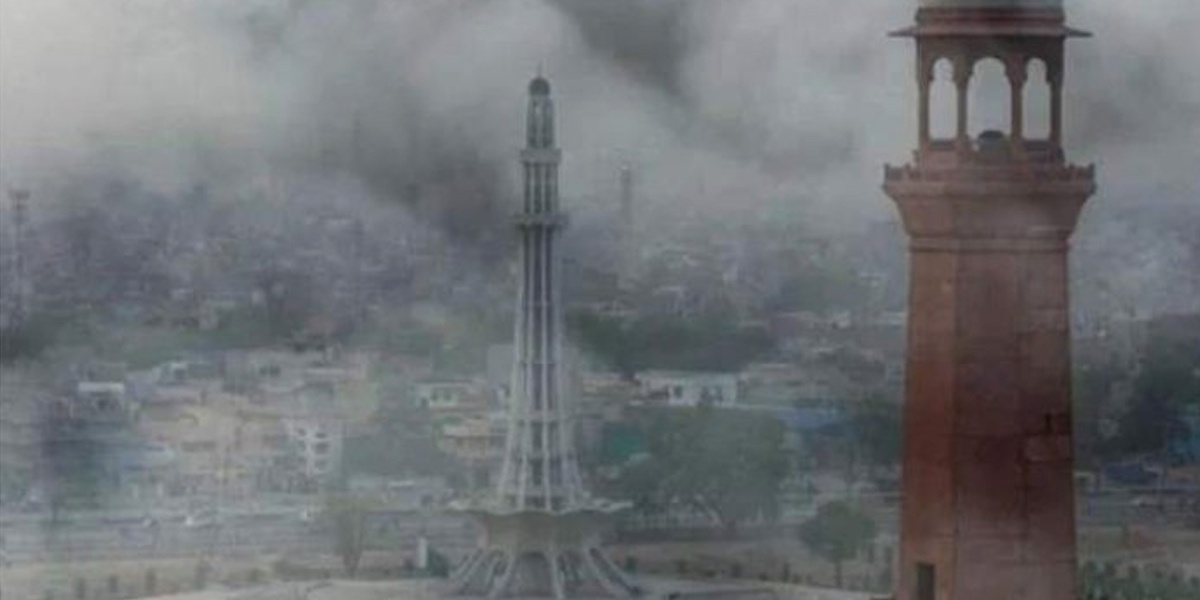
On 5 November 2026, Lahore was the most polluted major city on earth. IQAir’s live ranking placed it first, ahead of Delhi, with an Air Quality Index reading deep in the hazardous range. This is the same Punjab where tens of billions of rupees have been committed to environmental and climate schemes. According to the provincial development figures examined in a recent CRSS report, 30 environmental schemes carried an estimated cost of Rs38.68 billion, of which Rs11.05 billion had been spent by June 2025.
Billions have been committed, yet Lahore continues to choke. What explains the gap between public investment and the air people actually breathe? Is it a shortage of resources, a failure to identify the real causes, or a problem of priorities and technical expertise?
CRSS has worked on air pollution without a rupee of external funding. No donor set our agenda, and no project cycle shaped our conclusions. Our 2023 investigative report, The Dark Clouds of Pakistan, became a reference document for policymakers and the media. This year’s Karachi report followed, tracing that city’s toxic air to transport emissions, fuel adulteration and the unfinished K-IV water project.
Our work has consistently emphasised the importance of scientific and engineering expertise in understanding and addressing air pollution. The latest report, Lahore’s Air and Punjab’s Environment Spending: Ten Years of Smog, prepared by Engineer Arshad H. Abbasi, examines a decade of air quality data alongside the province’s environmental spending and procurement priorities. Its findings raise uncomfortable questions about how resources have been allocated and what measurable improvements they have delivered.
In October 2024, technical advice was shared with Punjab’s leadership, free of charge and on record. It called for air pollution to be tackled through scientific measurement, source identification and engineering solutions rather than seasonal restrictions and symbolic interventions. It also raised concerns about fuel adulteration, the quality of petrol and diesel, and the need for reliable testing and regulatory enforcement.
What became of that advice? Was it independently evaluated? Did it inform the provincial government’s interventions? If not, why not?
Money was never the only missing ingredient. On 28 March 2025, the World Bank approved a $300 million concessional loan from the International Development Association to support the Punjab Clean Air Program. The financing is intended to strengthen air quality management and reduce emissions from transport, agriculture, industry and other sectors.
But financing alone cannot clear the air. What matters is how the money is used, who determines the priorities, and whether interventions address the pollutants actually entering people’s lungs.
Consider some of the allocations. The provincial AirSafe programme, which includes anti-smog guns and monitoring equipment, has an approved scheme cost of approximately Rs5.38 billion. A further expansion involving 30 fog cannons was announced in 2026, although the published figures require reconciliation. The climate observatory has also featured prominently in budget announcements, with an allocation reported at Rs14.6 billion. Meanwhile, fixed and mobile fuel-quality testing laboratories appeared as a proposed Rs560 million scheme, with Rs40 million earmarked in the 2025–26 development programme.
These figures invite a simple question: are we investing enough in reducing pollution at its source, or are we spending too much on measuring, displaying and temporarily suppressing it?
Monitoring stations and observatories are important. No serious air quality programme can function without reliable data. But measuring pollution is not the same as removing it. Anti-smog guns may suppress dust locally, but can they meaningfully change pollution levels across the airshed of a city of millions? Where are the independent performance evaluations? What measurable reduction in PM2.5 has been achieved, and at what cost?
Imagine a hospital where the administrators spend generously on diagnostic equipment, public communication and impressive new facilities, while the underlying disease continues to worsen. The hospital may be visibly busy. Its management may be tireless. But would we call the treatment successful merely because money was spent and activity increased?
Enthusiasm is not anatomy, and advocacy is not medicine.
Air pollution is a technical problem rooted in atmospheric science, chemistry, engineering and the regulation of emissions. Communication and public awareness have their place, but they cannot substitute for scientific expertise. Those making decisions need to be guided by specialists who understand emissions inventories, fuel chemistry, industrial pollution, transport systems and the behaviour of pollutants under different atmospheric conditions.
That is why the quality of technical advice matters as much as the size of a budget.
Pakistan’s environmental sector has no shortage of consultants, projects, presentations and reports. Some provide valuable research and practical recommendations. Others raise questions about whether their findings are independently tested and translated into enforceable policy. When institutions responsible for implementing environmental programmes are also closely involved in evaluating them, how do we ensure independent scrutiny?
The problem is not the existence of consultancies or donor-supported programmes. It is the possibility that elaborate studies and expensive interventions become substitutes for measurable progress. The result can be decoration for conferences rather than roadmaps for reform.
And this has a cost. It costs the economy, it costs the public exchequer, and above all, it costs health. Children breathe this air without having had any say in how the billions were allocated.
The provincial government deserves recognition for the effort it has made during successive smog emergencies. But effort and outcome are not the same thing. Some of the newer programmes will require time before their impact can be properly judged. That is precisely why transparent performance reviews, credible data and independent technical oversight are essential.
Consider another simple analogy. If you needed complex surgery, you would look for a qualified specialist with recognised training, experience and professional credentials. Why should the lungs of millions of citizens receive any less rigorous treatment? Why should a problem that demands advanced scientific understanding be managed without sustained reliance on those best qualified to diagnose and address it?
So here is a suggestion for those responsible for environmental policymaking in Punjab. Read the CRSS report, Ten Years of Smog, and the Money Committed Against It, word by word. Not as a briefing note or a summary prepared by an aide. Examine what the data establish, where the evidence remains incomplete, and what questions need to be answered.
Publish the actual expenditure. Commission independent assessments of the major interventions. Explain the scientific basis on which projects were selected. Investigate fuel-quality concerns, strengthen emissions enforcement, and ensure that future expenditure is tied to measurable improvements in the air people breathe.
Above all, be prepared to acknowledge where existing approaches have fallen short.
Admitting failure is not weakness. It is the value of democracy. A system that can only repeat its successes is not accountable, and the worth of democracy lies in leaders who can say, we got this wrong and we will fix it.
Lahore’s air will not clear on press conferences, impressive presentations or expenditure figures alone. It will clear when those responsible are willing to ask difficult questions, listen to scientific advice and measure success not by the billions committed but by the pollution actually reduced.