



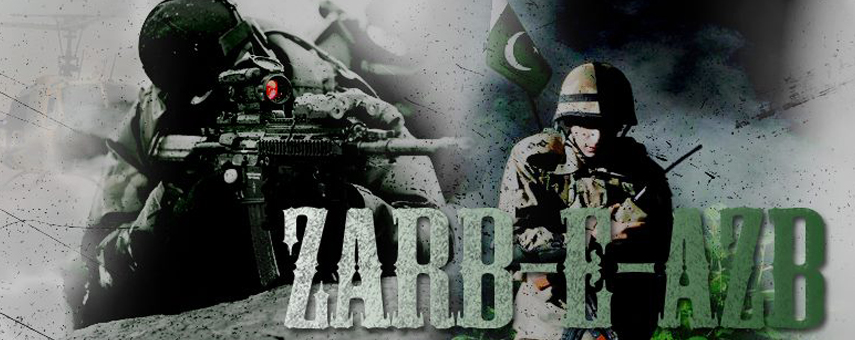
A year ago this month, Pakistan launched a multi-pronged military operation in the embattled North Waziristan tribal region to flush out Al-Qaeda-linked local and foreign militants. In the course of this campaign, Pakistan Army lost 347 soldiers including several officers. At the same time, it claims to have taken out about 2,763 terrorists of all hues – Pakistani, Arabs, Afghans, Uzbeks and Chinese Uighurs.[1]
The campaign has spread over some 6,000 square kms bordering Afghanistan, considered to be home to several Al-Qaeda-inspired terrorist outfits.
Director General of the Inter-Services Public Relations (ISPR) Major General Asim Bajwa says that a string of big and small 9000 intelligence-based-operations (IBOs) resulted in the destruction of some 837 terrorist hideouts and the recovery of about 253 tons of explosives, which would have been good to prepare and plant five improvised explosive devices every day for 20 years.[2]
As many as 18,087 weapons including heavy machine guns (HMGs), light machine guns (LMGs), sniper rifles, rocket launchers, and AK-47 rifles, were also recovered during the past one year.
Reality vs Claims
Government claims of terrorist casualties and seizures of weapons and explosives notwithstanding, the Zarb-e-Azb campaign has certainly created space for the government and the military.
Firstly, by stepping into regions which were considered as “no go areas” the army has not only managed to reclaim those areas but has also established the governmental writ there.
Secondly, the operational activity resonated a decision at the strategic level i.e. the military and the government are not ready to tolerate any anti-state activity by non-state actors any more– regardless of who they are.
Thirdly, the casualties among the armed forces, not only helped in restoring peoples’ trust in state institutions but it also reinforced the belief that the militants have to be taken head-on.
Fourth, the operation finally got the civilian-military ownership after the massive TTP terrorist attack on the Army Public School in Peshawar (Dec 2014) which had left nearly 145 children and teachers dead.
Never before have the civilians and the military worked in tandem as they do now. The fact that the government has levied an Operation Zarb-e-Azb tax as part of the national budget in effect from the first of July, also underscores the unanimity of the civilian and military leadership on the issue.
One big challenge for them, however, is how to solidify military gains into long-term political victory. This, according to many analysts, is not possible until the government legislates and changes the semi-autonomous status of the 27,200 square km territory known as the Federally Administered Tribal Areas (FATA). Laws of Pakistan don’t apply to this region that borders Afghanistan, making it easier for the militants and terrorists to exploit the region and the 2,560 km long border between Pakistan and Afghanistan.
The military is now planning a “final push” against militants in Waziristan, yet observers believe that the longevity of the “final push” would largely depend on the constitutional status of the region. Until the FATA region is mainstreamed and brought under the law of the land, keeping it clear of militants and criminals would be difficult, they argue.
Consolidating gains through the military campaign would also require greater bilateral trust and counter-terror cooperation with Afghanistan, where the government remains skeptical of the Pakistani activity. Afghan government officials on Sunday, for instance, attributed the recent surge in violence to the militants fleeing Pakistan’s Waziristan region. Despite big tactical gains in the past year, Pakistan’s military campaign against terrorist networks in Waziristan, it seems, has yet to go a long way. Breaking the nexus between militants and some religio-political groups – many of whom are sympathetic to trans-national groups such as Al-Qaeda and Islamic State (IS) – will be equally critical for lasting success.
Contributed by Imtiaz Gul, Executive Director, CRSS
[1] http://www.pakistantoday.com.pk/2015/06/13/national/zarb-e-azb-one-year-on/
[2] CRSS interview with Maj.Gen Bajwa