



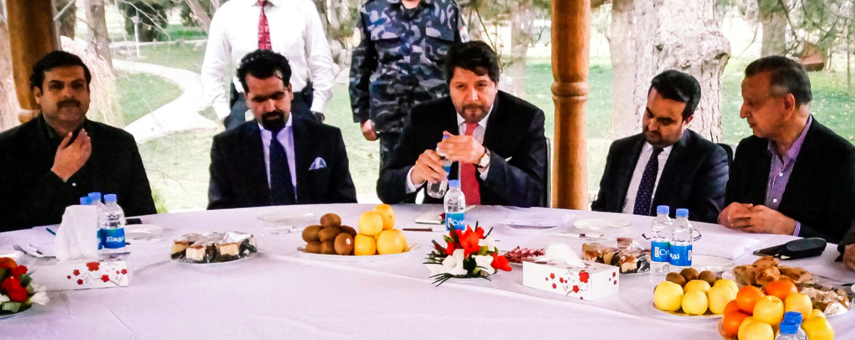
We don’t need hospitals or roads from Pakistan. We need those policies to change which have caused destruction in the past decades and continue to do so, Hikmet Karzai, Afghanistan’s deputy foreigner minister told a delegation on the sidelines of a Pak-Afghan Track11/1.5 in Kabul; Beyond Boundaries an initiative launched by an Islamabad based Center for Research and Security Studies (CRSS) – in partnership with its Afghan counterpart organization, DURAN Research and Analysis (DRA).
No amount of funding, dams or hospitals will help the bilateral relationship as much a perceptible change in the policies that have harmed Pakistan as much as Afghanistan and we need to collectively fight the consequences of those policies, he underlined.
Hikmet Karzai also acknowledged that as of now, Pakistan has been forthcoming as far as its commitment to the peace process within the QCG framework was concerned.
For us state to state relations are the most important as long as this is based on respect for our sovereignty and commitment to fight all those elements that are killing our innocent people.
Karzai pointed out that although the Quadrilateral Coordination Group (QCG) rests on respective roles of all four stakeholders, Pakistan’s role is the most critical in the reconciliation process.
As the QCG about to kick off with high expectations attached to it, Karzai said, it offers us an opportunity to tell the new generation that Pakistan is playing an important role in the reconciliation efforts through.
“Pakistan has the leverage and influence with Taliban leaders which we expect it to use. We also expect that the leverage needs to be used against all those elements who the QCG members feel are not amenable to peace in Afghanistan,” Karzai told the delegates.
His remarks came a few hours after Pakistan’s advisor on foreign affairs, Sartaj Aziz for the first time publicly admitted that the Afghan Taliban’s leadership enjoys a safe haven inside his country
Speaking at the Council on Foreign Affairs in Washington on 1 March , he said: “We have some influence on them because their leadership is in Pakistan and they get some medical facilities, their families are here…So we can use those levers to pressurize them to say: ‘Come to the table’,” he added.
Karzai, who is Afghanistan’s chief negotiator in the peace talks that had first begun in July 2015, also declared the Taliban Doha office as the legitimate interlocutor and said the government was comfortable with all those Taliban groups that were part of the Doha office.
Karzai agreed that Pakistan’s image in Afghanistan is negative but argued it had a history and we should all try to address the causes for this.
“Changing these perceptions is therefore going to be a difficult and complicated process which we will need to tackle slowly and gradually”, Karzai said when asked as to whether the government was undertaking any efforts to help improve the narrative on Pakistan in the Afghan media.
It will also depend on how and whether Pakistan delivers on the commitments it has made to peace and counter-terrorism in Afghanistan in the weeks and months to come, the minister said.
We need action against all non-state actors who help each other. Only then will we be able to convince our people and neutralize those opposed to the peace efforts, Karzai said.
It is therefore important to deal with the cause and not symptoms. Fix the sanctuaries wherever they are, he emphasized.
Karzai said we want people of the two countries to get closer to understand each other better. We want the Ulema/ religious scholars of the two countries to get together and condemn violence in the name of Islam, including suicide bombings.
We want academics, media and artists to interact with each other as much as possible. This will greatly help the bilateral relationship. Track 11 trans-border initiatives should and can help bring them all together to expand the dialogue among peoples, he said.