



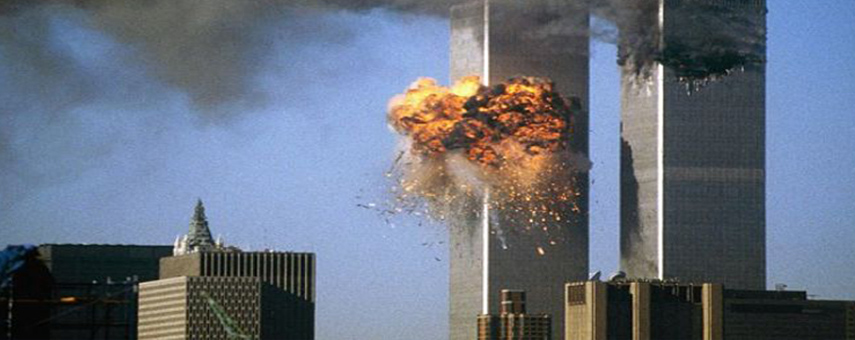
According to the 911 Commission Report the principal architect of 911 attacks was Khalid Shaikh Mohammad. Known for being mastermind of 9/11 attacks, Khalid has an impeccable record as a terrorist that no other terrorist could even come close to. He masterminded 9/11 attacks, planned Manila-based Bojinka attacks, plan to destroy suspension bridges in New York City, bank-rolled Islamists in the UK to bomb Big Ben and the Heathrow, logistically supported Islamist terrorists in bombing US, Israeli and UK embassies across the world and financed and helped plan many other high profile Islamist terrorist attacks both directly and indirectly. His terrorist career inspired others in his family to join Al-Qaeda. His nephew Abdul Basit al Karim aka Ramzi Yousaf made name in first World Trade Center attack in 1993; another of his nephew Amar al Baluchi was involved in financing the 9/11 attacks along with his US educated Pakistani wife Aafia Siddiqi or ‘lady Al-Qaeda’, about whom the radical Islamists are eager to see released from American custody.
Khalid alias Mukhtar was born in Kuwait to Pakistani parents of Baluchi origin (Balochistan Province, Pakistan). Like other important Islamist terrorists and ideologues Khalid Shaikh joined Muslim Brotherhood at an early age[1]. Alike Bin Laden and Ayman al Zawaihiri, Khalid was also a designated Arab Afghan[2] and fought against the Soviet forces in 1986 after attending training camps established during Afghan War (1979-89) period at Pakistan-Afghanistan border areas. Soon after the withdrawal of Soviet forces from Afghanistan as a result of Geneva Accords which ended the Afghan War Khalid went to fight alongside Bosnian forces in Yugoslav Wars of Succession and stayed on till 1994[3]. A mechanical engineer by virtue of education, Khalid attended North Carolina Agriculture and Technical University in late 1980s.
Despite having lived in the US and attended college, Khalid remained aphetic towards the west and specially the US. The Muslim Brotherhood’s Islamist influence remained on his mind. His likeminded nephew Ramzi Yousaf, another Afghan War veteran and British educated chemical engineer, bombed WTC buildings in 1993. Although unsuccessful in his plan but the idea was well taken by Khalid. Together they planned and attempted to execute Bojinka Plot in the Philippines in 1995, a plot to bomb 10 US-bound airliners in the midair. Ramzi like Khalid was fluent in Arabic, English and Urdu and both men kept changing their identities pretending to be Egyptians, Iraqis, Pakistanis and Saudis. Khalid joined hands with Laden’s Al-Qaeda while he was on the run after the failure of Bojinka Plot. He managed to flee Doha, Qatar where he worked as project engineer in Qatari government’s electricity ministry until his role in Operation Bojinka came to the notice of investigators.
Yousaf’s instant notoriety as the mastermind of the 1993 WTC bombing inspired Khalid to get involved in planning of 9/11 terrorist attack against the US[4].
Khalid presented the idea of blowing buildings symbolizing the US economic and military might. According to the 911Commission Report,
“At the meeting KSM presented the Al-Qaeda leader with a menu of ideas for terrorist operations.”[5] Bin Laden paid serious heed to the idea and started recruitment for the execution of plan. Indeed KSM has acknowledged that Bin Laden likely agreed to meet with him because of terrorist activities of his nephew Yousaf[6].
Khalid had connections and links with jihadist organizations worldwide, considerably wide because of his long affiliation with Muslim Brotherhood in Kuwait and elsewhere. Before his arrest in 2003 from Rawalpindi Pakistan he had travelled to Yemen, Malaysia, Sudan, Brazil, Czech Republic and the Philippines where he met leaders of radical Islamist organizations and developed strong ties with them. Khalid played a pivotal role in selection, recruitment, training and logistics of 911 bombers. After his arrest he confessed before the tribunal in Guantanamo about his role in 911 attacks (what he termed Holy Tuesday Operation). He also confessed of beheading Wall Street Journal’s correspondent Daniel Pearl in Karachi, 2002 and is also accused of financing Bali Bombings[7].
The Planning
As Bin Laden landed in Afghanistan and soon after Khalid Shaikh joined him and briefed him about his plan. In a 1984 book The 40 Minute War the author Chris Morris had presented such methodology of attack and it is widely suspected that Ramzi might have read that book. A Christian Identity Movement novel The Turner Diaries by Andew MacDonald contained similar plans.
The architects of 911 attacks had the very idea of striking the symbols of American might and by destroying them they wanted to make things stir up the global scenario. The plan was originally conceived by Ramzi Yousaf and Abdul Hakim Murad in the Philippines who were by then languishing in a super-max US prison in Colorado, therefore ‘the Uncle’ took the whole credit[8]. The original Khalid Shaikh’s plan was a more destructive one involving hijacked planes to be rammed on symbolic sites on both east and west coast and mid-west. Bin Laden worked over the plan very clandestinely along with his confidants Mohammad Atef and Ayman al Zawaihiri and in 1999 after completing all the “pre-production” work he summoned Khalid Shaikh who meanwhile left Afghanistan and staying in Czech Republic. Khalid arrived back in Kandahar, Afghanistan the same year and was introduced to newly recruited Hamburg Cell bombers[9].
Bin Laden formed a committee that held a series of meetings in order to chalk out the strategy for planning and executing the operation. Bin Laden had a choice to make from a variety of people but he selected Saudi and UAE passport holders as it was much easier for them to obtain visas of the United States. Hamburg Cell[10] members were to lead the operation as they were acquainted with the western lifestyle and had been living there and knew all the western ways without being suspected. Mohammad Atta because of his quiet personality and seriousness was selected as the commander of the entire operation. Other members of the cell like Zaid Jarrah, Marwan al Shehhi, and Hani Hanjour were assigned the tasks of leading hijacking teams[11].
Execution of Plan
Atta and his team boarded from Portland, Maine and Boston, Mass and soon after hijacked American Airlines flight 11 (bound for LA) with paper cutter knives and pepper spray (for pushing the passengers towards the tail of plane) and within next half an hour rammed the plane on Tower one of WTC. Shehhi and his team boarded United Airlines flight 175 and after applying the same tactics hijacked the plane and rammed it on the other tower of WTC. On the other hand Hani Hanjour along with his team boarded American Airlines flight 77 from Washington DC and after successful hijacking crashed it on Pentagon, destroying it partly. Zaid Jarrah and his team from Newark, New Jersey boarded United Airlines 93 but by that time news of other hijackings and plane crashes had become public and news was in the air. The last team although hijacked the plane but could not maintain the control as passengers revolted and tried to take over the plane. In their consecutive attempts the hijackers had become sure of the fact that they could no longer keep their plan intact and thus crashed the plane in a forest near Shanks Ville, Pennsylvania. The whole operation took 2 hours (8am to 10:03 am), with the same modus operandi. All the flights were transatlantic and fuel tanks were full with 20000 gallons of gasoline. The plan was in fact innovative and passengers except flight 93 could not have the idea that the hijackers were going to crash the plane and their intentions were not to place any demands before the authorities. In fact all the passengers were deceived as the hijackers asked them to remain calm and they were taking them back to the airports.
The whole exercise of this act of terrorism was a display of calm and calculated behavior with exact planning perhaps after testing each and every move carefully. Element of deception played the key role as all the passengers and authorities on ground did not get the slightest idea of what was going to happen as everything occurred at a fast pace. Atta had traveled across the US for calculating and gauging the weaknesses in the system plus observed everything meticulously. Atta initially made a mistake when he said that “we have some planes” but ATC personnel could not get out of it that what he really meant and thus could not take apt action or relay it to other control towers. Jarrah and his team on the other hand was late in executing the same plan and by that time the news was in the air and right after the taking over of the plane the passengers planned to fight back and started to take back the control. During this course of struggle Jarrah deliberately crashed the plane in Shanks Ville, Pennsylvania, killing everyone on board. He was still 20 minutes of flight time from the target. The passengers’ resistances made him fail in his desired objectives.
Soon after the collisions both towers of WTC collapsed in an hour resulting in the destruction of whole WTC complex. One side of the Pentagon building was also severely damaged and resulted in the deaths of 188 people[12].
KSM: The Super Terrorist
In the annals of terrorism history, Khalid Shaikh Mohammad alias Mukhtar alias KSM would be listed as a super terrorist. His innovative plans, skills, deceptive ways and cunningness are indeed some of his traits making him a peculiar case study. His violently radical Islamist beliefs blended with Wahabi-Salafi ideologies and inherent violent zeal were of the personality traits that definitely made him a super terrorist. His hatred of Judaism, Christianity, all other Islamic sects except Wahabi/Salafis, and command over five languages, and western education were some of the rare traits that one terrorist could have all together.
He managed to elude the US and allied governments for 8 years (Bojinka Plot, 1995). KSM maintained his solo terrorist career by not pledging oath to Bin Laden up till 2000. Before that he planned, surveyed, organized, provided training, and financed terrorist attacks at western targets along with his nephew Ramzi. He never considered himself less than Bin Laden or Ayman al-Zawahiri, keeping in view of his independent status and the magnitude of terrorist attacks he launched. Indeed his terrorist attacks were more significant and of higher magnitude than Al-Qaeda. Finally he swore allegiance to Bin Laden in Afghanistan several years after the arrest of his nephew, and became a member of Al-Qaeda Council. Due to his western exposure and education, he was also given the slot of director Media Operations where he published Al-Qaeda magazine Al-Sahab (Clouds). Bin Laden made him the head of committee responsible to organize, plan, follow-up and execute the 9/11 attacks or the Planes Operation (aka Holy Tuesday Operation).
After the death of Mohammad Atef alias Abu Hafs al-Masri, during US air raid after 9/11, Bin Laden designated KSM as Military Operational Commander for all foreign operations around the world.
According to Combatant Status Review Tribunal Hearing at Guantanamo Bay, KSM was responsible for 31 terrorist plots. The charges were:
- Planning, organizing, follow-up and execution of 9/11 Operation
- Following up on Dirty Bomb Operations on US soil
- 1993 World Trade Center Bombing
- Beheading of Daniel Pearl 2002
- Night club Bombing in Bali, Indonesia
- Planning, training, surveying and financing the New (or Second) Wave of attacks after 9/11 in the US
- Planning, training, surveying, and financing the operation to destroy the Panama Canal
- Planning, training, surveying, and financing the operation to assassinate former US Presidents
- Planning, training, surveying, and financing the operation to bomb suspension bridges in New York
- Plan to destroy Sears Tower
- Plan to destroy Heathrow Airport, Canary Wharf Building and Big Ben
- Planning, training, surveying, and financing the operation to bomb night clubs in Thailand
- Planning to destroy NYSE after 9/11
- Planning, training, surveying, and financing the operation to launch terrorist attacks at Israeli city of Elat
- Plan to destroy US embassies in Indonesia, Australia and Japan
- Plan to destroy Israeli embassies in Azerbaijan, India, the Philippines, and Australia
- Terrorist attack on hotel in Mombasa, Kenya
- Plan to destroy Israeli liners at Bangkok airport
- Plan to hit US targets in South Korea
- Plan to target US sites in Turkey
- Launching of terrorist attack with Russian made SA-7 missile on El-Al airline in Kenya
- Planning, training, surveying, and financing the operation to target nuclear plants in US cities
- Planning to bomb NATO headquarters in Brussels, Belgium
- Bojinka Operation involving plans to destroy midair US airliners
- Plans to assassinate Pope John Paul the Second during his visit to Manila
- Plan to assassinate US President Bill Clinton during his visit to Manila
- Training and financing for the assassination of Pakistani President Pervez Musharraf
- Terrorist plots to destroy US oil company in the Island of Sumatra, Indonesia[13]
By having a bird’s eye view of KSM’s life one could easily come to the conclusion that he was just another victim of identity crisis. KSM had a rough childhood. His ethnic Baluchi parents from Turbat, Baluchistan, Pakistan migrated to Badawiya, Kuwait in 1956. Coming to recently oil-explored Kuwait from Pakistan’s poorest province and then living in an apartheid society where the non-Arabs (non-Kuwaitis) would never be able to enjoy the same rights, and of course getting citizenship was out of question. According to Terry McDermott,
“The majority of residents, however, were not citizens and never would be. Most immigrant workers and their off springs were deemed unqualified. This created a caste system dividing those with citizenship, the native-born Kuwaitis, from the guest workers, known locally as bidoon—those without. The Baluch, no matter how long they stayed, were among the bidoon[14].”
Kuwait was an emerging oil economy, highly dependent on guest workers. Their number was swelling and even threatening to outnumber the local Kuwaitis. Palestinians, Pakistanis, Bangladeshis, Sri Lankans comprised the bulk of laborers and guest workers. A substantial part of labor class was Palestinians. The Palestinians brought with them Islamist organizations such as Muslim Brotherhood and Hizb ut Tahrir. While living among local Kuwaitis and experiencing a severe identity crisis, KSM rallied behind the Islamist teachings of Kuwaiti Muslim Brotherhood at an early age. He was born in 1965 in Kuwait and by 1980 was in Peshawar, Pakistan to join Jihad against the Soviets in Afghanistan.
KSM joined one of the offices established under Saudi-financed Maktab al-Khidmat wal Mujahedeen (Services Bureau for Holy Warriors) run by Palestinian cleric Abdullah Yousaf Azzam. He did receive several different trainings at various jihadi training camps, established on Pakistan-Afghanistan border region. He also had the company of two his nephews Abdul Basit al Karim alias Ramzi Yousaf and Amr al-Baluchi (later both earned big names in jihadi terrorism)
The Services Bureau project attracted Muslim jihadi volunteers from 43 countries. Many of them were Arabs, and later came to be called as the Arab-Afghans fighters. The mentor of these Arab jihadis was Abdullah Yusuf Azzam, a Palestinian and former professor of Al-Azhar University, Cairo, Egypt. The city of Peshawar became the rendezvous of Jihadists coming from all over the world. Raison de etre for opening of this office was to facilitate the Arab volunteers coming from Middle East and African countries and proximity of Peshawar to Afghan border was taken into account[15]. The MAK soon attracted many Arab rich kids wanted to join the jihad against the soviets. One of them was Osama Bin Laden, a spoiled youngster from Saudi Arabia. Azzam knew Bin Laden from his brief stay in Jeddah before landing in Pakistan and persuaded him to join the Jihad against the Soviets.
With Azzam’s expertise in luring in Jihadis and Bin Laden’s connection the flow of Arab Afghans gradually started to increase in the latter years of the war. But by no means was the number of Arab Afghans ever as significant as the actual Afghans fighting the war. According to estimates there were not more than 35,000 Arab Afghan in comparison to 250,000 Afghan fighters[16].
The Services Bureau played a crucial role in recruitment and facilitation of radical Muslim youth coming to Peshawar from all over the world. In this regard delegations were sent to Islamic and western countries, including the United States for the purpose of recruitment of local Muslim youth or anyone interested in fighting the Soviets. Abdullah Azzam visited more than 40 US cities and preached jihad. His books Join the Caravan and Defense of Muslim Lands were printed and widely distributed during his visits and lectures at mosques. His travelling expense, visas and documentation, tickets and accommodation, and scheduling was also handled under the operation head. Azzam through Bin Laden and Saudi GID was successful in luring the charity money (Zakat) from Arab countries[17].
While living in Pakistan, KSM established relations with Islamist party Jamaat-e-Islami which remained until his arrest from Rawalpindi, Pakistan in 2003[18]. KSM did not remain involved in active jihadi activities in Afghanistan, he, instead joined North Carolina Agriculture and Technical University in 1986 and successfully completed engineering in 1990. By early 1990s he was back in Pakistan and visited Afghanistan, only to find factional fighting among Afghan Mujahedeen groups after the withdrawal of Soviet forces in 1989. Amid no jihadi activities in Afghanistan and Pakistan KSM joined hands with his nephew Ramzi Yousaf for jihadi endeavors in other parts of the world.
The 1993 WTC Bombing
It would be fair to say that the world after the Cold War had entered into an altogether new epoch. Growing radicalism could be seen in almost every organized religion. Fall of Iran to radical Shia clerics and then rise of radical Sunni Taliban in Afghanistan were very evident proofs of it. While the Afghan factions were busy in civil war the Islamist militant groups in Pakistan threw themselves into another Holy War in Kashmir region. There were trained radical individuals who were planning to attack the United States for avenging this country for its continuous support for the state of Israel and presence of US troops in Saudi Arabia. Independent cells of these ex-jihadis had started to operate in different parts of world.
Ramzi Yousaf (aka Abdul Basit Mahmood), a Kuwaiti citizen of Pakistani descent was one of those who wanted to strike within the United States[19]. After spending time at various training camps in Afghanistan he landed in the United States on a fake Iraqi passport with this mission in mind. He had a degree in electrical engineering and knew well the art of making homemade bombs. Ramzi entered the US and sought political asylum, on an Iraqi passport, which was soon granted to him. After settling in New York City, Ramzi started to gang up with other likeminded Islamist radicals already present there. One of his mentors was Sheikh Omar Abdul Rahman, a blind cleric of New Jersey mosque. Rahman who had earlier mentored and indoctrinated the Islamist radicals in Peshawar knew Ramzi well and further radicalized Ramzi’s thought processing. Ramzi started working over the project already had in his mind. He assembled a 15,000 pounds homemade bomb. The plan was simple: destroy the WTC Tower One from its foundations, and when the pillars collapsed the Tower One would fall on Tower Two, resulting in the destruction of whole WTC complex and causing both these towers to collapse on other buildings nearby resulting in heavy loss of lives and property[20].
Although the scheme was planned and executed in the exact order but it could not cause much damage to the building that could lead to its fall. There were serious losses in terms of property ($600 million) and deaths of 6 people, nonetheless, the bomb blast could not result in destroying the pillars of the building. Ramzi executed his idea with a firm belief that it would result in many American deaths (his estimate was 250,000 deaths)[21].
It was the first ever terrorist attack of this kind in the history of the United States. And till 9/11 it remained heaviest in terms of damage to the property. (The terrorist attack on Federal Building in Oklahoma City caused more loss of lives till 9/11). One of the biggest investigations in history had started and very soon investigators got clues that led them to know the people behind the attack. It was soon found out that the vehicle used in the blast was rented by one of the conspirators Mohammad Salamah an Egyptian and fellow of Ramzi. But by that time Ramzi had flown out of the country. Salmah was soon arrested by the authorities and he confessed about the plan and revealed all the other details required for making a charge sheet against all involved including Sheikh Rahman. All the culprits’ involved were arrested except Abdul Rahman Yasin who flew to Iraq and still on the FBI’s most wanted list.
Ramzi Yousaf the main culprit was arrested from Pakistan in 1995 but before his arrest he had undertaken the planning of another severe attack on US from the Philippines: Operation Boijnka, indeed a very deadly plan which provided the very idea of planning of 9/11 to Osama Bin Laden (now in Afghanistan as an official guest of Taliban regime).
Operation Bojinka
Operation Bojinka or simply Bojinka[22] plot was one of most horrific and innovative plans by Islamic terrorist groups against the United States. The operation could not be executed but had given original ideas for the planning of 9/11 attacks. The main planners of this plot were Ramzi Yousaf and Khalid Shaikh Mohammad. It was not specifically planned to hit one target but a set of targets, including:
- Assassination of Pope John Paul during his Manila visit
- Assassination of President Bill Clinton during his visit to Manila
- Blowing up 10 to 12 airliners en route to the US in the air and killing up to 4000 passengers
- Crashing one of the hijacked plane on CIA headquarters
- Crashing several hijacked planes at high profile targets in the United States[23]
After planning and executing Twin Tower attacks in 1993, Ramzi was on the run. He immediately left the US right after the attacks and hovered around different places. He finally reached the Philippines along with some other fellow Afghan War veteran Arab Afghans, using his Abu Sayaf Group contacts which he developed while training at Jihadi camps in Afghanistan. Settling there with a fake name and teaming up with his uncle Khalid Shaikh Mohammad, Ramzi unsuccessfully worked over the execution of Bojinka Operation.
There were some other plans considered to be subplots in Bojinka Operation such as to assassinate Pope John Paul II on his visit to Manila, hijacking of planes then crashing these to targets in the US (targets were: The Sears Towers Chicago, The Pentagon, the US Capitol, the White House, Transamerica Tower San Francisco, CIA headquarter at Langley, World Trade Centre, NYC) and to assassinate President Bill Clinton. But the focus was laid on to blow up the airliners with homemade bombs to be placed in during flight time. The bombs were to be made on board with covertly smuggled chemicals in hand carry luggage (at that time allowed) and then placing these bombs beneath seats with time devices. The plotters were to leave the aircraft at transit and bombs would go off afterwards.
Ramzi and his uncle Khalid rented an apartment in Manila and with Ramzi’s bomb making experience and skills the team started to collect required chemicals in the apartment. The team comprising of Ramzi, Khalid, Wali Khan Amin Shah, and Abdul Hakim Murad started purchasing the chemicals with extra care and caution. For testing the effectiveness of these bombs Ramzi experimented it first at one Manila shopping mall which did not cause much damage to the building but there were injuries. Later he boarded a US bound flight, managed to take all the materials through security checks (taking chemicals in contact lenses bottles) and then assembled it on flight (in toilet) and successfully placed it beneath his seat. He then checked out at transit in Tokyo. The bomb went off as planned but could not cause much damage to the plane killing one passenger and injuring three others. The flight was redirected back and landed safely in Tokyo[24].
After testing the bombs’ intensity Ramzi had clear ideas about the quantity required for blowing up the planes in the air. The plan was on its way but due to an accidental fire that broke out in the apartment, the plotters had every reason to abandon it as fire fighters and police reached the apartment building and very soon discovered a huge quantity of chemical (that had to be used in bomb making) and manuals, actual details of the plan in Ramzi’s laptop and many other evidence. Soon after that manhunt had begun and police managed to arrest the plotters Abdul Hakim Murad, Wali Khan Amin Shah and Ramzi Yousaf in 1995 from Pakistan. Khalid Shaikh Mohammad could not be arrested. It was Khalid who later presented the idea before Osama Bin Laden and Ayman Al Zawahiri in Afghanistan. It is also believed that the funds for the Bojinka operation were provided by Mohammad Jamal Khalifa (also arrested in the US and deported to Jordan and later killed in Madagascar), but could not be charged because of lack of evidence[25].
The Bojinka Plan and its very idea was the main source later used for planning of 9/11 attacks. It provided the impetus to Bin Laden to execute such an innovative plan with very low level of resources at disposal resulting in massive damage. But the plan also required highly dedicated men with extraordinary zeal and brains essential for executing such complex operations having many phases. The problem solved when Bin Laden received westernized, educated, motivated and Wahabi-indoctrinated men with passion for Jihad and martyrdom, coming to Afghanistan from Hamburg, Germany. In 1998 the plan was presented by Khalid Shaikh Mohammad to Bin Laden and it took another three years to execute the plan in letter and spirit[26]. KSM remained careful for a while as he clearly knew that Americans were now after him. He got a job at Qatari Ministry of Works in Doha but soon FBI located him and on a tip off from a Qatari government official he departed for Afghanistan[27].
Assassination of Daniel Pearl and Arrest
In his testimony before the Combatant Status Review Tribunal Hearing, KSM proudly confessed of beheading the Pakistan-based Wall Street Journal reporter Daniel Pearl. He said,
“I decapitated with my blessed right hand the head of the American Jew, Daniel Pearl, in the city of Karachi, Pakistan. For those who would like to confirm, there are picture of me on the Internet holding his head[28].”
Daniel Pearl, the Wall Street Journal correspondent for Pakistan was an investigative journalist and at the time of his kidnapping in Karachi in 2002 was trying to unearth Richard Reid, the Shoe Bomber’s connections in Pakistan. In December 2001, Reid was arrested aboard American Airline Flight 63 bound for Miami from Paris for attempted to blow up the plane with a bomb concealed in shoe. Pearl was kidnapped by Harkat al Mujahedeen (HuM), a Kashmiri Islamist terrorist organization, operating in Karachi. KSM had connections with Islamist Kashmiri militants and many received training at Al-Qaeda-run training camps in Afghanistan during Taliban rule (1996-2001). As the Pakistani police was closing in, the HuM militants provided KSM with this opportunity to behead the journalist before camera. Many of those involved in kidnapping and murder of Pearl were later arrested in Karachi and Lahore and confirmed the KSM role in the beheading.
According to Meyer and McDermott,
“Even before the attacks (9/11 attacks), KSM had helped organize a collection of safe houses in Karachi and elsewhere in Pakistan, many of them operated by jihadi groups like Lashkar-e-Jhangvi, Harkat-ul-Mujahideen, Jaish-e-Mohammad, Sipah-e-Sahaba Pakistan, and Lashkar-e-Taiba, with whom KSM had had relations for years. He wanted Al-Qaeda to be ready for the US response.[29]”
KSM described the Pearl Operation as an indigenous Pakistani and stated his role as supplementary, he said,
“Some Operations which means out of al-Qaida (Sic). Its like beheading Daniel Pearl. Its not related to al-Qaida. It was shared in Pakistani other group, Mujahedeen. The story of Daniel Pearl, because he stated for the Pakistanis, group that he was working with the both. His mission was in Pakistan to track about Richard Reed trip to Israel…..His mission in Pakistan from Israeli intelligence, Mosad, to make interview to ask about when he was there. Also, he mentions to them he was both. He has relation with CIA people and was the Mosad. But he was not related to al-Qaida at all or UBL {Sic}.[30]”
KSM, while living in Pakistan, could have survived for some more years had he not gotten involved in the murder of Daniel Pearl. Pakistani police, intelligence and military regime of General Pervez Musharraf came under immense international pressure to arrest him. It took them one more year to finally locate him in Rawalpindi City, next to the Pakistani capital Islamabad. He was subsequently arrested on a tip off from one of his Baluchi cousins and immediately handed over to the US authorities for transportation to CIA black site.
Conclusion
KSM was Al-Qaeda’s point man. His career as a terrorist paints the picture of a super terrorist, unbeknownst to the world before the 9/11 attacks. His skills, innovative ideas and dedication, were second to none. His terrorist CV is full of plots, attempts and attacks, even the biggest every terrorist attack in history. KSM was an ultra-violent Islamist radical who strongly believed in working solo. He had to join Al-Qaeda only when he was on-the-run after the failure of Bojinka plot; he needed a safe haven to further, plan and execute new terrorist operations against the US. He also needed finances which only Bin Laden and his organization could provide him. Had he not needed money and shelter for his terrorist endeavors he might have continued with his solo terrorist career or establish his own terrorist outfit. This does not mean that KSM was less Islamist radical than Bin Laden or Zawahiri; he indeed was a man of action rather than media-savvy Al-Qaeda leaders.
KSM’s arrest from Pakistan not only ended his terrorist career but also in a way ended Al-Qaeda’s killing spree. No major Al-Qaeda terrorist attack or plot hitherto has been successful since his arrest in 2003. His network of jihadis also came to dissolve, as many high value Islamist terrorists from Indonesia, Malaysia, Thailand, Pakistan, Saudi Arabia and Singapore were arrested. Aafia Siddiqi, the ‘lady Al-Qaeda’, and wife of Amr al-Baluchi, another nephew of KSM was arrested in Ghazni, Afghanistan with charges of armed assault on US Marines, and for preparing to launch biological weapons against the US forces. Aafia, a Pakistan-born, U.S.-educated neuroscientist was sentenced to 86 years in a U.S. prison in 2010. Being a member of KSM extended family, and an Al-Qaeda asset, the Taliban, Al-Qaeda and recently Islamic State of Iraq and Sham (ISIS) all have demanded her release in exchange for kidnapped US citizens and soldiers[31].
KSM’s arrest from Rawalpindi, Pakistan was a magnum opus intelligence-led counter terrorism operation. Reaching KSM was no easy because of his strategy of remaining on the move and not holding on at any place for long. Arresting KSM was indeed one major operation where Pakistanis, and Americans, albeit all of their mistrusts, cooperated, shared intelligence and worked together.
Dr Farhan Zahid is an associate research fellow at CRSS. A police officer by profession, Dr.Zahid did his Ph.D. in Counter Terrorism from University of Brussels, Belgium.Dr Zahid has authored more than 20 research papers and articles. He writes on counter-terrorism, al-Qaeda, Pakistani al- Qaeda-linked groups, and Islamist violent non-state actors in Pakistan, Jihadi Ideologies and the Afghan Taliban.
_____________________________________________________________________________________
[1] Such as Ayman al-Zawahiri, Bin Laden, Abu Musab al-Suri and many other radical Islamists were either members of Muslim Brotherhood or attended Dars or religious group teachings by Islamist proselytizing parties (Tablighi Jamaat)
[2] Arab and other Islamist radicals who came to Afghanistan during Afghan War (1979-89), and received training at training camps established at Pakistan-Afghanistan border, later many of them returned to their parent countries while others stayed on in Pakistan and Afghanistan.
[3] The 9/11 Commission Report, p.145
[4] The 9/11 Commission Report, p.147
[5]The 9/11 Commission Report, p.148
[6] The 9/11 Commission Report, p.149
[7]The 9/11 Commission Report, p.148
[8]According to Terry McDermott the original idea of ramming passenger liners into the buildings was conceived by Wali Khan Amin Shah, an Afghan and associate of Bin Laden during Afghan War period. Amin Shah was arrested for his role in Bojinka Plot in Manila and currently imprisoned in the US. See Terry McDermott and Josh Meyer, The Hunt for KSM: Inside the Pursuit and Takedown of the Real 9/11 Mastermind, Little Brown Books, New York, 2012
[9]For details see, Lawrence Wright, The Looming Tower: Al-Qaeda and the Road to 9/11, Alfred K Knopf Publishers, New York, 2007
[10] A group of radical Islamists based in Hamburg, Germany that included students who eventually came to be key operatives in the 9/11 attacks. Key members were Mohammad Atta, Ziad Jarrah, Ramzi Bin al-Shibh and Marwan al-Shahi.
[11]As Bin Laden was planning for potential recruits, four young Arab students from Hamburg, Germany arrived in Afghanistan via Pakistan with a will to wage jihad against the Russians in Chechnya. They were advised by one Afghan War veteran in Germany to first receive training for Jihad in Afghanistan. Therefore the raison d etre of their visit was not 9/11, it was Bin laden who recognized the potential in them and considered them ideal for involving in an operation on western soil.
[12] The 9/11 Commission Report, p.215-253
[13] Combatant Status Review Tribunal Hearing for ISN 10024 (Unclassified), p.18-19
[14] Terry McDermott and Josh Meyer, The Hunt for KSM: Inside the Pursuit and Takedown of the Real 9/11 Mastermind, Little Brown Books, New York, 2012, p.25
[15]The Islamist radicals/jihadis were coming to Peshawar because of several reasons, first their respective governments, mostly Middle Eastern dictatorships, wanted to get rid of them and had been facilitating their departure to Peshawar, Pakistan to join the ‘jihad’ against the Soviets. Siege of Mecca in 1979 was another event that took the Saudis by surprise. A rebellion of that magnitude was unimaginable for the Saudi regime and Saudi cleric declared jihad against the Soviets in their Fatwas.
[16]Abdullah Azzam, The Godfather of Jihad, available at: (http://www.pwhce.org/azzam.html)
[17] Lawrence Wright, Looming Tower: Al-Qaida and the Road to 9/11, NY, Knopf, 2006, p.37
[18]KSM was arrested from the house of Abdul Qudoos, a local leader of Jamaat-e-Islami, Pakistan in a raid jointly conducted by the FBI and Pakistani inteliigence and law enforcement agencies in March 2003. He was handed over to the Americans the same month. FBI Special Agent and KSM case officer Agent Frank Pellegrino had been following after him since 1995 but could not manage to reach Pakistan at the time of raid.
[19]Believing in the Islamist notion ‘near enemy, far enemy’ coined by Islamist jihadist and ideologue Abdul Salam al-Faraj. According to which the ‘near enemy’ is the apostate regime such as Egypt, Pakistan, and other Muslim-majority countries whereas the ‘far enemy’ is the US which finances and militarily supports these apostate regime. The US is also charged for supporting the state of Israel, plundering the Arab wealth.
[20] Craig Whitlock, “Homemade, Cheap and Dangerous-Terror Cells favour simple ingredients in Building Bombs” (http://www.washingtonpost.com/wp-dyn/content/article/2007/07/04/AR2007070401814_pf.html)
[21] Steve Coll, Ghost Wars: The Secret History of the CIA, Afghanistan, and Bin Laden, from the Soviet Invasion to September 10, 2001, The Penguin Press, 2007
[22] According to one research work to know the etymological use of the word and also to comprehend the real purpose of KSM by using the term, “There has been some speculation about the word’s origin, as it is thought to be Serbo-Croatian (KSM fought in Bosnia), but it is usually claimed that the word bojinka does not exist in that language……and in Czech “bojink” is an informal way of writing “Boeing.” For details see, http://hcgroups.wordpress.com/2008/09/08/bojinka-might-mean-%E2%80%9Cof-a-boeing%E2%80%9D-in-serbo-croatian/
[23]Mark Mazzetti, “Portrait of 9/11: Jackal emerges as he awaits trial” New York Times, available at: http://www.nytimes.com/2009/11/15/us/15ksm.html
[24] “The Bojinka Plot”, Global Jihad.net, available at: http://www.globaljihad.net/view_page.asp?id=70
[25] Charles Wallace, “Web of Terrorism targeted US jets”, Toronto Star, May 28, 1995
[26] Carole C Dorsch, “Superterrorism: Assassins, Mobsters, and Weapons of Mass Destruction”, Glenn E. Schweitzer; Plenum Trade, 1998
[27]For details see Terry McDermott and Josh Meyer, The Hunt for KSM: Inside the Pursuit and Takedown of the Real 9/11 Mastermind, Little Brown Books, New York, 2012, p.25
[28][28]Ibid, Combatant Status Review Tribunal for ISN 10024
[29] Op Cit Terry McDermott and Josh Meyer, p.182
[30] Ibid, Combatant Status Review Tribunal Hearing ISN No 10024, p.20
[31]According to one Haaretz news report, “When detained in Afghanistan in 2008, she was carrying plans for a “mass casualty attack” at U.S. sites, including the Brooklyn Bridge, the Statue of Liberty and the Empire State Building. It’s also alleged she had documents related to using the Ebola virus as a weapon, and instructions on how to make chemical weapons.”, see “Who is the woman known as ‘lady Al-Qaeda’?”, Haaretz, September 1, 2014, available at: http://www.haaretz.com/news/middle-east/1.613411