



On July 10th, 2007 Pakistan military stormed the Lal Masjid (Red Mosque) in the heart of the federal capital, Islamabad. The operation named Operation Silence was aimed at neutralizing a group of armed militant men and women who had assumed the role of moral brigade to impose Shariah in the capital city.The operation left a trail of death and destruction; some 150 militants, led by Maulana Abdul Rasheed Ghazi, fell to the explosives and bullets of the storming troops. About a dozen army men including a colonel and some commandos also lost their lives in action. The bloody assault left deep scars on Pakistan political landscape and triggered a new debate on the impact of a questionable war that President Pervez Musharraf had joined a week after the terrorist attacks of 9/11 in the United States.
The emergence of the Ghazi force in the aftermath of the Operation Silence and the sharp increase in suicide attacks (36 within five months that year) on security forces and innocent Pakistanis are a potent reminder that state policies against militancy and extremism have inherent weaknesses which persist without much change in the method and vision of fighting terrorism and militancy.Lal Masjid sagain fact was a microcosm of the inherent flaws and weaknesses of the broad national policy of battling terrorism and extremism in all parts of the country.
The hue and cry before and after the Operation Silence requires a detailed scrutiny of the policies of some state institutions i.e., a) the military and the intelligence apparatus and its nexus with militants, b) the role of media, and c) the consequence of these policies and attitudes.
Background
While the Lal Masjid had made it to the headlines on several occasions prior to 2007, in January that year , it was in the news again with the Molly Campbell story. Campbell¶child of a Pakistani father and a Scottish mother¶had come to live with her father in Pakistan and was admitted to Jamia Hafsa. She refused to go back with her mother to Scotland because she claimed that she had converted to Islam. On January 21, female students of Jamia Hafsa, a female seminary affiliated with the Red Mosque, seized the nearby Public Library. By February, the stick-wielding, burqa-clad female students of Jamia Hafsa raided houses, allegedly being used as brothels and kidnapped women from there whom they suspected to be prostitutes. In April Lal Masjid announced the establishment of Shariah courts, which issued a verdict against Nilofer Bakhtiar, then the federal Tourism Minister, for hugging her male parachute jumping instructor. The local administration and the federal government kept tolerating them while the clerics of the Lal Masjid had even set up Islamic courts right in the heart of the capital and were resolving all sorts of people disputes.
From the beginning of the Lal Masjid moral brigade to its bloody end through the Operation Silence there are many unresolved mysteries and questions that remain unanswered after four years. Questions abound about the ability, method, and intention of the security apparatus and policymakers in Pakistan to effectively fight extremism and militancy. It is incomprehensible that while Pakistan was engaged in a war against terrorism with its entire security apparatus sharply focused on the eradication of violent and armed extremist elements, a seminary in the heart of the federal Capital transformed into a state within the state, guarded by numerous heavily armed and ready to kill ideologues? Is it a grave intelligence failure that piles of arms and ammunition as well as foreign militants found their way inside the seminary? Is it criminal laxity that the government waited almost six months allowing the Lal Masjid moral brigade to swell into a serious security threat that eventually required a military operation to quell? Whether the reason for allowing it to grow was to showcase to the world that Pakistan is more at threat from Talibanization than any other state? All these questions and many more remain unanswered.
The ISI and Ghazi Nexus
Ties between the Chief cleric of Lal Masjid, Abdul Rashid Ghazi, his brother Abdul Aziz Ghazi; their late father Abdullah Ghazi and the security establishment go back to 1980s when Abdullah Ghazi was a trusted ally of the military establishment, in the act of preparing seminary students of theology into Mujahidin to battle the Soviets. The ties soured after 2002 when Pakistan joined the ¿war on terror– and took a u-turn on its age-old affiliations with the Taliban. In 2005 Abdul Aziz the Chief Cleric of the mosque issued a fatwa (religious decree) against the army officers who were fighting against the Taliban and their supporters in the tribal areas close to the Afghan border. In the fatwa he declared that none of the army officers who were killed in the fighting in tribal areas was a martyr and religious sanctions were not available for their funeral. His fatwa irked the government and he was dismissed from service. But in fact, for the fear of public reaction the government did not attempt to remove him from his post.
The difference turned into a serious conflict with the decision of Capital Development Authority to raze illegal mosques in the city. In reaction to the razing of Ameer Hamza mosque and six other mosques, on January 24, 2007 the female students of the Jamia Hafsa occupied the Children Library adjacent to their madrassa. They demanded that the government must revoke its decision of razing the mosques. The Chief Cleric of the Lal Masjid Abdul Aziz Ghazi, along with his brother Abdul Rasheed Ghazi and around 10,000 pupils formed a baton force with the intention of thwarting any such acts of razing the illegal mosques in the city. The inhabitants of the seminary were soon joined by their supporters both men and women from different parts of the country who came down to Islamabad to show their support in the event of a decisive action against the seminary. Despite the government persuasions Abdul Aziz not only refused to vacate the illegal encroachments but also announced setting up of Shariah Courts and enforcing Shariah in the city. The situation became grave as the members of the baton force began to take law into their own hands and started to penalize people who, in their view, stood in violation of Shariah. As the moral policing was imposed arbitrarily against many citizens, the government began its efforts to mediate with the Lal Masjid and resolve the issue amicably without resorting to violence. Ejaz ul Haq, the then Minister for Religious Affairs, as well as numerous Ulema made efforts to negotiate a settlement just to avoid a bloody conflict, but the Ghazi brothers refused to abandon their stance. They threatened the government with dire consequences in the event of a military action.
Finally the state asserted its authority and conducted Operation Silence in the week of July 3-10 2007, which left approximately 250 people dead and hundreds injured.Main protagonist and the Chief cleric of the mosque Abdul Rasheed Ghazi was also killed in the operation.His brother Abdul Azizand more than 600 were detained. 27 charges including murder, kidnapping, holding people hostage, attacking government officials and destroying government property were leveled against Abdul Aziz.
On April 16 2009, the Supreme Court ordered the release of Maulana Abdul Aziz, ending his detention since July 2007. The Islamabad Administration on the assurance of Federal government and Wafaqul Madaris al-Arabiyya decided to allow him oversight of the mosque administration and granted the permission to lead Juma (Friday) prayers as well. A day after his return to Lal Masjid the cleric called for a people movement to implement Shariah in Pakistan and promised that one day Shariah will be enforced in the entire country. Warning of a ¿bloody revolution– he stated that Pakistan salvation lay in implementation of Shariah only.
Nest of vipers
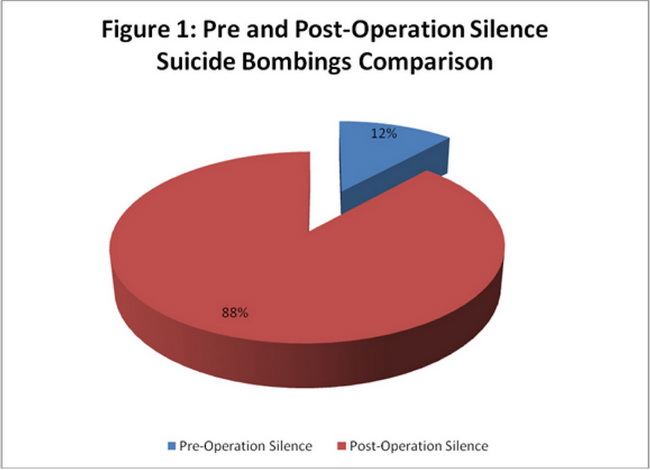
Before the operation Abdul Aziz had warned that a military operation against the mosque would elicit a violent reaction and result in suicide bombings across the country. His claim was proven true in the following years when the number of suicide bombings grew manifold. While the total number of suicide attacks from 2004 to the start of the Operation Silence was 34; since the operation against Lal Masjid, there have been 256 suicide attacks in to-date.[1] Figure 1 shows the share of the pre-Operation Silence and post-Operation Silence suicide attacks.
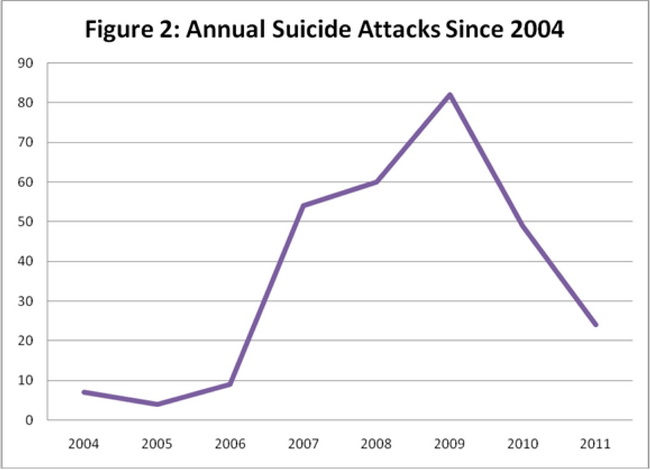
In most of the attacks in 2007 and 2008, the military and security agencies were targeted, which steeped from 2007 onwards, especially after the Operation Silence and peaked in 2009, gradually declining in 2010, partly because of the successful military operation against the militants in Swat.[2] Figure 2 shows an annual timeline of suicide attacks since 2004.
With sympathizers among ranks of such established militant groups such as Jaish-e-Mohammad renamed Khuddam-ul-Islam and Jamaat ul Furqan (a breakaway faction of Jaish), it was ostensibly easy for the students of the seminary to organize into numerous armed militant groups. Recently surfaced group Ghazi Force, named after Abdul Rasheed Ghazi was formed to avenge the deaths perpetrated by Operation Silence. Though none of the suicide attacks were directly attributed to the Ghazi Force, the footprints of the terrorists in some cases were traced back to this group. The group has ties with Hakimullah Mehsud, the head of Tehrik-e-Taliban Pakistan (TTP) and Fazlullah of Swat. The Ghazi force members are also known to have fought in Swat against the Pakistan army.
According to the security analysts, Ghazi Force as well as many students of Lal Masjid joined the ranks of Taliban. Abdul Aziz claimed in an interview that the students of the seminary had independently formed many groups to avenge the Lal Masjid debacle and carry forward their ideological agenda. He claimed that most of hisstudents belonged to Swat, Buner, Dir, and some nearby areas and that they were reacting and taking revenge of the blood of their relatives and friends and therefore frequent attacks on security forces in these areas. Abdul Aziz also said that his students would not commit suicide for any reason ¿but I cannot guarantee what they are doing in their native towns.– He also claimed that he had no affiliation with or control over their activities.
The security fallout of the Operation Silence shows that the policies of fighting militancy are carried out in isolation and without taking into account the far reaching impacts and implications of the decisions and actions. It was a criminal folly to carry out the operation without considering strategies to apprehend or control the radical elements that would be let loose after one of their pivotal nestling places was destroyed.
Role of Media
For months since the occupation by Jamia Hafsa, students of the Public Library, most of media had severely criticized the government and the army for failure in getting the premise vacated. But after the operation, the wave of media sympathy seemed to have turned in favor of those who had challenged the writ of the state. Most of the TV programs and newspaper comments projected the operation as an excess on ‘innocent occupants of the Red Mosque.’ Part of the blame also lies with the public diplomacy on the part of the government and the military. The government was unable to rally public support for the military operation against the Red Mosque prior to the full-scale use of military might in the heart of the capital. The government¶or more precisely Musharraf¶was too bogged down in political controversies after sacking the Chief Justice, Iftikhar Mohammad Chaudhry in March that year. Not only did the government fail in convincing the population of the country on the inevitability of the operation, it also failed in being culturally sensitive to the presence of women inside the compound of the Lal Masjid when the operation began. It was only after a couple of days of fighting that the female students of the Jamia Hafsa were evacuated, but there still were reports about the death of female students inside the compound, which were neatly overplayed by the right-wing religious organizations and sympathizers of the extremists.
Weak Law-enforcement and Judicial System
An ideal situation at the Red Mosque would have been a police action for the arrest of the clerics and their followers. It was a purely law-and-order issue whereby some baton-wielding male and female youth had taken law and justice unto their own hands. The swing of the pendulum from negotiations through government intermediaries to a full-scale military assault involving the elite Special Services Group (SSG) was viewed as excessive use of force by many and greatly exploited to their advantage by the militants. Even if the military was used to bring the situation under control, the logical ending to the Lal Masjid operation should have been the trial of the perpetrators in the court, their conviction and punishment thereby ending the cycle of violence. Those released should have remained under strict vigilance by the security agencies rather than being free to not only foster the ranks of other militant groups but also form their own militant groups. In a typical tragedy of the errors of policy-makers, as a result of mishandling of the issue, the students of the seminary became a much larger threat to the security of the country than their earlier status of just a baton-wielding moral police around the city.
While their spiritual leader, Abdul Aziz, was detained initially along with more than 600 students, they were all released on bail in the following months. It is outrageous that the individuals who were considered dangerous enough to be eradicated with a full scale military operation were released on bail and even after four years¶while the cases against them remain pending in the courts¶they have not been convicted, jailed or executed. Then, it also had exposed the internal contradictions of Pakistan political governance that was dominated and dictated by the military and intelligence establishment.
Today the Lal Masjid and its related seminaries¶Jamia Fareedia and Jamia Hafsa¶have 35 different branches in different areas of the twin cities of Islamabad and Rawalpindi, catering to more than 5,000 students at the moment. They till function fee of any direct government check or regulations that apply to private education institutions. The Operation Silence provided a certain fillip to militancy and also gave birth to the Ghazi Force and other such groups, that went after the government to avenge deaths of their comrades. It also points to the fatal flaws in the state policy of dealing with militancy and extremism.
Conclusion
In hindsight, the July 2007 Operation Silence in Islamabad was a political failure, while the Operation Rah-e-Haq (The Road to Truth, or The Right Path) launched in Swat against the militants led by Mullah Fazlullah in summer 2009 was a relative success. (Between July 4-6th, the army commemorated that success by organizing a national seminar on deradicalisation at Mignora, the administrative headquarter of Swat, where besides the Army Chief General Ashfaq Kayani, the prime minister Yousuf Reza Gilan also showed up to express solidarity with the local people). The reason for the success of the latter were the lessons that the military learnt from the mistakes of Operation Silence. The military operation in Swat was launched after exhausting all the other possible options of negotiations, civilian law-and-order etc. More importantly the army mobilized three divisions ´ almost 30,000 troops backed up by combat aviation and air-force only after a massive public outcry for doing so. The operation, even though extensive, was not undertaken with an overbearing use of force considering the enormity of the threat posed by the militants in Swat. Justice was allowed to take its course in Swat. Hardened militants were not freed soon after capture. Many of them are still languishing in jails, some even waiting for their trials. The softer militants were released on bonds and assurances from their village elders, but they were not let loose in the society, rather kept in strict surveillance. A comprehensive de-radicalization program was initiated for the youth indoctrinated to become suicide bombers by the Taliban. The military operation was followed by a series of television shows and drama serials based on true stories of the sacrifices of the military and the excesses of the Taliban in Swat. The operation was followed by a concerted¶even if flawed¶effort at reconstruction and development of the area with the inclusion of the local population to enhance their realization of a better life after the defeat of the Taliban. If all these steps were followed before, during, and after Operation Silence, things could have been different.
Swat is not the ultimate success though, a lot more needs to be done to set many other wrongs. While Pakistan army battles militants in the tribal areas, most mosques and madrassahs in many parts of the country continue to function unregulated and unchecked. Friday sermons in numerous mosques across the country continue to emanate radical messages against all that the clerics deem un-Islamic and sacrilegious. The state has no mechanism to ensure that the Friday sermon or the religious education imparted to a large majority in Pakistan remain within the confines of civility and not incite anger and hatred amongst numerous poor and deprived masses who remain in search of some kind of ideological anchorage.
As mentioned earlier, the example of over 3,000 militants arrested during and after the operations in Swat and South Waziristan , who are practically in illegal custody of the armed forces, makes it clear that that current legal framework lacks the wherewithal to deal with the unusual levels of threat and violence. Even murderers can get away with bails under the Anglo-Saxon Law, while the 1997 Anti-Terror Act is totally insufficient to deal with the present day terror cases.
Unfortunately the political will to fight extremism and militancy remains weak and the institutional framework deficient. The leading political parties have so far failed to come up with a unified national policy of fighting this menace. Therefore, the security establishment independently formulates policies that are often myopic and limited. Until the political forces unanimously decide to lead the battle against militancy and formulate a cohesive policy, the security establishment alone will not be able to effectively eradicate it.
With the impending exit of American forces and NATO that would start from September 2011 from Afghanistan, it is expected that the country will fall to the militants and become embroiled in a civil war. Pakistan must realize that in such a regional environment its porous borders coupled with radical elements festering within its own heartland, it will become highly unstable and vulnerable to chaos and therefore it is imperative to devise a holistic strategy to eradicate this menace.
The occupants of the Red Mosque had refused to submit to the state, taken up arms and thereby challenged the authority of the state and refused to surrender. This is what necessitated the operation after a six month stand-off. The Operation Silence was an unavoidable need of the hour but timely action coupled with political foresight probably could have prevented the bloodshed, and most probably the backlash that the country suffered in the aftermath of the Operation.
(Major Contributors: Senior Research Fellows Asifa Hassan and Aarish Khan)
[1] Based on data from http://pakistanbodycount.org/suicide_bombing
[2] Ibid.