



By Muhammad Darjat
As fertile lands disappear under floods and erosion, community-led restoration offers a practical blueprint for climate resilience in Pakistan’s mountain regions.
Across the high-altitude valleys of Gilgit-Baltistan, a tangible crisis is radically reshaping the physical and built environment. Driven by escalating global temperatures, accelerated snow and glacier melt have turned essential seasonal lifelines into instruments of destruction. Fertile agricultural lands cultivated for generations are being systematically buried under rocky debris, eroded by shifting riverbeds, or drowned by sudden flash floods.
The scars of this changing climate are increasingly visible across the mountainous region. In the Saling and Balghar area of Ghanche district and Hoto village in Skardu and the main Shigar Valley in Baltistan,the shifting, swelling waters of the Shyok , Balardu Rivers and their cumulative flow have eaten away vital farmland including agroforestry plots and apricot orchards. Meanwhile, in the villages of Dain and Pakora locality in Ishkomen Valley in Ghezir district, the intense summer heatwaves provoke sudden mudflows and debris torrents, transforming lush fruit orchards into rocky deserts. The rehabilitation work of 2025 floods in Thank in Diamer, Talidas Raoshan Gupis,and village Dain in Ishkoman are yet to be completed and the new destruction in Molaabad in Gupis and settlements in Ghanche district has started in the first week of July 2026.
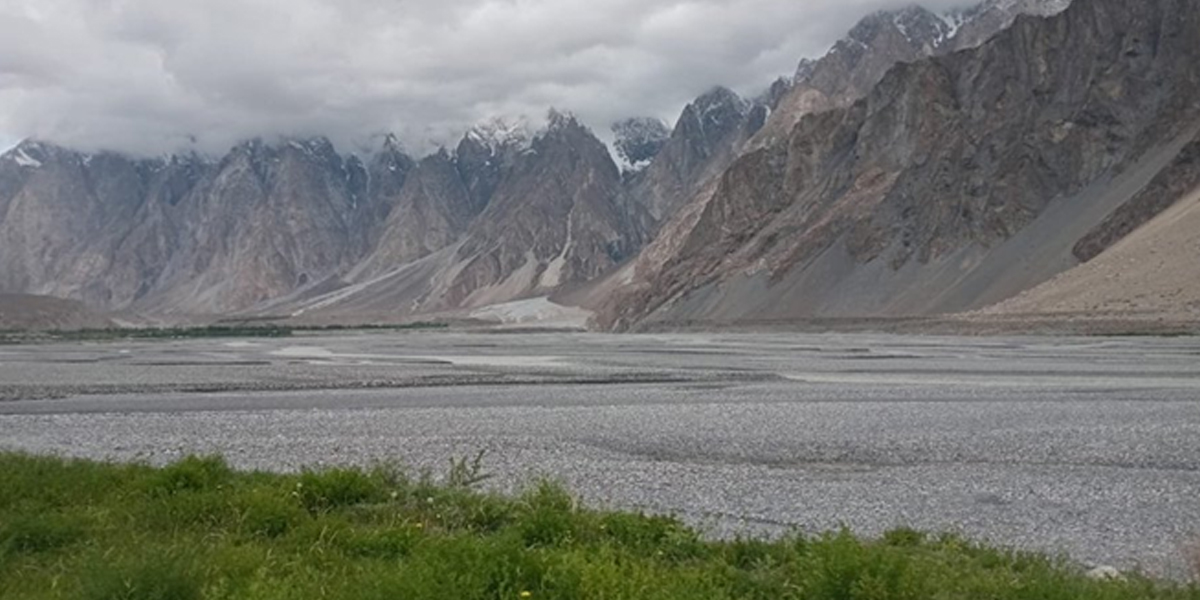
Further north in the village of Passu,in Hunza district aggressive lateral bank erosion and damage to farmland for decades and the turbulent flow by glacial runoff threatens the very foundations of agrarian livelihoods. Elders say that this old village used to be the settlement of 300 households and the land erosion incrementally forced people to migrate to other villages and locations within and outside Pakistan.
A perennial Glacier Outburst event in the village of Hassanabad in Hunza and Hopper in Nagar district has left damages and loss of physical assets including houses.
To reclaim these vital terrains, mountain communities cannot afford to rely solely on distant, high-cost engineering solutions. The path forward lies in critically assessing the situation and designing cost-effective bioengineering and mitigation structures, and explicitly linking at least partly their construction, monitoring, and long-term maintenance to local community institutions.
Heavy concrete flood walls in isolation are financially impractical for isolated villages and prone to cracking under extreme mountain weather conditions. A more climate-resilient approach pairs local materials including riprap mitigations structures with flexible design principles. Permeable retaining structures that absorb the velocity of rushing meltwater without collapsing and breaking. Similarly, vegetated loose-stone check dams if built across minor streams in valleys like Pakora and Golodass will slow down high-velocity flows, trapping fertile silt while letting water pass safely through.
Gray engineering solutions adapted in the mountains from the flood mitigation action from the plains probably need to be revisited with more focus on applying a biological reinforcement solution. In Passu, communities have successfully demonstrated a pilot project, riprap construction with the support of AKF Pakistan. However, strengthening the structure will require bioengineering solutions with planting domestic trees and sea buckthorns and addition of layers of boulders on yearly basis at critical points. This plant features an incredibly dense, deep root network that binds fragile, sandy mountain soils together. Its thorny branches act as a physical buffer against water currents, while its natural nitrogen-fixing capabilities help restore fertility to degraded, silt-covered soils.
Yet, physical infrastructure is only as resilient as the social framework backing it. The true key to sustainability lies in routing these projects through the established grassroots network of Village Organizations (VOs) at the village level and Local Support Organizations (LSOs) at the union council level, those have been fostered by the Aga Khan Rural Support Programme years back.
This institutional framework ensures that the entire lifecycle of a mitigation project remains localized. During the planning phase, VOs leverage generations of observational data regarding historical flood levels to ensure structures are placed precisely where they are needed most. When construction begins, the VO organizes local labor through traditional collective work models. This eliminates expensive outside censurer fees, ensures transparent material use, and instills a deep sense of local ownership over the physical structures.
Once built, the responsibility shifts to community monitoring networks. During the peak melting season from June to August, designated village youth monitor high-altitude melt channels daily, reporting structural shifts or rising water hazards back to their organizations. To ensure long-term viability, the district government needs to create disaster response funds and VOs can establish localized operation and maintenance mechanisms. And the Vos can manage the funds independently with more focus in hiring machinery for transportation of boulders, excavations and expanding bio-barriers without waiting for delayed state interventions.
The environmental pressures facing Hoto, Pakora, Passu, Salin and Shigar are daunting, but they are not insurmountable. By shifting the focus toward low-cost, adaptive bioengineering and anchoring these efforts within the institutional strength of local organizations in Gilgit-Baltistan can establish a powerful, self-reliant blueprint for mountain climate adaptation. Reclaiming farmland is no longer just an engineering challenge; it is a vital act of community resilience for soil control, food security, and enhancing resilient ecosystem services, which is most needed for the people and the planet.
Muhammad Darjat is a prominent researcher, and climate and development expert based from Gilgit-Baltistan (GB).