



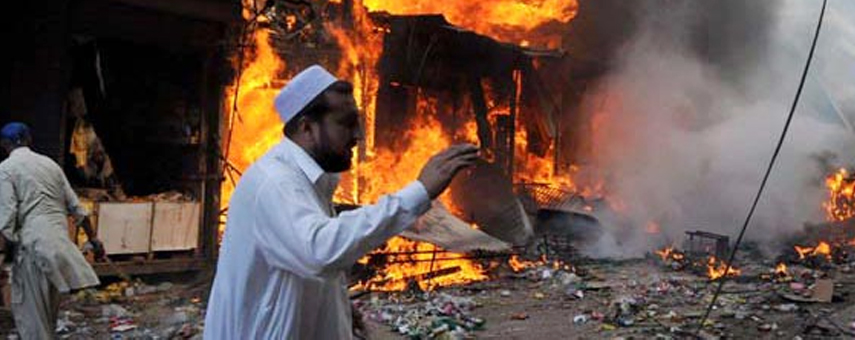
Within days of the terrorist attacks on the twin towers in New York and the Pentagon on 11 September 2001, Pakistan became an inseparable element in calculations about responding to al-Qaeda. Not only was Pakistan seen as a potential springboard for punitive action against the transnational organization but it also came to be regarded as a crucible of terrorism.
The global image of Pakistan today is rooted in preconceptions about the country’s role in international terrorism. It is often thought that the leaders of al-Qaeda and the Taliban are hiding in Pakistan, and that terrorist groups of all shades, including those inimical to India, China, the US and the West at large, use Pakistani territory for their operations. Another preconception is that sections of the Pakistani military establishment maintain close links with such Islamist radical groups as the Haqqani Network, Afghan Taliban and Lashkare-Taiba (LeT), which focuses its attention on India.
These entrenched preconceptions form part of the global discourse on counter-terrorism that continues to stigmatise Pakistan. The situation is not without debilitating socio-political and economic costs. Pakistan has lost over 50,000 people since becoming part of the US-led war on terror. Its economy has suffered because of the ensuing security crisis. According to Pakistani journalist Ismail Khan, Pakistan’s economy has suffered a US$78 billion loss in the last 10 years due to terrorism alone.
Is Pakistan alone responsible or did US-led global geopolitics suck it into this dire situation? Or is it a combination of both?
In the 1980s, to counter the Soviet Union’s invasion in Afghanistan, young jihadis (‘holy warriors’) were trained in Pakistan’s semi-autonomous, practically lawless western border tribal areas—popularly known as the Federally Administered Tribal Areas (FATA). Since then, the area has served as a training ground for terrorist activities both in Afghanistan and Pakistan. Militant networks nestled there recruit young men, brainwash and train them to be snipers and suicide bombers for missions against NATO troops in Afghanistan. They also train them to incite sectarian hatred and faith-based violence, or to attack domestic targets like schools and houses of worship in Pakistan. Since 2007, terrorist networks in Pakistan have frequently targeted political leaders, tribal leaders, minority Shia, schools as well as the military and the police.
Some of the world’s most wanted and dangerous terrorists have been captured or killed through covert US intelligence operations or drone attacks in Pakistan, including Osama Bin Laden; Tahir Yuldasheve, cofounder of the Islamic Movement of Uzbekistan; Khalid Sheikh Mohammad, another al-Qaeda mastermind involved in the plotting of 9/11; Abu Zubaydah, a Saudi citizen believed to have been a link between Osama Bin Laden and other al-Qaeda cells; Mullah Abdul Ghani Baradar, an Afghan Taliban leader, arrested by the Pakistani authorities; and Ahmed Omar Saeed Sheikh, an al-Qaeda aligned kidnapper and murderer of Wall Street Journal reporter Daniel Pearl.
The Pakistani government estimates that more than 60 militant outfits are operating both overtly and covertly in Pakistan. Terrorist organisations have also successfully conducted two brazen jailbreaks, freeing hundreds of their detained members. At the forefront of most terrorist activities is the Tehreek-i-Taliban Pakistan (TTP), a home-grown franchise of al-Qaeda. It is allied with the infamous Haqqani Network, the East Turkestan Islamic Movement (ETIM)—a separatist group founded by Uighur Muslim militants in western China—and the Islamic Movement of Uzbekistan (IMU), which claimed responsibility for the 8 June 2014 attack on Karachi International Airport.
In late August, several TTP commanders announced the creation of a new group called Jamaatul Ahrar. Led by Maulana Qasim Khurasani, the group vowed allegiance to the Islamic State of Iraq and Syria (ISIS). Most of its members have declared the Pakistani government and the military its enemy.
For over a decade most TTP, IMU and ETIM terrorists have used Waziristan, one of the seven FATA districts, as a sanctuary and training ground. The Afghan Taliban operate out of North Waziristan to mount terrorist attacks on Afghan and NATO troops. This finally prompted the Pakistani army to launch Zarbe-Azb, a military operation to destroy and disrupt al-Qaeda-linked terrorist networks holed up in North Waziristan. Since the offensive began on 15 June 2014, the military claims to have killed over 500 mostly foreign militants, including Uzbeks and Chechens, as well as people from Dagestan, Kazakhstan and Turkmenistan.
It is quite ironic that the military had to move against those very groups that Pakistan’s Inter-Services Intelligence (ISI) had once funded and trained, with CIA support, to counter the Soviet threat in the region.
A number of radicals caught conducting terrorist activities overseas have been traced to Pakistan and have admitted receiving terrorist training from Islamist outfits in Waziristan. One such is Faisal Shehzad, a Pakistani-American who was arrested in May 2010 for attempting to bomb Times Square in New York. Abdul Rof, a British Muslim, (otherwise known as Richard Colvin Reid) also admitted to becoming ‘radicalised’ and training as a terrorist in Pakistan and Afghanistan by al-Qaeda. In December 2001 Rof attempted to detonate explosives packed into the shoes he was wearing on American Airlines Flight 63 from Paris to Miami. Omar Patek, the notorious Indonesian Islamist militant linked to the Bali bombings, was also arrested from the northern Pakistani town of Abbottabad in early 2011. Jordanian suicide bomber Humam Khalil Abu-Mulal al-Balawi, who killed seven CIA personnel at the forward operating base Chapman in eastern Afghanistan on 30 December 2009, had also passed through Pakistan.
The high number of local and foreign terrorists in, or transiting through, Pakistan underlines a bitter unintended consequence of a free for-all anti-Soviet jihad mission in the early 1980s—militants inspired by the Muslim Brotherhood, alQaeda and the IMU have exploited Pakistan’s porous governance, leaking law enforcement and security apparatus, and inadequate legal and administrative structures. The security establishment’s inclination to maintain relations with non-state actors such as Lashkar-e-Taiba (LeT) or the Afghan Taliban or use them as foreign policy instruments has served as a facilitating factor for global jihadists.
It is therefore no surprise that as recently as August 2014, during his visit to New Delhi, the US Secretary of State, John Kerry, reassured India that the United States would keep pressing Pakistan on its alleged support for LeT. India sees LeT as an arm of the ISI and a major irritant in its relations with Islamabad. At a press conference, Kerry equated LeT with al-Qaeda and pledged to work with India to disrupt both terrorist organisations. His statement was seen to imply that Pakistan willingly advocated state sponsored terrorism and was a threat to both the US and India.
Many internal factors have contributed to Pakistan’s weakness in the face of radical Islam. Its military establishment has a lopsided notion of ‘strategic depth’; it is plagued by fundamental governance issues and questionable law-enforcement; and by elements in the military hobnobbing with non-state actors along the eastern borders. But global geopolitics also played a part, particularly Washington’s campaigns first against the former Soviet Union and later against al-Qaeda. On both occasions, Pakistan found itself under the rule of military dictators who were looking for international legitimacy, and thus became willing partners in campaigns which were geo-political in nature but entailed disastrous socio-political consequences for the country.
During the anti-Moscow jihad, Pakistani army-led authorities welcomed every Tom, Dick and Harry from around the world. Despots like Egypt’s Hosni Mubarak ‘emptied their jails’ to help shore up the jihadi forces in Afghanistan, with the help of over US$6 billion that the CIA funnelled into the war. As intelligence commentators Paul Todd and Jonathan Bloch explain, ‘the Saudis matched the United States in arms funding. A network of ISI-run training camps in both Pakistan and in Afghanistan itself instructed over 35,000 foreign mujahideen from throughout the Islamic world by the early 1990s, a significant proportion from Saudi Arabia’.
This situation offered Pakistan an opportunity to realise its long cherished dream of securing ‘strategic depth’ in Afghanistan by having a friendly and pliant government in Kabul, and so preclude the possibility of invasion from the west in a conflict with India. This at least was the premise when General Zia-ul-Haq (the then military ruler) decided to co-opt his security and intelligence apparatus into covertly fighting the CIA-funded war.
The US-led war on terror that began in October 2001 gave Pakistan, then under another military ruler, General Pervez Musharraf, another chance to stay relevant in Afghanistan and pursue ‘strategic depth’. Cooperation with the US-led coalition forces accompanied a quiet pursuit of the old policy that considered Afghan Taliban groups under Mullah Omar and the Haqqani Network to be ‘strategic assets’. It also meant condoning their command and control centres on Pakistani territory by looking the other way.
The Afghan Taliban took advantage of this and began drawing manpower from inside Pakistan. Splinter groups of LeT, TTP, and many others recruited volunteers to fight coalition forces. They also facilitated the movement of al-Qaeda-linked American, British, Uzbek and African Muslims through Pakistan, creating a double jeopardy for Islamabad—pro Pakistan Afghan Taliban and warlords in Waziristan began sheltering and helping local and foreign militants whom the Pakistan army was hunting.
As late as November 2013, Pakistan again came under the global spotlight when the Saudi foreign minister reportedly asked Islamabad for manpower to reinforce the Syrian rebels in their efforts to dislodge the Assad regime. A Saudi State Department official declined to comment on the Saudi training program, but Pakistan did receive a loan of US$1.5 billion in February 2013. Pakistan’s Finance Minister, Ishaq Dar, initially refused to disclose the source but the government later conceded that the ‘donation’ had originated in Saudi Arabia. This triggered speculation that the Saudis may have asked to recruit ex mujahideen who could be deployed in Syria.
Andrey Serenko, an expert from the Center of Contemporary Afghan Studies, says many fighters in Pakistan’s tribal areas have just returned from fighting in Syria. A Taliban operative also confirmed Pakistani Taliban militants have set up a base to monitor ‘the jihad’ in that region. Hence, it seems that Taliban from Waziristan did lend a helping hand to the Saudis’ ‘jihad’ against the Assad government.
Pakistan—unofficially and inadvertently—supports and sympathises with militant forces that, in essence, can qualify as extensions of the al-Qaeda-led conglomerate of global terrorism. The spirit of jihad that, for geopolitical objectives, had been instilled in the minds of thousands of Arab, Afghan and African crusaders eventually morphed into a quest for jihad aimed at ‘cleansing’ the world of US-led ‘satanic imperialism’.
Pakistan’s military used Islam to further its objectives. This was a huge risk which has had alarming consequences. General Zia-ul-Haq’s strategy involved indoctrinating Muslims with an extremist ideology for jihad in Afghanistan. During the CIA-led anti-Soviet war, radicalization became a major policy instrument for the first time in Pakistan’s history. In only four years hundreds of religious schools were created to provide quick extremist education.
During this period and the following two decades, not only was a significant faction of the Pakistani society radicalised, but the region also saw the emergence of several militant organisations, including Harkat-ul Mujahideen (founded in the 1980s), al-Qaeda (founded in 1989), LeT in 1990, IMU in 1991, and Lashkare-Jhangvi (LeJ) in 1996. After the Soviets withdrew from Afghanistan in February 1989, the Taliban were able to capture the capital, Kabul, and most of Afghanistan during the ensuing civil war. This was possible because of official and private support from Saudi Arabia and the UAE were quick to recognise the Taliban regime, which went on to host militants from all over the world, including thousands from Pakistan.
Geopolitics, as well as Pakistan’s inherent porous governance, deficient rule of law, political instability and reliance on non-state actors to achieve foreign policy objectives have all combined to render the country vulnerable to transnational Islamist networks. The official tolerance of religio-political groups with a radical pan-Islamist Weltanschauung creates space for the radicalisation of minds and even encourages radicals to peddle their anti-Western agenda, to the detriment of democracy.
Radicalism has infected Pakistan’s security apparatus, exemplified by the conviction of Brigadier Ali Khan and three others in 2011 for their links to another ideologically radical outfit, Hizb ut-Tahrir. They also held radical views on Pakistan’s cooperation with the US that resonated with calls by Ayman al-Zawahiri, the present chief of al-Qaeda, and the rank and file for a rebellion against the army leadership for its involvement in the war against terrorism. Both al-Qaeda and Hizb ut-Tahrir consider Pakistan to be the major impediment to their jihad against the West and its allies.
Pakistan currently faces the formidable challenge of reversing the consequences of its flawed policies of ‘strategic depth’ and containing the contagion of religious radicalisation. Until the government and its entire security apparatus drastically revises its strategic matrix, divorces itself from the radical groups it helped create and support, diagnoses the causes of internal insecurity, and draws up a comprehensive internal security strategy aimed at disrupting, destroying and pre-empting religious radicalisation, it will find it hard to shake off the image that Pakistan is the crucible of terrorism.
Article is written by Imtiaz Gul, the writer is the executive director of the Centre for Research and Security Studies. The article is published in East Asia Forum Quarterly, Vol.6 No.4 October-December 2014
Source: http://press.anu.edu.au/wp-content/uploads/2014/11/whole.pdf