



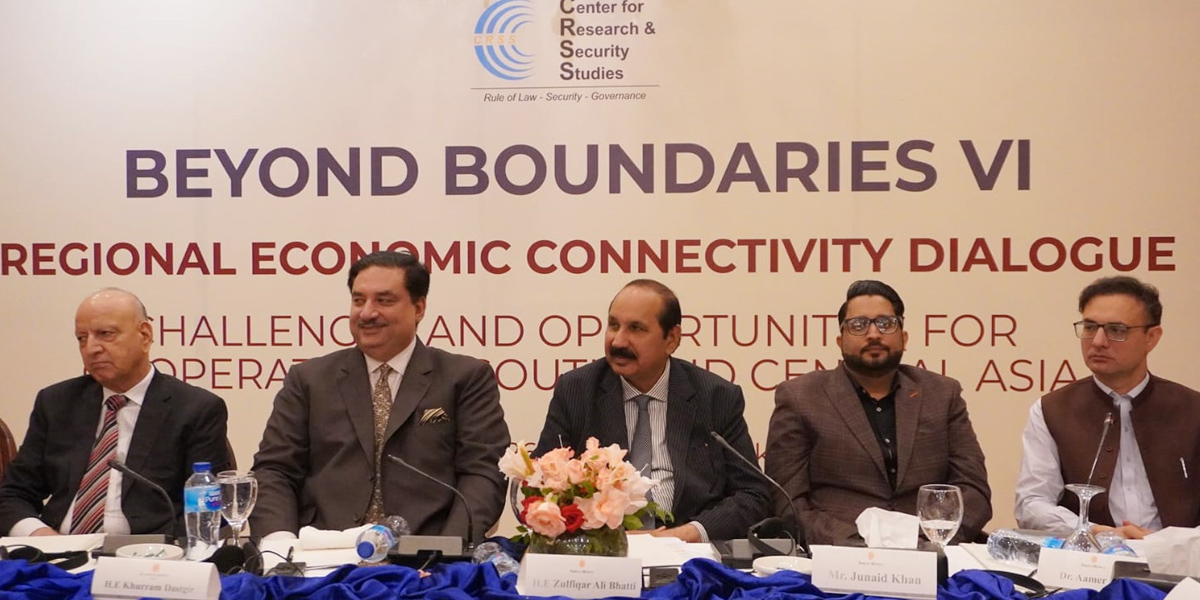
Trade between Pakistan and Afghanistan must continue irrespective of challenges in other areas of bilateral relations, as sustained economic engagement can serve as a constructive lever to improve the overall relationship, said the Federal Parliamentary Secretary for Commerce, Dr. Zulfiqar Ali Bhatti during the Regional Economic Connectivity Dialogue on challenges and opportunities for cooperation in South and Central Asia, organized by Center for Research and Security Studies (CRSS) as part of its multitrack diplomacy initiative Beyond Boundaries.
The dialogue brought together senior representatives from the business community and chambers of commerce across Pakistan, alongside policy experts, legislators, and officials from the Federal Board of Revenue (FBR) and Pakistan Customs.
The federal secretary for commerce further noted that trade should be viewed as a stabilizing force and a shared stake that encourages cooperation rather than discord. Highlighting the strategic importance of the region, he underscored that security and connectivity are critical for both countries, which serve as vital economic corridors for each other. Afghanistan provides Pakistan with access to Central Asia, while Pakistan offers Afghanistan a gateway to international markets and maritime routes. This interdependence, he stressed, must be leveraged to promote mutual prosperity.
He further acknowledged the difficulties faced by the business community due to ongoing tensions and security-related disruptions, and called for targeted policy relief to ease their burden and sustain economic activity. In this regard, he stressed the need for pragmatic and business-friendly measures that can help restore confidence among traders and investors.
Reaffirming the Ministry of Commerce’s commitment, he offered to convene meetings to deliberate on the proposals submitted, including those put forward by CRSS. He assured participants that he would facilitate engagement with relevant government stakeholders and ensure that the concerns of the business community are effectively represented and addressed. He reiterated his full support for continued dialogue and institutional facilitation to help resolve bottlenecks and advance bilateral trade cooperation.
“While the trade must go on and movement of people and goods between Pakistan and Afghanistan must continue, in a regulated and facilitated manner, both countries must respect each other’s sovereignty, as a prerequisite for rapprochement and creating joint stakes for peaceful coexistence, as friendly and cooperative neighbours”, said the senior PML-N leader and former federal minister, Khurram Dastgir Khan.
He noted that both countries have been taking each other for granted for too long despite their enormous potential for growing and prospering together, through shared goals and cooperation for development, stability, and connectivity.
Both sides should respect the sanctity of the frontier for economic, people-to-people, political, and security connectivity, and not adopt a paradigm where it is seen as a divider and a conduit of hostilities against each other. Their shared ethnic, cultural, religious, and linguistic ties should have served to tie both sides strongly and not sever the relationship instead.
Since August 2021, when the Taliban returned to power in Afghanistan, terrorist violence has substantially surged in Pakistan for four consecutive years, with 2025 recorded as the deadliest and most violent year for Pakistan in a decade.
To seek an off-ramp to the ongoing conflict and in the interest of a conflict-proof relationship, he urged both sides to adopt a facilitation mindset over a regulation mindset for their bilateral and transit trade relations. The current trade impasse benefits neither Pakistan nor Afghanistan; banning has never served as a solution, which is, unfortunately, an approach adopted to tackle contentious issues.
Like the parliamentary secretary for commerce, he assured that the CRSS’s proposal to the Ministry of Commerce, outlining the recommendations of the members of the business community and chambers of commerce across the country, can pave the way to break the stalemate, resume economic activity, and improve cross-border livelihoods.
Ali Raza Hanjra, Project Director of CAREC-RIBS (ITTMS) at the Federal Board of Revenue, stated that modern infrastructure systems like ITTMS can only deliver real benefits if regional trade corridors remain open.
He proposed the establishment of a joint de-escalation mechanism to proactively manage tensions and prevent the escalation of disputes between the two sides. Emphasizing the need for institutionalized coordination, he highlighted that recurring operational challenges at the ground level should not remain ad hoc concerns, but instead be systematically analyzed and elevated into policy considerations. This, he noted, would enable their formal incorporation into decision-making frameworks, ensuring more coherent, responsive, and sustainable bilateral management of trade and border-related issues.
Mr. Arbab Qaiser, Chief Customs Wing, Federal Board of Revenue (FBR), Islamabad, highlighted that cross-border trade and the movement of goods are inherently dynamic domains, where operational challenges are likely to persist even after existing issues are addressed. Given this evolving nature, he emphasized that resolving current bottlenecks should not be seen as a one-time achievement, as new challenges can emerge over time. He stressed the importance of building adaptive and responsive mechanisms to continuously manage and address such issues, ensuring the smooth and sustainable functioning of cross-border trade.
Chairman of One-Man Commission on Minorities Rights, Dr. Shoaib Suddle underscored the imperative of facilitating sustained communication as a prerequisite for addressing all issues of concern and contention between the two sides. He cautioned that prolonged border closures risk creating a damaging standstill, which undermines not only bilateral relations but also regional economic connectivity. Such disruptions, he emphasized, are detrimental to both Pakistan’s economic interests and broader efforts toward regional integration and stability.
Participants from chambers of commerce, trade associations, and the broader business community across Pakistan collectively highlighted the severe economic fallout of the recent trade disruptions, describing the past few months as one of the most challenging periods in the history of Pakistan–Afghanistan trade. They underscored widespread financial losses amounting to millions of dollars, business closures, rising unemployment, and long-term damage to market confidence, with some traders fearing irrecoverable setbacks.
A key concern was the unpredictability of border closures and trade policies, often driven by security considerations without prior consultation with stakeholders. This, they noted, has not only disrupted supply chains and clearance systems but also eroded Pakistan’s credibility as a reliable trade and transit partner in the region, allowing competing corridors through neighboring countries to fill the vacuum.
Participants emphasized structural and operational challenges, including slow and inefficient clearance systems, lack of formal banking and remittance mechanisms, visa restrictions, and the absence of coordinated border management. They also pointed to policy inconsistencies that inadvertently encourage informal trade and smuggling, while penalizing legitimate businesses and manufacturers across provinces.
The business community called for a predictable and facilitative trade regime, including assurances against abrupt border closures, targeted policy relief and financial support for affected exporters, and the introduction of export financing facilities. They advocated for the expansion of exportable goods beyond essential items, improvements in trade infrastructure and border operations (including round-the-clock functioning where feasible), and stricter enforcement against smuggling.
Furthermore, they stressed the need for institutionalized dialogue and inclusion of business stakeholders in policymaking, proposing the creation of a multi-stakeholder task force comprising government entities, chambers, and trade bodies. Enhanced communication with Afghan counterparts, easing of visa regimes, development of formal payment channels (including local currency trade options), and leveraging trade as a tool for regional connectivity and peacebuilding were also highlighted as critical priorities.