


“Ma’am, why is it only India who always initiates Peace”, asked a class XII student
I asked him to share some examples. He quoted bilateral meetings initiated by India, PM Narendra Modi’s swearing in ceremony and his visit to Pakistan. He further said that India keeps initiating without any positive response.
Initially, I shared some examples to burst the “peace is one-sided” narrative that exists in both countries. I then asked him to share the source of his information. To which he replied that he reads the newspaper regularly. Thereafter, I provided some clues to facilitate a discussion in the whole class about yellow journalism, the way media works as a means for the ends of a nation-state, the politics of media and moreover, knowledge between India and Pakistan.
This conversation was part of a peace building workshop of Aaghaz-e-Dosti, an Indo-Pak Friendship Initiative, in a school in Delhi. These workshops that are about peace building and conflict resolution in general and Indo-Pak in specific are designed to familiarize students about life and people across the border, educate them about issues of conflict between India and Pakistan, and to facilitate critical thinking. Based on the responses of students and the interaction, this workshop highlighted the role that media plays in Indo-Pak relations.
In view of the restrictions in mobility, the media forms the main source of knowledge between India and Pakistan. The media is the platform to know the ‘other’. It is also the platform to understand the Conflict. As we see in the above cited incident, the student had a particular image of Pakistan and Indo-Pak peace based on his readings of the newspapers. This was not limited to this one student, school or just to India.
During my trip to Pakistan last year, I had interacted with students in a Lahore school. The students raised the case of a Pakistani musical band that faced opposition by an extremist, anti-peace political group in India. The students believed that this was supported by Indian Government and all Indians. They were not aware about the support that several organisations had extended to the musical band. The counter culture put up by the people was not found in the newspapers with equal vigour.
On both sides, the media plays a very important role in connecting or disconnecting the people of both countries. With the diversity in media channels, their interests and politics, they play different roles.
Owing to the popularity and availability of Indian movies and serials in Pakistan, the Pakistanis know about India and Indian culture far more than Indians do about Pakistan. This is reflected in the kinds of question that Pakistani students ask to Indian guests in peace sessions in Pakistan. During our sessions especially that connects Indian and Pakistani students through video conferencing, the conversation is entirely around Bollywood, with students of both sides singing songs together. In one such session held earlier this year, students from a Karachi school sung a popular bhajan.
The Indian side, on the other hand, remains largely unaware about Pakistan and holds a homogenized image of the country and its people. The coming in of Pakistani serials through Zindagi Channel had bridged this gap to some extent. Infact, some students in this Delhi school shared their love for Zindagi Channel. There were two students who had started exploring Pakistani movies and other serials after their initiation through Zindagi Channel. One student had also referred to Zindagi Channel as a Pakistani Channel in India.
TV Media and Cinema is known to have a great emotional impact on people. The reel is able to transcend all boundaries and touch the heart of the real. In the context of Indo-Pak relations, it also plays an important role in connecting the people of both countries and contributing to a culture of peace and understanding. It builds a sense of familiarity and the potential to bond. It bursts stereotypes, counters the foundation that Indians hate Pakistan and vice versa as it works to highlight the fact that we are the same people and that there are black sheep on both sides.
The recent strains in Indo-Pak relations has also had repercussions for cross-border media and art. On both sides, steps have been taken to stop and boycott cross-border. In Pakistan, PEMRA has put a ban on release of Indian Movies in Pakistan. On the Indian sides, while the Government of India had not officially issues a ban and infact, the Home Minister of India, Rajnath Singh, had officially announced that India will not stop granting visas to Pakistani artists, some extremist groups supported by media groups influenced popular opinion against Pakistani artists. Zindagi Channel also stopped the telecast of Pakistani serials. This decision of Zindagi Channel remains to be absurd in several respects. For the channel which came with the tag line “jodey dilo ko” (to connect hearts) that seemed to convey the role of media to facilitate people to people communication and bring about a change, this decision to ban Pakistani serials was a contradiction to its own vision.
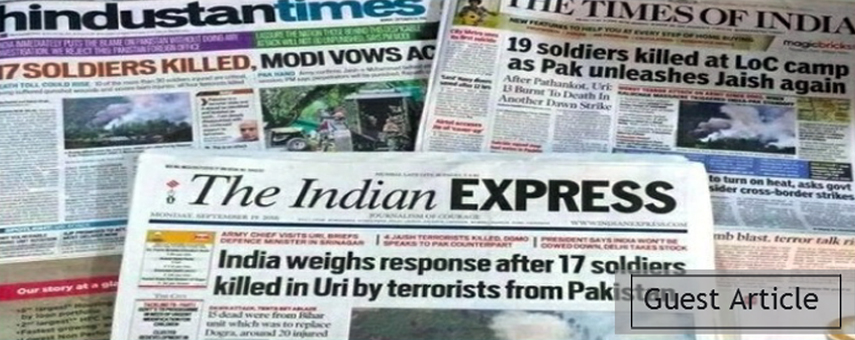
In both countries, the News Media – TV and print, with its claim of authenticity of information is problematic. As we saw in the cited incident where the student claimed to be right because he read the newspaper, took the coverage uncritically because of his trust in the claimed authenticity.
This is not just limited to these young students. While we all know the way the media often obsessed with TRP and underlying agendas, when it comes to conflict and especially Indo-Pak Conflict, we accept whatever it reports without a doubt. There have been several examples of misinformation and exaggerations in the case of Indo-Pak relations. Medias of both sides also tend to present any first information that they get hold of as final facts. The clarification and cross-verification happens later with much less sensationalisation. This has been noted in cases of unidentified boats, farmers, villagers mistakenly crossing the border and any suspicious activity.
It is imperative that we realise the different roles that Media plays in the Indo-Pak relations, its impact. It is imperative that we realise that the nature of media – the selection of news, its coverage based on TRP, competition and interests, remains the same for all issues. Our knowledge about each other lies within the boundaries of the nation-state and a capitalist media.
Devika Mittal is pursuing Ph.D in Sociology from Delhi School of Economics. She is the Convener (India) of Aaghaz-e-Dosti, an Indo-Pak Friendship initiative. She tweets at @devikasmittal.