



Press Release
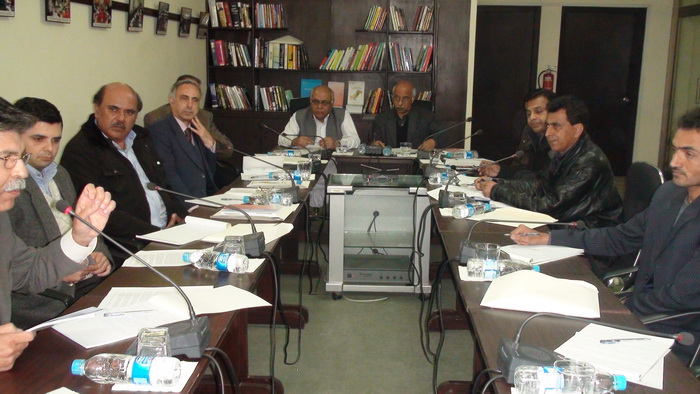
Islamabad (Tuesday, February, 20, 2012): Balochistan and Pakistan have never been on the same page during history. History, which is taught in Pakistan, does not tell us about the circumstances under which Pakistan came into being and Balochistan joined it. This was said during an event by the Center for Research and Security Studies (CRSS) for launching three of its annual publications, including ‘Balochistan Maze of Violence’ at its office premises in Islamabad.
During the launching ceremony, Senator Mir Hasil Bizenjo, vice president, National Party, Balochistan underscored that since beginning Baloch people were not part of the process, through which some Baloch sardars decided to join Pakistan in 1947. And even after the passage of 65 years, they are not part of the political process. He narrated that oppressive military operation of 1973 set the stage for separatist sentiments in Balochistan and in 1977 first militant organization, Balochistan Popular Liberation was formed. ‘Today, military through its para-military force, Frontier Constabulary (FC) is ruling the province and it is duly guided by the Inter-Service Intelligence (ISI)’, he observed. Present civilian government badly failed to change the long held status quo in the hapless province, as first case of mutilated bodies came up just ten days after the speech of Prime Minister Yousuf Raza Gillani in the Parliament in connection with the announcement of Balochistan Rights– Package on November 24, 2009. As a way forward, he suggested that the government should try to ebb the tide of missing persons– killing and recover them.
CRSS report underlines that the situation in Balochistan continues to aggravate with the passage of time, despite the government efforts to curtail the downward spiral and win back the trust of the disenchanted Balochis. The present government announced NFC Award and Balochistan Rights– Package in 2009 to upend the rising tide of militancy in the province, yet the situation on ground remains stubbornly volatile. In part, situation on ground also magnifies the apathetic attitude on the part of the central and provincial governments to address Balochistan issue. At a time, when there are widespread reports of disinterest among provincial lawmakers in discussing provincial; the Central Government is also contributing towards existent indifference among lawmakers to take Balochistan issue seriously. As the parliamentary committee constituted as a result of a unanimous resolution by the Parliament in August 2011 to ascertain the causes behind deteriorating law and order situation in the province, has failed to visit the province, even once during last five months.
Against this backdrop of apathetic attitude on the part of the government and raging militancy in the province, relentless violence marked 2011. Moreover, while mapping the territory of violence, we found that unlike in the past, the present year witnessed the diversification and at times overlapping of the forces behind violence in the province. According to our findings in Balochistan Maze of Violence:
- Staggering violence left 621 people dead during the course of the year. Among these, 281 people were shot dead in different incidents of target killing and firing, 68 fell prey to two deadly suicide attacks, while bomb blasts and landmine explosions perished 120 others.
- The ongoing ¿kill and dump– operation, further contributing to the already dismal law and order situation in the ill fated province, swallowed 231 people, whose mutilated and bullet-ridden dead bodies— were mostly found lying by the roadsides in different parts of the province.
- Meanwhile, according to the Home Department of Balochistan Government estimates 196 bodies of the missing persons were recovered mostly from Baloch dominated districts of the province, such as Quetta, Sibi, Kalat, Mekran, Nasirabad and Zhob.
- According to the Human Rights Commission of Pakistan about 6000 people are still missing in the province.
- Steep rise in sectarian violence was the hallmark of 2011. As Balochistan government estimates suggest that 117 people lost their lives in 20 incidents of sectarian violence. While 92 out them belonged to Shia sect of Hazara community, mostly inhabited in and around Quetta city.
- Also, there were 102 incidents of sabotage and subversion in the province, targeting railway tracks and gas pipelines. And the number is far higher than 2010, when only 24 such incidents were recorded across the province.
- During 2011, militants– relentless take on security forces resulted in the killing of 218 men belonging to FC, police, and Levies. The prime target was paramilitary force FC, while Baloch Republican Army and Balochistan Liberation Front claimed responsibility for most of the attacks against security forces.
- The year 2011 ended with the gruesome killing of Dr Baqir Shah (the police surgeon, who carried out autopsy on foreigners killed in Kharotabad incident). And the pace of violence set in past year continues to undermine the security landscape in the province during 2012. According to our findings almost 70 people have lost their lives in different episodes of violence in January 2012.
Furthermore, Balochis are being targeted in other provinces as well. As according to a news report, three people belonging to the family of provincial Baloch lawmaker (Sahabzada Bkhtiar Khan Domki, a relative of late Nawab Akbar Bugti) were gunned down in Karachi. The story elaborates the scale and outreach of violence involving the Balochis. In sum, a keen look into the incidents of violence and sabotage activities suggest that situation on the ground in Balochistan is taking turn for the worst. And looking at the apathy of the state and inflexibility of actors involved in violence in Balochistan, one can foresee an unparalleled violence in 2012.