



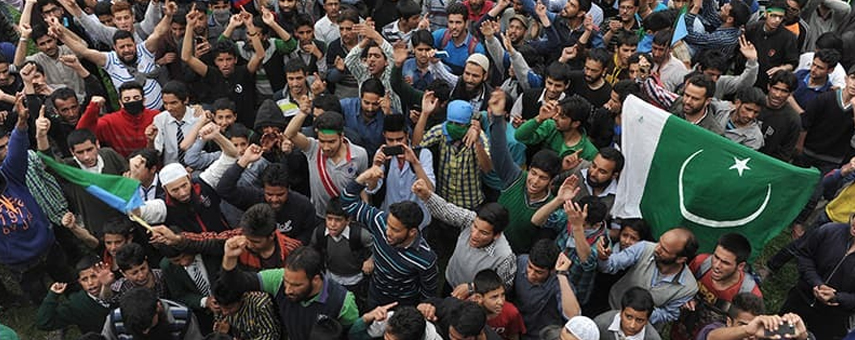
The people of the Azad Jammu and Kashmir, as well as Kashmiris living in 12 constituencies in various parts of Pakistan, voted on July 21 to elect the state Legislative Assembly (LA).
The Kashmir chapter of the Pakistan Muslim League Nawaz (PMLN), Pakistan’s ruling party, literally swept the polls by bagging 32 of the 41 directly contested seats. Some 423 candidates contested the polls for the 41 seats on the basis of the direct adult franchise. Out of these, 29 seats are meant for all 10 districts of AJK and 12 are meant for Pakistan-based refugees from theKashmir Valley, Jammu and others areas.
Ironically, the first-past-the-post system handed a thumping victory to the PML-N despite the fact that it polled about 689,000 votes, while the Pakistan Tehreek-e-Insaf (PTI), and the Pakistan Peoples’ Party (PPP), jointly received 735,000 votes. This however translated in only 4 seats. Thereby, PML-N will determine the fate of Kashmir under Pakistan control.
This skewed distribution of voter power, as pointed out by Dr. Syed Nazir Gilani, head of the Jammu/Kashmir Council for Human Rights (JKCHR), necessitates vigilance at all strata of the society to prevent the ruling party from bulldozing democratic norms and flouting constitutional obligations.
“We need to act as vigilant citizens and make sure that PMLN (AJK) doesn’t deviate from the democratic path that is so essential for keeping the cause of Kashmiris alive,” Dr. Gilani says.
He points out that the civil society must keep the pressure up so as the Governments in Muzaffarabad as well as Islamabad understand, and not fail the following:
- Government of Pakistan has assumed trust responsibilities under UNCIP Resolution in Azad Kashmir “to provide for the better government and administration of Azad Jammu and Kashmir until such time as the status of Jammu and Kashmir is determined in accordance with the freely expressed will of the people of the state through the democratic method of free and fair plebiscite under the auspices of the United Nations as envisaged in the UNCIP Resolutions adopted from time to time”. [The Azad Jammu and Kashmir Interim Constitution Act 1974].
- We need to ensure that the new government acts and operates accordingly in the interests of the people and Kashmir case.
- The elected members have to elect 5 women, 1 religious scholar, 1 member from Kashmiris living abroad and 1 technocrat in the assembly of forty-nine members. We need to ensure that the elections of these 8 members are fair, on merit and in the interests of the people and Kashmir case.
- The Prime Minister of Pakistan has undertaken constitutional role in the affairs of Azad Kashmir as Chairman Azad Jammu and Kashmir Council. He nominates 5 members on the Council from amongst Federal Minsters and Members of Parliament. We need to ensure that the nomination of these 5 people in the AJ&K Council is fair, on merit and in the interests of the people and Kashmir case.
- Government of Pakistan has allocated to itself further trust duties under articles 19, 21, 31 (3) and 56 of The Azad Jammu and Kashmir Interim Constitution Act, 1974. Kashmiris need to ensure that the office of the Prime Minister of Pakistan as chairman of the Council is able and willing to discharge its responsibilities in Kashmir case.
This demand comes in the context of a history of bitter and acrimonious contests over control of Muzaffarabad, the capital of Pakistan-controlled Kashmir between mainstream parties such as the PMLN and the PPP in the 1980s and 1990s. Both of these, as well as the new entrant PTI which ended as a runner-up in the latest elections, have often used Kashmir to project their power in Pakistan.
Kashmiri observers and legal experts believe that this power play with Kashmir has had a negative bearing on the cause and diluted Pakistan’s position on the issue.
The author Imtiaz Gul is the Executive Director of Center for Research and Security Studies (CRSS).