



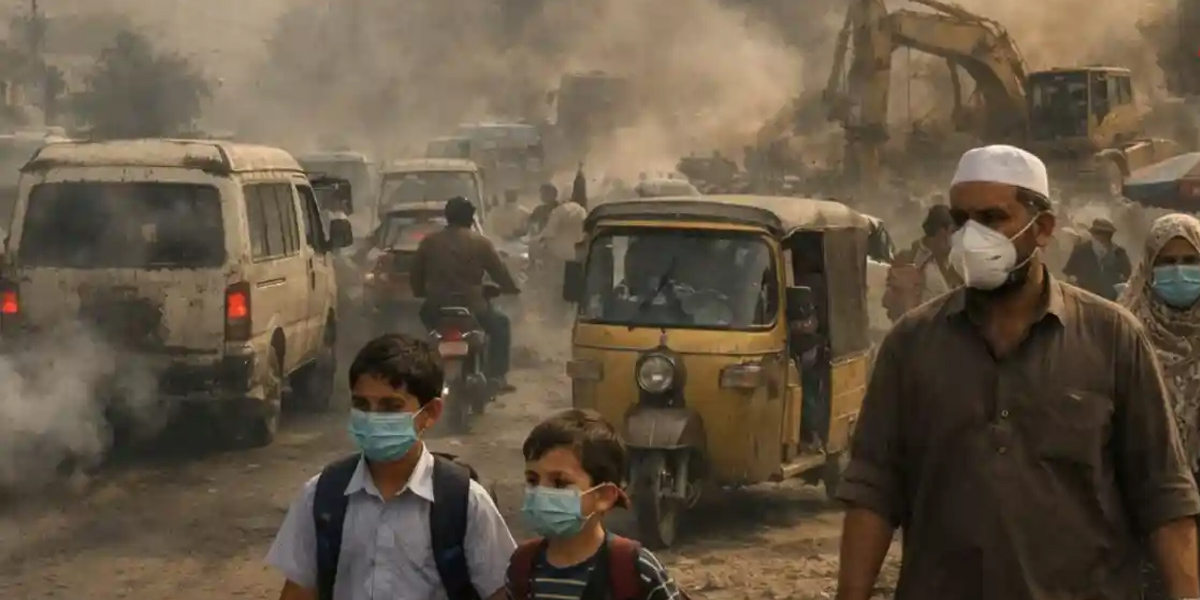
This report presents a comprehensive, evidence-based analysis of Karachi’s air quality trajectory over a twenty-two-year period (2004–2026), synthesising data from three major studies: the 2004 PCSIR baseline assessment, the 2020/2024 SEPA monitoring campaign, and the 2026 policy critique published in The Friday Times.
The findings are unequivocal and alarming. In 2004, Karachi’s atmosphere — as measured for five gaseous pollutants (SO₂, CO, NO, NOx, O₃) — was fully compliant with World Health Organization guidelines. The study concluded with cautious optimism, warning only of potential future risks from rising vehicular and industrial activity.
By 2020, that warning had become a public health catastrophe. Particulate matter (PM₂.₅ and PM₁₀) — entirely unmeasured in 2004 — emerged as the dominant pollutant, with 51 of 90 monitored locations exceeding Sindh Environmental Quality Standards. Peak PM₂.₅ concentrations reached 385.98 μg/m³ in Korangi District — 25.7 times the WHO 24-hour guideline of 15 μg/m³.
The 2026 policy analysis provides the critical causal link: the transport sector accounts for 75.5% of Karachi’s total pollution burden, including 90.4% of carbon monoxide and 80.5% of nitrogen oxides — the chemical precursors to ground-level ozone and heat-amplified smog.
Download PDF