



by Farooq Yousaf, for South Asia Democratic Forum”
A featured story recently published by Forbes magazine read “Pakistan: The Next Colombia Success Story?” For many, this story could ring surprise – or shock – bells, but for some, the story also holds truth in certain aspects of the recent developments taking place in Pakistan.
The country is currently going through final phases of its major Operation Zarb e Azb against the Taliban in the FATA region, whereas the internally displaced residents of the region have also started heading home.
Although the war against terrorists and insurgents is far from over, the signs and outcomes of Zarb e Azb, consequently resulting in lower terror attacks this year, surely present a somewhat positive security picture of the country.
In terms of national politics, a healthy competition is also taking place between Imran Khan’s Pakistan Tehrik e Insaf (Justice Movement Party) in Khyber Pakhtunkhwa province, and Nawaz Sharif’s Muslim League in the Centre.
On the economic front, the Sharif government has been somewhat able to strengthen the value of the Pakistani rupee against the US Dollar, whereas foreign investments are also on the rise.
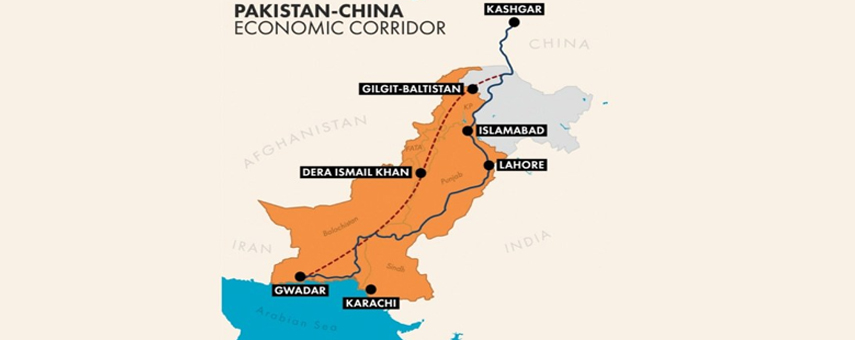
One such investment, making headlines recently, is the China Pak Economic Corridor (CPEC) – China’s largest investment in the country to date. The project is one of the many links joining China’s ambitious (or some may call it over-ambitious) “One Belt One Road” vision for the region.
The CPEC is a 46 billion project announced by the Chinese supremo Xi Jinping that would help Pakistan build highways, develop energy projects, as well as install oil and gas pipelines – all via Chinese companies
PM Sharif recently announced that many sections of Karachi-Peshawar highway under the CPEC would be completed by 2017, whereas a number of associated energy projects would also be completed on a fast track basis in the near future.
The PM also believes that the CPEC could breathe a fresh air of prosperity into the fragile economy of the country, but whether his vision and expectations from the project are met on time, is yet to be seen.
But all is not rosy when it comes to CPEC and the political climate of Pakistan.
Baluchistan and Khyber Pakhtunkhwa provinces have raised serious concerns and reservations over the government neglecting the original route passing through these provinces, and diverting it for regional and political benefits. Moreover, both the provinces believe that any diversion of the original CPEC route is primarily aimed at giving benefits to the Punjab province at the cost of the smaller provinces.
Such provincial reservations and failure to reach national political consensus could bear serious repercussions for the outcomes of the project.
Imtiaz Gul, a regional expert and director of the Islamabad based think tank Centre for Research and Security Studies, also echoes similar concerns.
In his opinion piece for an English daily, he writes, “Though buoyed by the promise of $46 billion worth of investment, the PML-N government bears a huge responsibility in fostering a national consensus on the CPEC route, and also in expediting construction or upgradation of whatever is necessary to kick-start the work on the CPEC, which has indeed become the envy of many countries in the region.”
Gul also believes that China is sending a strong message to Nawaz and his government that a national political consensus should be reached, and impeding issues be tackled, in order to create a suitable environment for the project throughout the country.
But having said that, the threats faced by both China and Pakistan, in form of TTP and East Turkistan Islamic Movement (ETIM) respectively making possible complications for the CPEC, are also potentially grave and serious.
Where China is concerned about ETIM’s alleged training camps, backed by the local Taliban and Al Qaeda, in Pakistan, Pakistan, on the other hand, has concerns over TTP and Baloch separatists’ possible targeted attacks on the Chinese officials and installations in Pakistan.
One of the CPEC’s strong links in Pakistan is the Gwadar port in Baluchistan province. But even that strong link has its fragilities in form of threats from the Baloch separatists constantly attacking the state apparatus and multinational companies. The rebels have vowed to attack all multinational companies, irrespective of their country of origin, operating in the Baluchistan province.
In March this year, unknown attackers set fire to five oil tankers carrying fuel for a Chinese company working on the Saindak project in Chaghi district.
To make matters worse, Pakistan has constantly accused India over its involvement in the Baloch insurgency, yet has failed to bring substantial evidence on national or international platforms. Khwaja Asif, Pakistan’s defence minister claimed earlier this year that Baloch separatist leaders not only travelled with Indian passports, but also took their directions from the country – claims that were neither affirmed nor rejected.
India, on the other hand, has not only categorically rejected Pakistan’s reservations, but also raised serious concerns over Chinese investments in Gwadar and Pakistan-occupied Kashmir.
In midst of these complications, Baluchistan has also witnessed a spike in terror attacks on the Shia Hazara minority from banned outfits such as Laskhar e Jhangvi, further adding to the miseries of the state and security forces.
It could take years for the government of Pakistan to address issues persisting in the province as the rebels have rarely given any indication of reconciliation or talks with the state.
And before any possible settlement is reached between both the conflicting parties, both CPEC and Gwadar could fail to achieve their optimum potential. Such circumstances could also test and challenge the “all weather” friendship and cooperation of both China and Pakistan.
CPEC could well be a lifeline that Pakistan was long waiting for. Yet, it is too early to speculate whether the project could turn into success or become a white elephant for both the Chinese and Pakistani governments.
Biography of the author: Farooq Yousaf is a PhD Politics Candidate from Pakistan currently pursuing his studies in Australia. He has previously completed his Masters in Public Policy from University of Erfurt, Germany. He also consults Islamabad-based Security think tank, Centre for Research and Security Studies, and occasionally writes for various news and media sources on issues such as counter radicalisation, conflict resolution and regional security. He is specializing in Indigenous conflict resolution and counter insurgency. He tweets at @faruqyusaf and can be reached at farukyusaf@gmail.com
This article first appeared in http://sadf.eu/new/blog/sadf-