



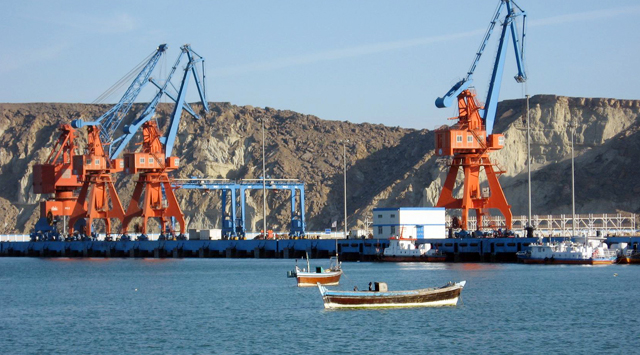
In February this year, Pakistan finally handed over the operations of Gwadar Port, located in Balochistan province, to China. For both countries the deal was business as usual, but for India, the deal rang alarm bells, with Indian defense minister, A.K. Antony calling it amatter of concern[i].
In 2007, during the rule of General Pervez Musharraf, the development and operating rights for Gwadar Port were handed over to the Port of Singapore Authority (PSA) on a forty-year lease. Few had anticipated this decision, given that China had provided eighty percent of the total funding during the first phase of the port’s development.However, Musharraf at the time was mindful of displeasing Washington by giving the lease to China[ii].
Along with the PSA deal came concessions in the form of tax and customs duty exemptions. Still, it took only five years for thePSA to back out of the deal, citing as primary factors a land transfer deadlock and Pakistan’s failure to meet obligations[iii].
Gwadar Port sits just 200 miles from the strategically important Strait of Hormuz ´ one of the most important oil conduits in the world. Given this, China would have long pondered the possible utility of a port that could shorten its oil transport chain. But oil is not the only game here. India, Pakistan’s arch rival and China’s competitive neighbor, has voiced concerns on regional and global forums regarding the Chinese takeover.
Soon after the Chinese takeover, the“China encircling India[iv]“and “China undermining Indian maritime security[v]” theories began surfacing, with media and analysts wrote scores of op-eds and commentaries, accusing China of having military aspirations for Gwadar.
Experts and geopolitical analysts in Pakistan believe the port still has a long way to go before it will be fully operational as an international transit facility. This analysis reflects certain realities on the ground.
First and foremost, Balochistan province is experiencingan ongoing insurgency that began in the 1960s. Pakistan largest and resource-rich province has never received the attention it deserves from Islamabad. Given the insurgency, along with military deployments, sectarian militancy, and frequent infrastructure sabotage, it seems improbable that work on the project will be smooth. For Baloch insurgents, the port is just is another attempt at a “conspiracy” to exploit the region’s resources.
Meanwhile, Pakistan’s Navy holds an important piece of land necessary for the development of Gwadar Port. This land was a major bone of contention for the PSA, and led to its withdrawal from the project. Pakistan Senate recently formed a subcommittee in a bid toresolve the issuebetween the Navy and Balochistan’s provincial government and keep the project moving forward[vi].
Adding to the mix proxy wars and bilateral ties, the growing Indianinfluence in Afghanistan[vii]and interference in Balochistan[viii], as alleged by Pakistan, could also be important factors hindering the port’s progress.
Given all these factors, calling Gwadar a military threat for India is somewhat an overstatement. With the growing insurgency in Balochistan coupled with minimal success against sectarian terrorists, the situation is likely to remain fragile to achieve the status of threat to India.
If Gwadar Port can be developed into a transit facility or an oil pipeline hub for China, that would be a major achievement. Only after that milestone is reached should talk of development of a naval base or an outpost´Pakistani or Chinese ¶ be taken seriously.
Farooq Yousaf, CRSS Analyst
References:
[iv] http://www.energytribune.com/74635/encircling-india-chinas-south-asia-string-of-pearls#sthash.71gAFZ68.GQjQFcCk.dpbs
[v] http://maritimesecurity.asia/free-2/sea-lines-of-communication/chinas-submarines-in-indian-ocean-worry-indian-navy-hindustan-times/
[vi] http://paktribune.com/business/news/Senate-body-for-resolving-land-dispute-in-Gwadar-Port-11495.html