



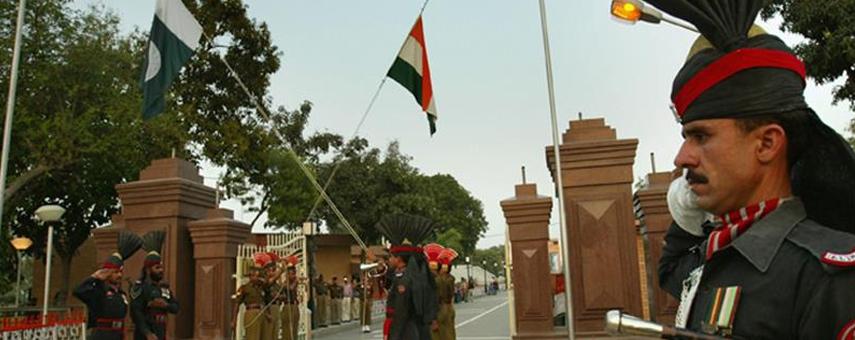
India and Pakistan have been locked into adversarial relations since 1947. The major conflict between the two countries is the territorial status of Kashmir including several sidelining issues that further deteriorated the bilateral relations. The two countries have been part of several pacts, peace initiatives to manage and resolve their conflict, however, none of the peace efforts could bring them nearer to final settlement. Regional and international developments also impacted relations between India and Pakistan and both were part of various international alliances in cold war era. In post cold war times, the two countries acquired nuclear weapons in May 1998 and since then Kashmir was declared as nuclear flash point. It is therefore needed to encourage India and Pakistan to seek common grounds for better peace prospects in the region. The paper caters a historical survey as well as analysis on India – Pakistan confidence building measures (CBMs) and also suggests future prospects for peaceful co-existence. It also outlines why few agreements could not save the two countries for preceding acrimony and did not serve the purpose ofresolving Kashmir conflict once for all.
Introduction
South Asia has a history of interstate and intrastate conflicts, troubled neighbourhood, internecine struggle and movements within the countries, peace deals, confrontational and cooperative environment and, in very recent past, the end of 30 years of guerilla war in Sri Lanka. At inter-state level, the region bears historic animosity between India and Pakistan. The central issue of their bilateral conflicts is Kashmir over which they fought three major wars (1948, 1965, and 1971) and several low intensity military confrontations (most importantly Siachen 1987 and Kargil in 1999) since 1947. Their overt nuclearization in 1998 had declared Kashmir as a nuclear flash point, which is termed by international community as a threat to regional and world peace. Several measures were taken by India and Pakistan and momentarily built hopes for settlement of their differences, however none brought final resolution.
The Composite Dialogue took place between India and Pakistan in 2004 – 08,
South Asian Studies 31 (1)
brought higher hopes to the region in the initial phase. The dialogue continued for four years and brought some progress on issues such as resumption of communication links such as air and railways, talks on trade and investment, cultural exchange etc. Hence, with the tragedy at Mumbai on 26 November 2008 and Pakistan’s alleged role, composite dialogue was discontinued for some time. The deadlock after Mumbai attack was unlocked with the proposal of Secretary Level talks by India to Pakistan in early 2010. It was also clearly stated by the Indian leadership that the proposal was just a diplomatic move, should not necessarily be termed as “resumption of composite dialogue”. Indian Foreign Secretary Nirupama Rao said: “the time was not ripe to resume the suspended “composite dialogue, but “we will keep this channel of communication open” (Haran, 2010). The mistrust between the two South Asian powers has been lingering in the back drop of Mumbai attacks and subsequent internal chaos of
Pakistan due to militancy and India’s reluctance to resume dialogue further reduced the chances of cooperation or mitigation between India and Pakistan. Sustaining confidence building process is rather a herculean task than initiating a totally new one. The phenomena of CBMs is largely misunderstood as ‘war-time’ measures. CBMs are more workable in peace times to bring adversaries closer to establish cooperative security. The sole purpose of conducting CBMs is not only to sign and implement an agreement but to keep communicating till consensus is built and trust is obtained to proceed further. A purposeful set of CBMs entails efforts and initiatives that help parties to open up and continue communication, bringing a good level of trust in the relationship and promising sustainability of the measures in future. In case of India and Pakistan, the main challenge remains for them to re-initiate confidence building process and then transform that into a ‘sustainable and target oriented’ peace process. The sustainability of such dialogues between India and Pakistan has always been risky due to the role of peace spoilers on both sides. The two countries need to adopt an approach that doesn’t encourage disruption or discontinuation of the existent peace process for any reason or event.
The paper dwells upon the following:
- Outlining the existing measures to build trust between India and Pakistan. A chronological survey has been given on the measures taken by two countries to build trust for peaceful management of their differences.
- A comprehensive analysis on the CBMs in South Asia comprising implementation of the measures.
- Recommendations for CBMs with future prospects to prepare grounds or lay foundation for sustainable conflict management and resolution between India and Pakistan.
Chronological Survey of the Initiatives between India and Pakistan
The total number of initiatives to engage the two countries through trust building measures officially and unofficially are as follows (Hussain, 2003):
Read full analysis here.
Disclaimer: Views expressed in the article are not necessarily supported by CRSS.