



Engineer Arshad H Abbasi and Imtiaz Gul
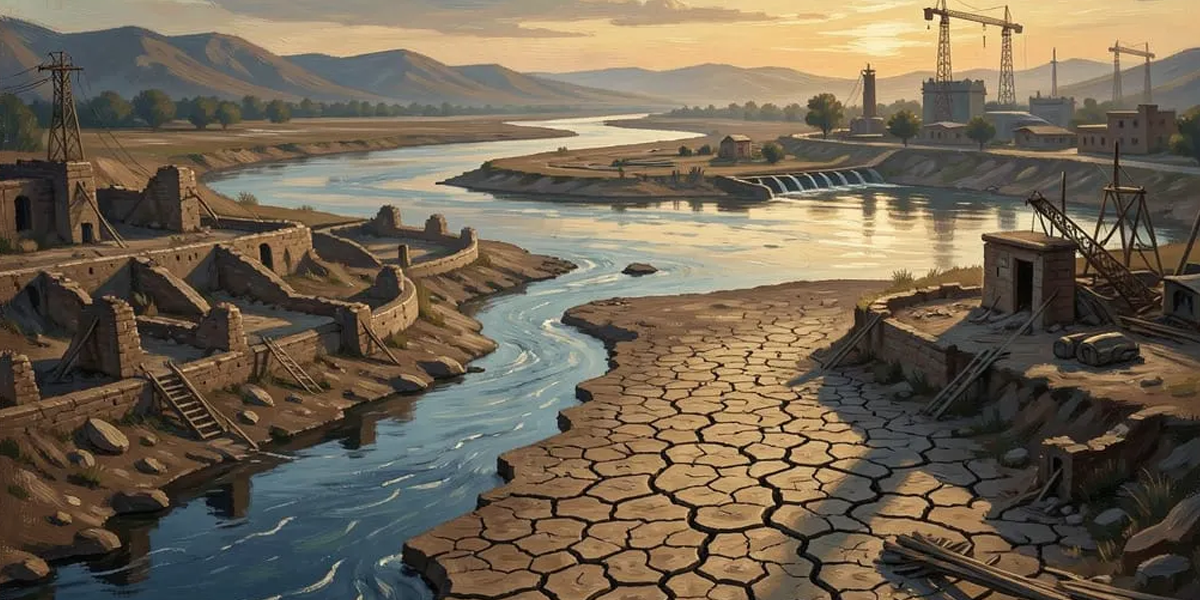
Born from one of the world’s most successful examples of international water diplomacy, the Indus Waters Treaty enabled the construction of the infrastructure that powered Pakistan’s economic rise. As debates over the treaty intensify, this article explores both the extraordinary achievements of the Indus Basin Project and the costly erosion of the vision that once transformed Pakistan’s future.
In 1951, Eugene Robert Black, President of the World Bank, looked at the newly partitioned subcontinent and saw not a territorial dispute but an engineering problem — and an opportunity. The Indus River system, the lifeblood of South Asia’s most productive agricultural plain, had been severed at Partition like a vital artery. India controlled the headworks. Pakistan depended on the flows. The standoff was inching toward war.
Inspired by a bold proposal from American engineer David Lilienthal — the architect of the Tennessee Valley Authority — Black mediated across nine painstaking years of diplomacy. The result was the Indus Waters Treaty of 1960. It remains, to this day, the most durable water-sharing agreement in human history — surviving three wars, nuclear standoffs, and sixty-five years of enmity.
What followed was not merely a legal settlement. It was the economic birth of modern Pakistan. Under the Indus Basin Development Fund Agreement, an international coalition mobilized USD 566 million in external funding: the United States contributing USD 247 million, Germany USD 126 million as an outright grant, the World Bank an USD 80 million loan, Canada USD 22.1 million, the United Kingdom USD 20.86 million, Australia USD 6.97 million, New Zealand USD 1 million — and India USD 62.06 million. The World Bank did not write a check and walk away. It supervised the design and execution of one of the most complex hydraulic programs in history: two storage dams, six barrages, eight inter-river link canals, drainage networks, roads, and bridges — all delivered on time, within budget, without corruption.
Mangla Dam stands as permanent proof of institutional competence. Construction began in 1961; the dam opened in 1967 — six years, on schedule, at a cost of USD 1.5 billion. Designed by a British firm and built by eight American firms led by Guy F. Atkinson, Mangla created a reservoir of 5.88 million acre-feet on the Jhelum River — transforming Punjab’s soils into some of Asia’s most productive farmland.
Then came Tarbela Dam. Construction began in 1968 on the Indus River, with minimal heavy machinery, in terrain that demanded access roads before foundations. Tarbela delivered the world’s largest earth-filled dam in 1976: eight years, no cost overrun, no delay. The feat was comparable, in sheer logistical complexity, to the construction of the Hoover Dam.
The Indus Basin Project did not merely build dams. It built an economy. Pakistan’s GDP growth rate in the decade following completion of Tarbela Dam averaged above 7 % per annum — among the highest sustained rates in Asia at the time. This was not a coincidence. Cheap, reliable hydroelectric power reduced the cost of industrial production. Regulated water supply eliminated the rainfall-dependency that had kept agriculture subsistence-level. The multiplier effect of canal-irrigated farming flowed through every sector: processing, transport, exports, and employment.
Agricultural land expanded from 11.7 million hectares in 1947 to 27.3 million hectares by 2007 — a 133 % increase driven almost entirely by the irrigation infrastructure of the Indus Basin Project. Pakistan transitioned from a food-importing nation to net exporter of cotton, rice, and wheat, earning the foreign exchange that financed a generation of industrialisation. Tarbela Dam alone, by assessments current to June 2025, has generated over USD 460 billion in cumulative economic value — through hydroelectric generation, regulated irrigation, and flood control. The full Indus Basin Project is also the mother of the 1,450 MW Ghazi Barotha project, the 184 MW Chashma plant, and Tarbela’s extension projects delivering a further 1,410 MW, represents the single most productive investment ever made in Pakistan’s territory. Today, 78 % of Pakistan’s hydroelectricity and 95 % of its water storage trace directly to that original World Bank commitment.
Eugene Black, addressing the Bank’s executive directors on April 18, 1960, stated: “Water reservoirs are indispensable for energy and food security.” He was not making a policy suggestion. He was writing Pakistan’s economic future in advance.
How Pakistan Forfeited the Legacy: The betrayal of the Indus Basin legacy is not rhetoric — it is a quantifiable engineering and economic failure.
Neelum-Jhelum Hydropower Project, rated at 969 MW, has been effectively abandoned since 2022 following the discovery of severe design faults and the use of substandard construction materials in the tunnel lining. Diamer-Bhasha Dam, inaugurated with ceremony by President Pervez Musharraf in January 2006, had not completed abutment and foundation pit excavation by the beginning of 2026 — twenty years after its inauguration. Compare: Tarbela and Mangla Dams, with 1960s machinery and no GPS, no digital modelling, no global supply chains. Bhasha, with every modern tool available, cannot complete its foundation in two decades.
The cause is structural, not incidental. From the 1990s onward, Pakistan systematically shifted power generation from hydropower — carrying near-zero marginal fuel cost — to coal, furnace oil, and LNG plants, driven by short-termism, vendor lobbying, and institutional corruption that made Pakistan a global begging bowl.
The WAPDA House in Lahore — completed in 1965, still among Pakistan’s finest public buildings in material quality and architectural discipline — is the last standing monument to that era. Pakistan has not built its equal since.
India cannot suspend the Indus Waters Treaty in April 2025, as there is no unilateral exit clause. India shouldn’t forget that legitimate fact that treaty is multilaterally funded public infrastructure. The Indus Basin Development Fund received outright grants — not recoverable loans — from Germany, the United States, Canada, the United Kingdom, Australia, and New Zealand. These nations did not grant money to India or Pakistan bilaterally. They contributed to a permanent multilateral fund held by the World Bank, for the express purpose of constructing replacement works that made the water allocation regime physically operational. The 19 barrages, eight link canals, and two storage dams built under this fund are international public works financed by public treasuries of sovereign states. Before India diverts water from the Chenab to the Ravi or Beas — rivers that belong to Pakistan under the treaty — it must answer to the citizens and governments of every country that financed the infrastructure upon which that allocation was premised. India does not have the legal or moral authority to redirect those rivers without the consent of those donor nations, whose grants were made in exchange for a permanent, treaty-bound hydraulic order. India’s USD 62.06 million payment into the Indus Basin Development Fund was not voluntary foreign aid. Having received and exercised those rights for sixty-five years, India cannot now repudiate the reciprocal obligation that was purchased with that payment. In any legal forum — the Permanent Court of Arbitration, the International Court of Justice, or the World Bank’s own dispute mechanism under Annex G of the treaty — India’s own financial contribution would stand as evidence of its binding acceptance of Pakistan’s water rights.
The Indus Basin Development Project also constructed 19 barrages and headworks, and an extensive system of link and distribution canals, engineered precisely to the flow characteristics of the Western Rivers as allocated in 1960. The rivers flow as they flowed then. The engineering works function as they were designed to function. There is no hydrological basis, no force majeure, no changed circumstance that legally justifies altering the allocation regime. Any diversion from the Chenab would constitute not merely a treaty breach but physical destruction of the economic and agricultural foundation of 220 million people.
The Indus Waters Treaty is not India’s concession to Pakistan. It is a multilateral covenant — conceived by an American, financed by seven nations, and ratified in international law. Before India touches those rivers, it must first ask its own people whether they wish to repudiate a treaty their government signed and funded. Then it must ask the people of Germany, Australia, Canada, the United Kingdom, the United States, and New Zealand whether they consent to the nullification of the infrastructure their taxes built. The answer, in every capital and every court, would be the same.