



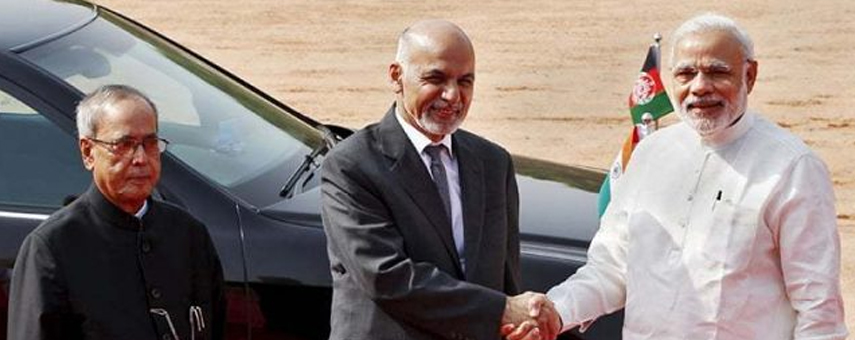
President Ashraf Ghani made an unexpected visit to India on the Eves of Eid-ul Adha to meet Prime Minister Narendra Modi. After the meeting, Indian Prime Minister pledged an astounding one billion dollar in economic aid to Afghanistan. This tightening ties between the two countries is in a serious of sequences that has begun with President Ghani vision of investing in regional cooperation rather than relying solely on the so called international community. But cozying up to India at such a critical era at the expense of jeopardizing relation with Pakistan is not a wise policy decision. Modi is no messiah and his Agenda for Afghanistan must be critically assessed and cautiously approached.
Modi’s India is in the mildest of economic progress and the steady growth of incomes to what might be called nationalists patriotic mobilization. Critics of Modi believe that in the last two years since he was elected Prime Minister, his stock of political capital has fallen considerably at home. It is increasingly becoming clear that his hyper-promises in the campaign are no longer attainable, as such an outright looking hawkish foreign policy can serve as a timely scapegoat for Modi and his party.
The critics argue that Modi’s India has been revealed to be at a depressing stage on which the demons of religious bigotry and hyper-nationalism hover unsleepingly over the vital debates of a society in transition. In the view of Chandrahas Choudhury, Hindu nationalism, an organized political force is actually the spiritual parent of Bharatiya Janata Party which Modi first joined as a teenager. Hindu nationalism holds that Hinduism is the real unifying thread of the Indian past, and the Hindu way of life should continue to be the motor that stabilizes and drives the present.
Being hammered at home by his opponents, Modi tries to gain on his foreign policy, thus, India’s pivot east will redefine regional politics. Narendra Modi is thinking of “Act East” policy, replacing the previous government’s “Look East” policy. According to Modi, “Rapidly developing India and Association of Southeast Asian Nations (ASEAN) can be great partners for each other,”. Speaking in November 2014 at the annual summit of the Association of Southeast Asian Nations “We are both keen to enhance our cooperation in advancing balance, peace, and stability in the region.” Given these stakes, he has chosen to manipulate Afghanistan as a podium to his own ends. For Modi, Afghanistan is an important part of ideological regional project against Pakistan, rooted in deeply held beliefs. Therefore, in a calculated approach on three occasions over Afghanistan case he has tried to provoke Afghan’s anti-Pakistan sentiments.
In December 25, 2015, in his inauguration speech of the Afghan Parliament building donated by India, Modi said, “I stand here, on behalf of 1.25 billion friends in India, in admiration for your achievements, in gratitude for your friendship and in solidarity for your future.” He continued, “Over the mighty Hindu Kush and through the forbidden Khyber Pass, monks, merchants and monarchs have linked us through knowledge, culture, religion, commerce and kingdoms”. Later on at the Afghan Salma Dam inauguration in Herat, he promised Afghans in a speech televised live on major Afghan stations. “India will not forget you or turn away. Your friendship is our honour; your dreams are our duty.”.
PM Narendra Modi on Wednesday June 8th 2016 went so far as to talk for Afghanistan in Washington and reminded the US Congress that Afghans are appreciative of the US support, “Afghans naturally recognize that the sacrifices of American have helped create a better life.” He added in his speech that India too has made an enormous contribution and sacrifices to support our friendship with Afghan people. A commitment to rebuild a peaceful, and stable and prosperous Afghanistan is our shared objective.”. By the same token he indirectly attacked Pakistan saying “I commend the members of the U.S. Congress for sending a clear message to those who preach and practice terrorism for political gains.”
From Modi’s rhetoric on Afghanistan, it is not difficult to read his overarching strategic nationalist agenda. The circumstances around the World, particularly in the region command on Afghanistan to make a wise choice between Modi’s rhetoric and realities on the ground. India traditionally follows a progressive conservative approach towards Afghanistan. Historical experiences have shown that despite warm and usual rhetoric statements since its partition India always has tried to be a good friend in distance with Kabul, even during the 1980s when its rival Pakistan had substantive military engagement in Afghanistan.
Therefore, to locate itself in the Asians calculations, Afghanistan must not let India to use the plight and circumstances in the country to gain victory over its rival, but instead Afghanistan needs to work to balance its relations with both Pakistan and India for peace. Today it is clearly visible that Afghanistan has reached the nadir of its destruction. A peaceful and prosperous Afghanistan is an essential recipe to Asian growth. Kabul must certainly do its part. The first and foremost is to balance its relations with its neighbours as well as with the World and regional powers. It seems President Ashraf Ghani has realized this by making his first official visit to Beijing, not Washington. The narrative of the Afghan president is largely framed in an Asian future. Negotiating peace with Taliban with thorough Pakistani engagement was a smart choice and still remains the only viable option. The problem is that the government in Kabul is a direct product of the last 14 years of Western domination and close to India. The regime must win the trust of its neighbour states and India must not be the only neighbour especially an India under Narendra Modi.
This article originally appeared on www.pajhwok.com. Original link.
Disclaimer: Views expressed in the article are not necessarily supported by CRSS.