




Positive Messaging Essential to Help Complex Afghan Peace Process: Foreign Secretary
Pakistan’s foreign secretary Aizaz Ahmed Chaudhry says the speed with which the Quadrilateral Coordination Group (QCG) has moved reflects the commitment of all stakeholders to the Afghan peace and reconciliation.
In a meeting with the Afghan members of the civil society, currently visiting Pakistan as part of the Beyond Boundaries – Pak-Afghan Track II/1.5 initiative undertaken by an Islamabad based Center for Research and Security Studies (CRSS), the chief diplomat said that Pakistan believes in a sovereign, united, prosperous, peaceful Afghanistan. This is in the interest of the entire region and that is why Pakistan together with the US and China is doing its best to help Afghans achieve the goal of peace and stability.
“Hope and faith in the process as well as in Pakistan’s sincerity in the peace efforts will work better than continuous blame-game and skepticism”, Mr. Chaudhry added while underlining that you could inspire confidence only by staying positive.
“Pakistan has developed a complete national consensus to counter-terrorism. The state of Pakistan is determined to deal with all those militants across the board who are killing innocent women and children both in Pakistan and Afghanistan”.
With regard to peace process in Afghanistan, the foreign secretary said “We must, sequence the process and take a step-by-step approach rather than coming up with pre-conditions by either side in an extremely complex and difficult process”. Pointing to the aggravated security situation, factional divisions and emergence of Daesh, Mr. Chaudhry said these factors posed big challenge to the QCG process but hoped that given the resolve of all four countries, they were not insurmountable.
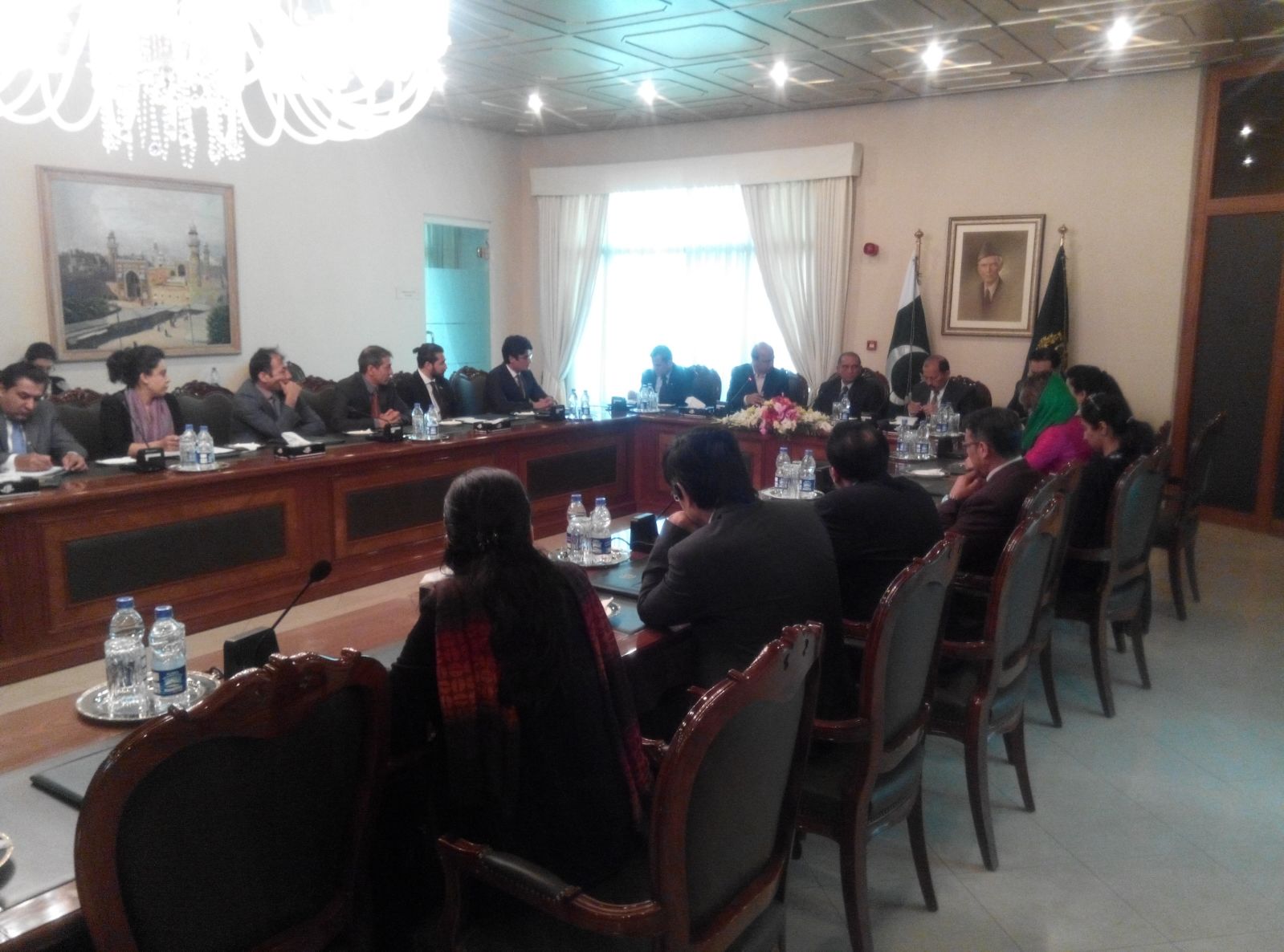
The foreign secretary also gave the Afghan delegation a run-down of the QCG meetings held so far and hoped its concerted efforts would result in direct intra-Afghan talks sooner than later. In that context, he underscored that the positive messaging by all stakeholders was essential to help improve perceptions. This will also help the respective governments to move in tandem in the reconciliation process and neutralize the impact of spoilers. He also expressed the hope that the Afghan civil society and the media would play their role in making the peace efforts successful.
The Afghan civil society delegation also met with the scholars from US who were the members of U.S.-Pakistan Interreligious Consortium (UPIC); an initiative to build relationships, shatter stereotypes and, together, create and implement an action agenda that seeks to reduce tensions between the two countries. They were in Pakistan for the US-Pakistan Leaders Forum sponsored by Intersections International in New York; holding their third annual conference. CRSS played a crucial role in facilitating a rich and deep engagement of UPIC’S American delegates with both Pakistani and Afghan civil society thought leaders. The encounter over a working lunch enabled the American delegates to have both frank and candid discussions about stereotypes of each other’s societies, as well as brainstorming about ways to rectify the misconceptions – and cooperate on an array of development and security issues that would improve the lives of Afghans, Pakistanis, and Americans. There was consensus among all the delegates, from all three countries, that there were concrete ways to promote peace and tolerance in their societies – and that these working groups should continue to sustain a dialogue that could result in practical initiatives significantly altering the status quo for the better.
Robert Chase, the lead UPIC delegate, commended the Beyond Boundaries initiative of CRSS as a tool for message multiplication and said this was exactly why the American scholars were visiting Pakistan. Other members also explained how important a people to people dialogue was for creating greater understanding, and promoting values of tolerance, rule of law and inclusive governance.