



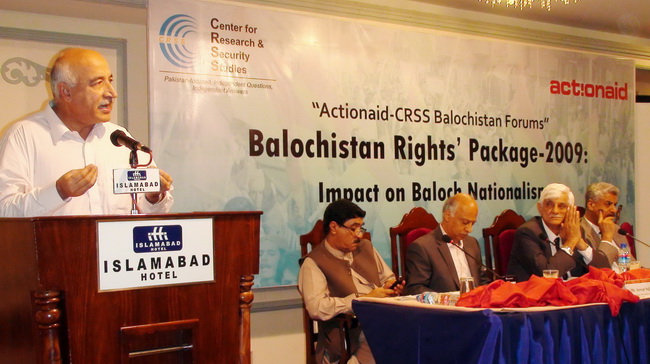
 Let the Baloch People Decide their Destiny
ISLAMABAD: Tuesday (November 29, 2011) : Two years after the prime minister had announced the Balochistan Rights’ Package, most of the Baloch people continue to dismiss it as a “joke and an insufficient” initiative. What precedes such packages is restoration of trust and consensus on some of the fundamental issues that constitute the core of conflict in a particular region of the country. These views came through in most of the speeches at a seminar held to review the impact of the Balochistan Rights– Package. Politicians and civil society members spoke in unison while underlining that the Rights’ Package had miserably failed in changing the status quo in the province where the security establishment continued to call the shots , with little role in decision-making for the political leadership.
PML-N lawmaker, and former governor of Balochistan, Lt. Gen. (retd.) Abdul Quadir, Senator Dr Abdul Malik Baloch of National Party, former PPP senator Taj Haider and Dr.Assem Sajjad were among prominent speakers at the organized by the Center for Research and Security Studies (CRSS), Islamabad and Actionaid-Pakistan, as part of their campaign to raise awareness among masses about the status of implementation of Balochistan Rights– Package. The seminar also coincided with the second anniversary of the announcement of Balochistan Rights– Package, which is also called Aghaz-e-Haqooq-e-Balochistan Package.
Addressing the participants, Qadeir Baloch observed that the roots of Baloch nationalism lie in partition of British India. He underscored that the imposition of state authority over Khan of Kalat in 1948 through bullet sowed the seeds of disillusionment among Balochs towards the federation. He noted that it is travesty of fairness if one blames Baloch sardars for the backwardness of Balochistan. Alluding to an interesting fact, he said that 71 out of 74 Baloch sardars were with former President Musharraf, and despite that he failed to deliver in Balochistan, and ended up creating more mess. Rather, he stressed that it is sardari mindset and not sardars are impeding progress of common people in Balochistan and this trend is wrecking havoc throughout the country. He proposed that someone from academia, civil society or media should come forward and conduct an investigative study to ascertain the causes and factors, ‘which kept Balochis out of national arena and forced them to take up arms against the federation.’ Balochis want to be treated on parity basis like other Pakistanis and want control over their land and resources, he accentuated. He observed that ‘political role of military is a dilemma’ for Pakistan.
Highlighting the pivotal cause of Balochis discontentment towards the federation, PPP leader and Senator Taj Haider said ‘there is always problem with a relationship except the one based on love and trust.’ He pointed out that the only option the PPP government had was to go for reconciliation, rather than confronting the disgruntled Baloch people. He underlined that currently the issue between the federation and the province is of distrust. He said Balochis were always accommodative in their conduct and approach towards the federation: the approval of 1973 Constitution and the role of Baloch Ghaus Bakhsh Bizenjo in making it possible is instructive fact. He underscored that the creation of law and order situation in the province and ‘subsequent deployment of heavy security contingents is being done out of ulterior motives and vested interests.’ Senator Haider highlighted: ‘the political realization is essential for addressing Balochistan issue.’ He noted that no economic package can be alternative for political blunders, and therefore the state should initiate political reconciliation process in Balochistan and all the stakeholders should be taken on board. He proposed that the government of Pakistan should adopt legal measures to address the fears of Baloch people, like mass migration of non-Balochis towards Balochistan. He said that it can be achieved only during democratic set up and we all should support the continuation of democratic set up in Pakistan.
Shunning the politics of packages, Senator Dr Abdul Malik Baloch of National Party, Balochistan said ‘Balochis are worried about their identity, and they don–t want economic packages’. He said that the state should reread history before imposing its will on Balochis: they were never part of British India. He said that we will never be a part of ‘Khecheri (obscure) nationalism’ while we want to uphold and preserve our own ethno-national identity. He blamed the state for looting and plundering of Baloch resources. He stated that former President Musharraf tried to put Gawadar under federal control, 125 property schemes were launched in 25 days in the area and the land was sold out within days. He observed that this colonial model of governance and its not going to work in 21st century. ‘Balochis resisted Martial Laws and bore the brunt for not subduing before the military dictators’, he narrated.
Dr Aasim Sajjad Akhtar of National Institute of Pakistan Studies, Qauid-i-Azam University said that the talk of economic packages does not make sense in the absence of political rights. He observed that even the announcement of hundreds of Balochistan Rights– Packages will not make any difference on the ground in the ill-fated province, if the issues of provincial autonomy, control over resources and administrative freedom are not sorted out. ‘One state institution is working with impunity in the province and it is regrettable that it is continuing even when there is democratic government in Pakistan’, he lamented. Mr. Anwar Sajidi, editor-in-chief, Daily Intekhab, Quetta said that the federal agencies are governing Balochistan as a sensitive security zone and there is no concept of civilian supremacy in the province. He said ‘the wave of discontentment among Baloch youth runs very high and they are no more willing to fly Pakistani flag.’ He said unchecked influx of foreign immigrants into Balochistan is threatening the identity of Baloch people and the government should check it. Mr. Talha Masood of the Organization for the Development of Youth, Quetta underlined that Baloch youth has no prospects and Balochistan Rights– Package ahs failed miserably to make any difference at the grass roots level. Moreover, disparaging the Balochistan Rights– Package for its failure to address the cultural rights of Balochis, Mr. Sultan Ahmed, program coordinator, Human and Rural Development Organization (HARD) Khuzdar observed that the package did not touch upon the issue of cultural rights of Balochis and it shows the apathy of state towards the protection of identity on Balochis.
Participants at the seminar were wary of the government motives behind the announcement and implementation of Balochistan Rights– Package, since the package has despondently failed to address the long held grievances of Balochis. At the same time, they were critical of the government failure to check the ongoing ‘kill and dump’ operation across Balochistan, where mutilated and torched bodies of missing persons are being recovered from road sides on daily basis. They underscored the need for adopting political solution to address the political issue of Baloch nationalism and the announcement of economic packages is nothing but an exercise in buying more time. In his concluding remarks, executive director, CRSS, Mr. Imtiaz Gul observed that no economic package, but the people themselves can make the difference and change the situation on ground. He said that it is time for the people to stand up for their rights.
Balochistan Rights' Package-2009: Impact on Baloch Nationalism
TOP STORIES
TESTIMONIALS
“Fiscal empowerment, robust trade, and economic connectivity can act as buffer against radicalisation and extremism.”