



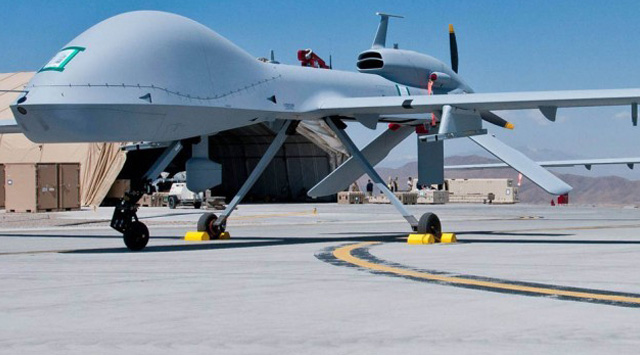

CRSS Role in Anti-Drone Campaign
December 18, 2013 marked an important day in the life of the 193-member strong United Nations General Assembly. On this day, the world body unanimously spoke out against the controversial US drone campaign in foreign territories. The resolution to this effect underlines the culmination of an enquiry that Special Rapporteur Ben Emmerson had launched in Pakistan and Africa a year ago. Mr. Emmerson submitted his report on drones in October 2013.
The comprehensive 28-paragraph resolution, entitled ‘Protection of human rights and fundamental freedoms while countering terrorism’ calls on the United States to comply with international law, and underscores the ‘urgent and imperative’ need for an agreement among member states on legal questions about drone operations.
The unanimous call for regulating the use of remotely piloted aircraft against suspected terrorists was also accompanied by the demand that the US ensure that any measures taken or means employed to counter-terrorism, including the use of remotely piloted aircraft, complied with international law. This includes Charter of the United Nations, human rights law and international humanitarian law.
The text also calls for taking into account relevant UN resolutions and decisions on human rights and giving due consideration to recommendations of special procedures and mechanisms of the Human Rights Council, and relevant comments and views of UN human rights treaty bodies.
The US administration had always made the point that its combat drone campaign inside Pakistan is in line with the rules and regulations of warfare, and that it fully abides by the international treaties governing the use of force. It had based its arguments on the United Nations Security Council (UNSC) resolution 1373, adopted in the immediate aftermath of September 11, 2001. The resolution called upon all states to cooperate in bringing to justice those responsible for these acts of terrorism.
However, a statement of the UN special rapporteur Ben Emmerson rendered these arguments meaningless and against international laws. A look into the US drone campaign inside Pakistan underlines that the US is using disproportionate force against those allegedly involved in terrorist attacks, while also denying them the opportunity of proving themselves innocent at a court of law.
Christof Heyns, another UN special rapporteur on extrajudicial killings, had also stated that the American use of drone strikes to carry out target killings is undermining the international laws put in place to govern the use of force among states in the aftermath of World War II. He further elaborated that some drone strikes “may even constitute war crimes”.
Pakistani Perspective: CRSS Contribution
The latest UN anti-drone resolution also resonates the Pakistani perspective.
The country, where drones have generated heated political debate and added to simmering anti-US sentiment, has been a vocal opponent of the strikes conducted through unmanned aerial vehicles (UAVs) in Pakistan tribal areas. Its permanent representative Masood Khan had pointed out during a UN General Assembly rights committee debate: ‘In Pakistan, all drone strikes are a chilling reminder that reprisal strikes by terrorists are around the corner. Civilians suffered ‘inhumane’ deaths and the strikes had ‘radicalised’ public opinion in Pakistan. We call for the immediate cessation of drone attacks inside the territorial borders of Pakistan,’ Khan had stated.
Part of Ben Emmerson report had come from a field investigation that the Centre for Research and Security Studies (CRSS) had conducted in the affected areas. CRSS had handed the UN envoy 24 cases of ‘innocent victims of drone strikes’ cases where innocent women, children and men became the unintended victims of the drone strikes.
Also, in its security report ‘The Deadly Drone Campaign: A Pakistani Perspective’ CRSS made observations similar to those expressed in the UN resolution. These were based on extensive field studies on the consequences of the drone campaign (For details see State in Turmoil2012 at – Excerpts from the report are also being reproduced below).
The London-based Bureau of Investigative Journalism in October had put the total death toll since the campaign began in Pakistan in 2004 at between 2,525 and 3,613. The Bureau stated that between 407 and 926 of those killed were civilians ´ 16 to 25 percent of the total. Ben Emmerson said in his report that Pakistan had told him that 400 of the 2,200 victims of drone attacks over the past decade ´ 18 percent ´ were civilians.
The CRSS Recommendations
On the basis of the analysis, the following recommendations were offered for attempting to solve the issue amicably and without damaging potential success in the long-term war against terrorism:
The US should cooperate and coordinate more robustly with the Pakistani government in selecting and targeting the suspected terrorists in tribal areas, to give the campaign legitimacy in the eyes of local people and international community.
The US should reconsider its strategy of targeting markets, marriage ceremonies, funeral processions and other religious and cultural gatherings, which cause a deep sense of resentment among local people.
The US should initiate independent investigations into drone strike deaths, consistent with the calls made by human rights organizations and UN Special Report on the promotion and protection of human rights and fundamental freedoms.
In conjunction with robust investigations and, where appropriate, prosecutions, compensation programs should be established for those whose lives and property are damaged.
The US should fulfill its international humanitarian and human rights law obligations with respect to the use of force, including restraining the use of lethal force against individuals who are not members of armed groups, or otherwise against individuals not posing an imminent threat.
The media should cease the common practice of referring simply to militant deaths, without further explanation similarly, it should refrain itself from over-sensationalizing in the event of every drone attack, risking further rifts in its own society.
Background
In June 2004, the US had launched a missile strike against Nek Muhammad, a Pakistani Taliban commander, who had announced his support for Al Qaeda. Witnesses reported that the missile was fired from a drone circling overhead, but the Pakistani military denied any US involvement, instead taking credit for the operation. Today, this is remembered as the first US drone strike in Pakistan. The ease with which the most feared Taliban commander was eliminated set a new course for counter-terrorism campaign in the area.
Although the Bush administration started the drone campaign in Pakistan, it was very cautious in selecting targets to avoid political backlash and civilian casualties. This led to the implementation of ‘personality attacks’ whereby it was essential that the target of a drone attack should be a renowned Al-Qaeda leader, operative or a Taliban commander.
During 2004-2008 only 52 drone strikes were recorded inside Pakistani territory in which the targets were identified as `terrorists’. However, the civilian loss, like the attack on a religious seminary (Madrassa) in Damadola killing 83 people, resulted in a huge outcry in Pakistan and around the world. Similarly, an attack on a local Jirga (traditional and revered Tribal gathering) in North Waziristan Agency in 2011, killing scores of innocent civilians resulted in scathing criticism from Pakistani leadership and people.
Remaining restricted under Bush administration (2002-2007), the drone campaign expanded during Obama’s administration, to include far more `profile’- or so-called `signature’- strikes based on a `pattern of life’ analysis.
According to US officials’ privy to the drone campaign, these strikes targeted groups of men who bore certain signatures, or defining characteristics associated with terrorists, but who have not been identified as known terrorists . Needless to say, such attacks caused large scale civilian casualties.
Overall, there have been between 2,593 and 3,365 casualties in these drone strikes. These have been concentrated in South and North Waziristan agencies, which border Afghanistan. According to estimates, between 474 and 884 civilians were killed in these attacks; 176 of these casualties were children
Intensification in drone campaign inside Pakistan in recent years has met with an international outcry, local anger, calls for more transparency from international bodies like the United Nations, as well as non-governmental organizations like Amnesty International, Human Rights Watch and others.
The drone strikes reshaped and redefined the nature and conduct of future warfare, and rapidly shifted the balance in favour of the states which possessed drone technology. At the same time, using drones as part of military strategy set a dangerous precedent which other states such as India, China, and Russia (who have conflicts with their neighboring states) could emulate.
Similarly, combat drones ushered in an era of `disengaged’ wars; it is now possible for a state to be involved in a war without any direct threat to its homeland, and minimal casualties to its ground troops. It is also divorcing the dimension of political cost from a conflict, which can sometimes serve as a factor in determining the length and intensity of a conflict.
The fundamental question is about the legitimacy of the use of force and ‘remote’ target killing by a state inside a country whose state actors are officially, or otherwise not at war with that particular country.
There are several legal and ethical concerns that need to be addressed in connection with drones, including the US President’s controversial direct role in approving targets; the shift towards considering the presence of any fighting-age men as a ‘signature’ of terrorist activity and therefore a valid target; and the extrajudicial killing rather than the capture of suspects, thereby undermining traditional norms of justice.
Moreover, the US has intentionally kept the drone campaign, and the nature of its relationship with Pakistan in conducting and coordinating this campaign, secret.
However, it is evident that this campaign is clearly undermining Pakistani domestic law. According to the Pakistani constitution, any bilateral agreement cannot be between two individuals or individual organizations; rather it should be on state-to-state level fulfilling all the legal and constitutional requirements.
Although, the number of drone strikes in 2013 went down to about two dozen (compared to twice the number in 2012), the issue remains a source of big embarrassment for the government. Due to its heavy reliance on the US for economic aid and domestic political legitimacy, the government cannot explicitly condemn these attacks. Neither can it afford to publicly admit its helplessness vis a vis the US high-handed approach on these issue. Any direct action such as shooting down the Reaper drones may invite direct US-NATO intervention on one or the other pretext. Practically, the hands of the Pakistani government are tied both politically as well as economically.
On the other hand, the government of Pakistan is also under extreme pressure from media and many civil society organizations, to adopt a more aggressive stand on this issue. It is interesting to note that the failure of the civilian government in forcing the US to stop these attacks makes it complicit in the eyes of local people and political opposition.
Drone strikes in Pakistan are hugely contributing in bringing the right wing political and religious parties together, as the government draws flak from all around for its alleged duplicity i.e. protesting drones in public and accepting/appreciating them in private. The partial suspension of the US-NATO cargo via Pakistan also represents the right-wing, nationalist sentiment against drones. Pakistan Tehreek-e-Insaf (PTI) and Jamaat-e-Islami, lead partners in the coalition that rules the volatile northwestern Khyber Pakhtunkhwa province adjacent to the tribal regions between Pakistan and Afghanistan is also rooted in the opposition to the drone strikes. Both parties are demanding an end to the drone attacks. Even the Tehreek-e-Taliban Pakistan, the militant group behind the terror campaign inside the country, also uses drone strikes as a pretext for not responding to government talks offer.
As a whole,the alliance of the right also restricts the space for those moderate and liberal political quarters who are pleading for a more collaborative US-Pakistan anti-terror framework instead of the unilateral American pursuit of terrorists in the Pakistani border regions through drones. The deadly campaign is regarded as an unjust and disproportionate use of force by US in violation of Pakistan territorial sovereignty. At the same time it is also fueling anti-Americanism, which works to the detriment of not only the government of Pakistan but also undermines even well-intended economic aid that comes from the United States and its major NATO allies.