



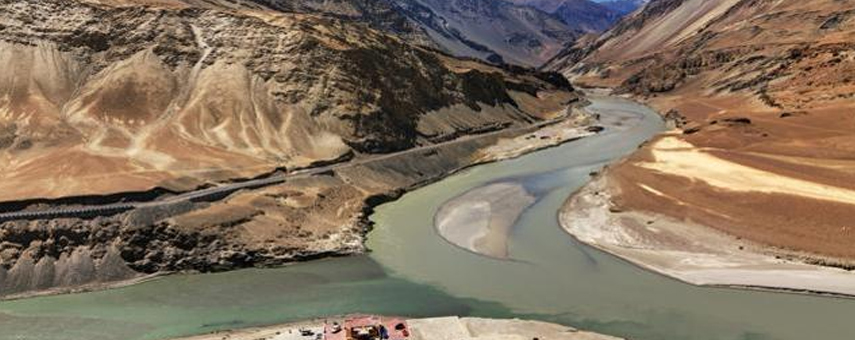
As the government reviews the Indus Water treaty , it would do well to remember that the water sharing arrangement and the Rann of Kutch agreements that have both stood the test of time and wars, were both negotiated by a third party. While the World Bank helped India and Pakistan with Indus, the UK played a role in solving the border dispute over the salty marsh lands.
As India and Pakistan spar once again, over the unrest in Kashmir and the terror attack at an army camp in Uri, should New Delhi redraw its redlines and opt for a mediator?
As a keen watcher of the Kashmir conflict, I’d make the case that a third party makes maximum logical strategic sense.
Here’s why.
It is in India’s interest to engage Nawaz a third party for several reasons. First, Pakistan reiterates its demand for third party mediation on Kashmir and thus would be hard-pressed to reject this approach. Speak to senior Pakistani diplomats and bureaucrats and they will concede privately that were such a process to start, the outcome would evolve towards the view that the Line of Control (LoC) be made the international border.
India has everything to gain and Pakistan more to lose in the event of third party involvement. President Bill Clinton virtually endorsed the LoC as an international border when, he said in Islamabad in March 2000, soon after the short but sharp war in Kargil that, “History will not reward those who try to forcefully redraw borders with blood.”
Bilateral talks with Pakistan are unlikely to transform the LoC into an international border. Talks with Pakistan and a third party are likely to be more effective in clarifying the unreality of Pakistan’s stated goals for Kashmir. It would not be difficult for Indian government officials to defend third party involvement politically. Indeed, it would be easier to generate public support for third party involvement than for a resumption of the bilateral dialogue that hasn’t seen much progress since the Mumbai attacks of 2008.
Contemporary history shows that America does not hesitate to bring itself into the South Asia picture when it perceives that to be necessary. It was evident during the Kargil war when Clinton summoned Sharif to Washington and asked him to withdraw his troops from the snow-clad heights.
Post-Kargil and in the aftermath of the Mumbai attacks in which American citizens were killed, India should feel more confident about Washington being a prospective third party. India needs no reminder to the direction in which the US tilts when it comes to the issue of state-sponsored terror. Not after Osama-bin-Laden was snuffed out of hiding in Pakistan’s Abbottabad from under the military establishment’s nose.
There are of course, various forms of mediation. A smaller country could host such an effort as Oslo did for the Middle East peace process. Special envoys—trusted people appointed by the Indian and Pakistani governments respectively—could meet in Norway, a safe distance away from the pressure of politics and hawks. Given the difficult nature of the Kashmir dispute, any likely settlement would need to be underwritten by the United States for it to stand the test of time. This is possible only if India addresses the unrest in Kashmir and takes positive steps to deal with the large-scale Kashmiri sense of alienation.
Some important questions remain: Would the ISI and the Pakistani Army give up their “bleed India” policy even if a facilitator manages to help negotiate the conversion of the LoC into an international border?
Well, the chances of their doing so are greater if a third party raises the costs of non-compliance and if India establishes its willingness for a settlement that restores greater powers to the state and addresses the issue of Kashmiri alienation. By doing so, India would also strengthen its international position in the event of subsequent Pakistani non-compliance.
Dawn News adds
In its anti-Pakistan rhetoric following Islamabad’s recent diplomatic effort to highlight the Kashmir issue, the government of Indian Prime Minister Narendra Modi has been whipping up ideas to scrap the Indus Waters Treaty (IWT) of 1960 to cause irreparable economic loss to the lower riparian.
While such a move could be labelled as a ‘hostile act’ and attract international criticism, India has the capability to increase the use of waters flowing into the Indus, Chenab and Jhelum rivers. It can also build more reservoirs in India-occupied Kashmir as a double-edge weapon.
Signed by President Ayub Khan and Prime Minister Jawaharlal Nehru in Sept 1960 and brokered by the World Bank, the treaty set bilateral principles of water sharing between the two nations. Under the provisions of the treaty that also survived the 1965 and 1971 wars, the waters of the eastern rivers — the Sutlej, Beas and Ravi — had been allocated to India and the western rivers — the Indus, Jhelum and Chenab — to Pakistan except for certain non-consumptive uses.
Dawn News spoke to Ahmer Bilal Soofi, a former federal law minister, President Research Society of International Law and an advocate in the Supreme Court on the issue.
According to Mr. Soofi, “India has no legal competence under the treaty to revoke it per se on its own. Article 12(4) of the treaty entitles the termination of the treaty only if both India and Pakistan agree in writing. In other words, a termination treaty has to be drafted by both states and then ratified by both, to bring the IWT to an end. The treaty has no provision for unilateral “suspension”. It is of an indefinite duration and was never intended to be time-specific or event-specific.
The IWT is not regime-specific — but rather state-specific. It will not expire with regime change. It is binding on both the states equally and offers no exit provision. Walking away from a treaty is in effect its breach. If India unilaterally stops following the treaty by giving any justification such as “revocation”, “suspension”, “withdrawal” or “annulment” etc. then it really means that it has decided to interrupt the water flow into Pakistan. In other words what India will call “revocation or withdrawal”, Pakistan will refer to as a “breach”.”
When asked if there is any arbitration clause that can be set in motion should India go to that extreme, Mr. Soofi stated that “there is an arbitration clause in the IWT. It is article IX and annexes F and G which contain detailed procedures about the taking of the grievance by either party under the IWT first to the commission, then to a neutral expert and later to the forum of arbitrators. Under the IWT, if India thinks that Pakistan’s conduct constitutes a dispute under article IX, then it must commence the procedure prescribed under Annexes F and G. India cannot itself conclude that Pakistan has breached the treaty on any grounds, including mistrust.
In case India “revokes” the treaty, it literally means it has shunned it. The dispute resolution mechanism under article IX and Annexes F and G of the IWT will be of no use and assistance to Pakistan.”
When asked in case India stops Pakistani waters downstream, could this set a precedent for China upstream, Mr. Soofi stated “even if there were no IWT, an upper riparian, under the International Water Law, has no right to stop the water flow to a lower riparian. In case India tries to interrupt water flow into Pakistan as an upper riparian, it is setting up a regional state practice which under international law can serve as a precedence and equip China with an argument to consider suspension of the waters of Brahmaputra River.
India may have already damaged itself by even considering the suspension of water flow as an upper riparian and the Chinese government must be watching Indian moves with interest.”
The Third Pole, an Indian source, adds
Uttam Sinha, a research fellow at New Delhi based Institute for Defence Studies and Analyses (IDSA) also disagreed with those asking for scrapping the treaty.
“For sending a message to Pakistan, we don’t necessarily need to go to the extent of scrapping the Indus Waters Treaty. We can even send a strong message to Pakistan by using the waters of western rivers of Indus basin for irrigation, electricity and storage of up to 3.6 Million Acre Feet (MAF), well within the norms laid down in the treaty,” Sinha told thethirdpole.net.
“Scrapping the treaty would rather act against our own interests and international standing as it would cause anxiety among our other neighbours like Bangladesh and Nepal with which we have water-sharing treaties, apart from earning us a bad image in the global community.”
Azeem Ali Shah, a Lahore based researcher with the International Water Management Institute (IWMI), told thethirdpole.net, “A unilateral withdrawal from the Treaty will bring World Bank into the dispute. It will also incite further anxiety among Pakistani people and might lead to violence.”
Despite a huge debate generated in the media, the silence of the principal parties, whether it is the Indian government or the World Bank, seems to indicate that the treaty is safe for the time being. The former chief minister of the Indian state of Jammu & Kashmir, Omar Abdullah, tweeted, “Will stick my neck out and say that nothing will happen to Indus Waters Treaty. It survived four wars and a J&K assembly unanimous resolution.” Jammu & Kashmir Assembly had passed a resolution in 2003 asking India and Pakistan to review the treaty which had not considered the developmental needs of the state, which mostly hosts the three rivers allocated to Pakistan.
“Such statements in favour of scrapping the treaty can only be treated as mere propaganda, not a diplomatic option,” Medha Bisht, who teaches International Relations at South Asian University, told thethirdpole.net. One major reason for this is that India is itself a middle riparian country for two of the six rivers mentioned in the treaty. The Indus and the Sutlej flow from Tibet, and there is no treaty between China and India to manage the relationship. One senior Indian commentator has even claimed that China has indicated it would act to divert waters from India if India decided to divert waters from Pakistan. Such a scenario, though, would lead to flooding and huge damages to all three countries. This highlights that, more than anything else, such treaties survive not just because of trust or goodwill, but because they serve the interests of all the nations involved.
This article originally appeared in The Hindustan Times September 26, 2016. Original link.
The full interview with Ahmer Bilal Soofi can be accessed at Dawn News website. Original link.
The full article at www.thirdpole.net can be accessed here: Original link.
Disclaimer: Views expressed in the article are not necessarily supported by CRSS.