



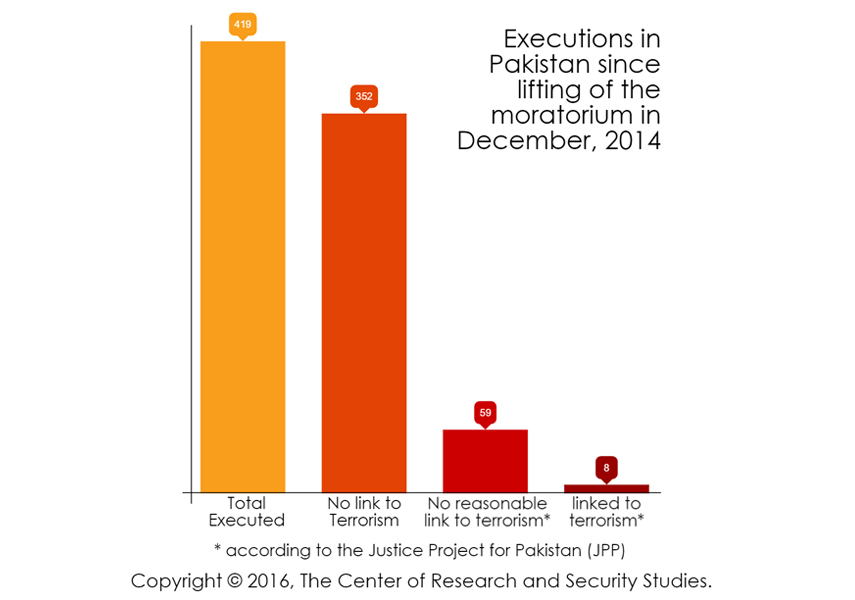
In a recent report[1] released by the Justice Project for Pakistan (JPP), of the 419 executions conducted by Pakistan since the moratorium[2] on the death penalty, only 16%, or 67 individuals, were linked to terrorism. Of this 16% (or 67), 88% (or 59) had “no link to a terrorist organization or anything that can reasonably be defined as terrorism.” In other words, 8 of the 419 executed had serious terrorism-related convictions. This is in direct contrast to the first point in the National Action Plan (NAP), which specifically states that there will be implementation “of death sentence of those convicted in cases of terrorism.”
According to the JPP[3], 8,200 are on death row in Pakistan, and have been convicted for a wide variety of crimes. There are a total of 27 crimes in Pakistan, for which the death penalty may be awarded. They include everything from the conventional such as murder and rape, to the unconventional, such as blasphemy. Put another way, most convicts on death row will not be convicted of terrorism or even terrorism-related charges. Even if the 16% figure is extrapolated to the 8,200 population, 1,312 of those would be convicted of terrorism offenses. On the low end, this number may be merely 164. The inflation results from a very broad definition of what constitutes as terrorism, but that is a debate for another time.
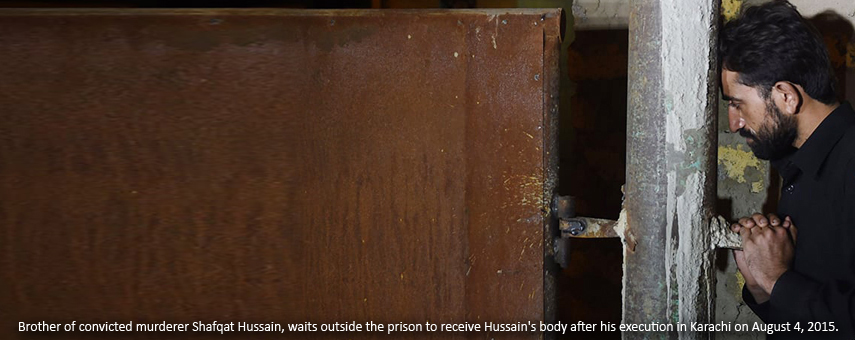
So why is Pakistan executing every individual on death row, when the NAP specifically calls for “implementation of death sentence of those convicted in cases of terrorism?” The problem is that there exists no mechanism for lifting the moratorium selectively. Once it is lifted, anyone and everyone on death row must be executed by law. This is part of the reason that the government has come under severe criticism from rights organizations for executing inmates who may have been juveniles when convicted[4], or trying to execute a quadriplegic[5].
Lawmakers could legislate so that only those convicted of terrorism-related charges may be executed under the NAP, as this would give them a leg to stand on. However, the possibility of this step is minute and there exists little precedent for preferential treatment when it comes to executions, anywhere in the world. Therefore, Pakistan will continue to face criticism for a) executing inmates by the hundreds, and b) not fulfilling the first NAP promise by executing everyone who is on serving time on death row.
The author Zeeshan Salahuddin serves as a Senior Research Fellow at the Center for Research and Security Studies, Islamabad, is a freelance journalist, and holds a bachelor and master degree in strategic communications from Ithaca College, NY. He can be reached via zeeshan[dot]salahuddin[at]gmail.com and tweets @zeesalahuddin.
[1] Lemmer, Y. (2016, December 17). Most executions in Pakistan unrelated to terrorism. Retrieved on December 22, 2016, from http://newsweekpakistan.com/most-executions-in-pakistan-unrelated-to-terrorism/.
[2] The moratoriums had been in effect since 2008.
[3] Justice Protect Pakistan website. http://www.jpp.org.pk/.
[4] Dawn.com. (2015, August 04). Shafqat Hussain executed at Karachi Central Jail. Retrieved on December 22, 2016, from http://www.dawn.com/news/1186953.
[5] Boone, John. (2015, September 22). Paraplegic death row prisoner gets last-minute stay of execution in Pakistan. Retrieved on December 22, 2016, from https://www.theguardian.com/world/2015/sep/22/paraplegic-death-row-prisoner-abdul-basit-stay-of-execution-pakistan.