



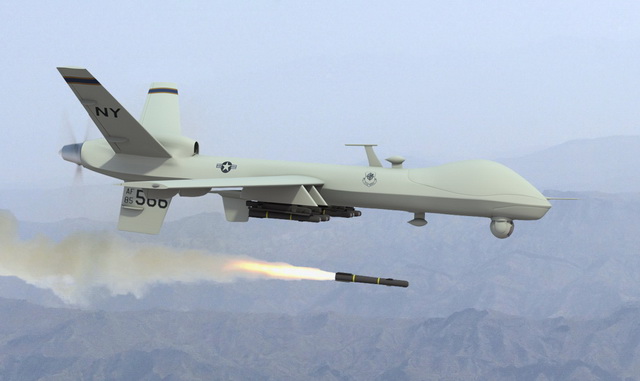
The latest rain of Hellfire missiles fired off CIA-operated drones on targets in Waziristan, in the Federally Administered Tribal Areas(FATA), offer Pakistan another excuse to protest the series of attacks that have killed some three dozen people between August 19 to August 24. The latest string of these multiple strikes on Friday, August 24, left at least 18 people dead, reportedly including either Badruddin Haqqani, the younger brother of the head of the Haqqani Network, Sirajuddin, or a younger member of the family[i]. Only 24 hours earlier, August 23, Pakistani officials had lodged a formal protest to the US on North Warziristan drone attacks[ii]. Pakistan maintains that such strikes not only violate international laws but also its territorial sovereignty.
During the current year so far, the CIA has operated as many as 32 lethal drone strikes. A cursory breakdown of these strikes suggests that some 14 were directed against the Haqqani Network, nine against Hafiz Gul Bahadur, a North Waziristan-based warlord considered the mainstay support for the Haqqani Network and Al Qaeda fighters, three against Maulvi Nazir (Wana, South Waziristan), about six aimed at the TTP warlord Hakeemullah Mehsud and 5 for other splinters of Taliban, largely known as Punjabi Taliban.
On the face of it, the intensification underlines a revival of intelligence-sharing between the US and Pakistani institutions. One indicator for that is a drone strike in the region between Pakistan’s Bajaur agency and the eastern Afghan Kunar province, which anti-Pakistan TTP is reportedly using for attacks on Pakistani security posts. The death in a US-Afghan attack on the Afghan soil of Mulla Dadullah, the head of the Bajaur agency TTP, over the weekend, and raging border region skirmishes between the TTP and Pakistani military also point to the possible resumption of tactical contacts between forces on both sides of the Durand Line.
Constellation of Militants
The TTP has also vowed revenge for Dadullah killing but signs continue emerging of an imminent multi-pronged crackdown on the militants holed up in the Waziristan region i.e. not only against the Haqqani network but also against others who seem united by Al-Qaeda anti-American narrative. A cursory look at this constellation of militant group explains the formidable challenge that they pose to Pakistan, and the US-led coalition across the border.
- Al-Qaeda, led by the Egyptian Dr Ayman al Zawahiri, stands out as the ideological leader of shades of Islamist militant groups in the Af-Pak region.
- The Haqqani Network serves as a protective shield for these groups– activities in support of Al-Qaeda regional and global anti-US agenda.
- Prominent groups such as the Hafiz Gul Bahadur Tehreeke Taliban (North Waziristan) , the Tehrik e Taliban Pakistan (TTP), uprooted from the region of its origin i.e. South Waziristan in Oct 2009, the Tehrik e Taliban South Waziristan of Mullah Nazir Ahmed – host and protect non-indigenous militant groups such as Lashkar e Jhangvi(LeJ), Lashkar e Taiba (LeT), Jaish e Muhammad, Lashkar al Alam Al-Islami, and the vicious Islamic Movement of Uzbekistan, a radical militant group comprising anti-government Islamists from the Central Asian state of Uzbekistan.
- More alarmingly, militants also use Tableeghi Jamaat, a massive organization built on principles of peaceful preaching across the globe, for social security and refuge from law. Sections within this massive organization also concur with the narrative that often comes from Al Qaeda and is parroted by most militant organizations. Many militants consider participation in the Tableeghi Jamaat congregations outside Lahore, the capital of Pakistan most populous Punjab province, as semi-pilgrimage before heading off to Afghanistan for ‘jihad’ in Afghanistan via the border regions.
Analyzing this complex constellation, it is quite likely that in case of a big military action these groups will position themselves for action against the government, military and installations, and public places such as commercial markets and utility outlets. Most people in North Waziristan are already scared and many have left for safer places in anticipation of a military operation. This means more internally displaced persons (IDPs).
Reality
But viewed against the looming American Presidential election, as well as the mounting networking of the militant outfits in North Waziristan, action against them seems imminent. Also, it is obvious that the CIA will continue sending drones to Waziristan to hunt down the militant community that is inspired by Al Qaeda, protected by the Haqqani Network and facilitated by others – Hafiz Gul Bahadur group, the Tehrik e Taliban Pakistan (TTP) and the Tehrik e Taliban Mullah Nazir group. By forcing Pakistan army into action against these groups, the US administration needs to convey to the opposition and the common Americans that it has prevailed upon Pakistan and has made it move against those ‘who take and threaten our soldiers– lives.’
Controversy
But the relentless drone campaign remains at the centre of a global human rights– controversy as well. Although precise and accurate in data collection, unmanned predators continue to draw heavy criticism by activists who argue that often targeting a single militant leads to the death of several innocent women and children in vicinity.
The United Nations Special Rapporteur on Human Rights, Ben Ememrson, has also asked the US to allow internal investigation on its Drone Programme for the sake of internal security[iii]. This demand by the UN official sends a positive message to Pakistan that if it takes substantive measures against militancy, it could plead a strong case against Drone attacks in the United Nations. Philip Alsten, Ben Australian predecessor had made more or less similar demands in 2010, demanding that the lead of drones be given to the US military for accountability of the consequences.
Conclusion
But viewed against the stated objectives of the Obama administration, the debate over the use of Drone technology ´ both in and outside the United States ´ , however, is not likely to bear much influence on the drone operations for the simple reason that that as long as the unwanted people ´ considered as terrorists and a threat to the US-NATO and Afghan forces – shelter in, or operate out of North Waziristan, the CIA will keep sending drones. Also, officially, Pakistan will keep protesting every strike, as it has in past, without any military action against the drones. Many within Pakistan, including the religio-political leader Maulana Fazlurrehman[iv], have even urged deployment of Air Force aircraft against drones. But meanwhile there seems to be an unwritten, tacit understanding on this issue between the two countries, and the drone strikes hence are likely to continue.
Critics have often pleaded for a transparent, and publicly acceptable mechanism for the drone strikes, rather than ducking under opposition to these operations by a certain segment of politicians. Apparently, if more TTP militants came under attack in the greater Paktia region of Afghanistan in the coming days, including drone strikes, this would mean both allies have agreed to expand the scope of cooperation in North Waziristan. This will likely see a more coordinated Pak-US movement in the region i.e. Pakistan tightening screws on the Haqqanis and affiliates, while the US-ISAF trying to neutralize the TTP and other anti-Pakistan groups currently using the Afghan soil for cross-border attacks.
But it is questionable whether a big military operation and more drone strikes will entail something substantial for both Pakistan and the United States after big publicity on impending operation in North Waziristan? Most of them will fan out to safer places, rather than waiting for the Pakistani or American-Afghan forces to get them. This may be good to sell to the American public and legislators but will not mean much as far as neutralizing and eliminating the Al Qaeda-inspired militant networks from the region. Only quiet, well-coordinated and sincere multi-lateral crackdown may can provide us all the much-neededrelief.
Analysis by:
Farooq Yousaf
Research Analyst / Programme Consultant
CRSS
Notes: