



Pakistan’s turn-around early this year on Syria and its faltering relations with Iran epitomize the ambivalence that has often accompanied its foreign policy for decades. Geo-political compulsions aside, the foreign policy has either remained frozen or perpetuated on false, duplicitous premises. The policy on Syria offers a classic reflection of this.
In response to probing questions about the 1.5 billion dollars worth of Saudi Arabian “donation,” Adviser to the Prime Minister on National Security and Foreign Affairs Mr Sartaj Aziz had in several interviews argued that nothing was wrong in getting financial donations from a country where “two million Pakistani workers reside and annually remit about 4 billion dollars.[1] He had also justified the renewed warmth in the Saudi-Pak relation, saying the relations had cooled down during the Zardari government and there was a need to revive it.[2]
But interestingly, Sartaj Aziz posed a counter-question to the critics: “Saudi Arabia gave us a lot of help after the nuclear tests in 1998; what did we do for them? Nothing,” Aziz said in a couple of media interviews. “I am really surprised (to hear this) because they will ask why are Pakistanis critical when Saudi Arabia is helping them,” was what he exactly told a foreign radio.
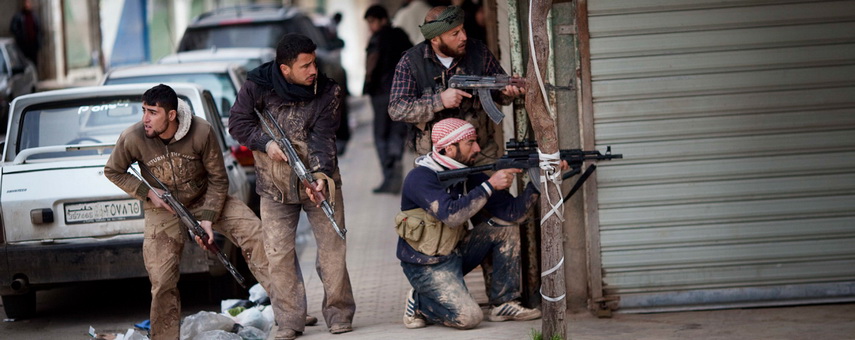
Detractors raised objections and expressed reservations about the Saudi-Pak relations to the context of the rumours that Pakistan was being used to recruit fighters for the anti-Assad war in Syria.
Reports from within Waziristan suggest that the recruitment began in March 2013, followed by a few batches in October and November, when at least 132 Taliban/Mujahideen commanders reportedly transited through Rawalpindi, Lahore and Karachi on their way to Syria. Some unconfirmed reports speak of clandestine training camps being run by some proscribed Punjabi and Pashtoon groups in Shawaal, Janikhel and Mirali. Locals have also reported arrival of about two dozen foreigners into FATA for several week-long trainings.
Regardless of the veracity of these reports, Pakistani authorities do face a daunting challenge of convincing locals as well as foreigners that recruitment and training for Syria, if any, has no official sanction.
The governmental denials notwithstanding, a gradual shift in Pakistan’s stance on the Syrian crisis is clearly discernible; moving from a strictly neutral player to a tacit supporter of the rebels in the war-torn predominantly Shia Muslim state, by allowing recruitment of “mujahideen” to shore up the fight against the Syrian government.
Back in 2012, Islamabad had sought a peaceful political solution, opposing military option altogether. However, it took a turn in February 2014 when a Saudi delegation visited Islamabad; then it openly supported formation of a transitional body with executive powers to run the affairs in Syria[3]. In fact New America Foundation’s Foreign Policy magazine had already reported in early November about the Saudi plans to enlist Pakistanis manpower for its dirty war in Syrian. What accompanied these reports were speculations – which turned out to be a cover – that Saudi Arabia wanted Pakistan to supply arms for the Syrian rebels. Although the government gave some clarifications, yet its reluctance in transparently explaining what the Saudi Arabian $1.5 billion were for, announced after the visits of successive Saudi delegations to Islamabad between November 2013 and February 2014[4].
This shift in policy understandably discomforted the Shia Pakistanis, who fear that the tilt towards the Wahabite Royal Kingdom might spell more troubles for them in case of renewed sectarian violence, targeting the shia Muslims in the country.
Even a senior foreign ministry official recently expressed his frustration over the way the government has dealt with the issue. “It’s a Syrian issue. We are against any foreign adventures (in Syria) and the crisis in Syria should be resolved politically.”
The general headquarters (GHQ) had its reservations too; already stretched thin because of the so many wars it’s fighting from the north to the south and south-west, the army reportedly declined to relieve officers for Saudi Arabia and Bahrain. That was in fact a cover for direct military assistance to the anti-Damascus radicals.
The civilian government’s apparent agreement to get involved – and Sartaj Aziz’s interview with foreign media does point to that – has ostensibly not only politically polarized Pakistan but also once again strained relations with Iran – which supports the Syrian regime, presumably because of the sectarian and geo-political factors. Beyond doubt the Iranian disagreement or displeasure would also deny Islamabad possible Iranian support on the Afghan issue where, Iran may not support even legitimate Pakistani concerns in the coming months and years.
Most political parties are opposed to this paradigm shift and advise the government to stay neutral. In interviews with the Center for Research and Security Studies (CRSS), the leaders of the mainstream political parties have taken an unambiguous position on Syrian crisis as they feared that support to the Saudi cause on Syria could plunge the country into jihadism.
The MQM, for instance, wants the country to remain neutral in its own interest instead of taking sides with Saudi Arabia. “If Pakistan supports rebels in Syria then it would be like indirectly supporting al-Qaeda there,” MQM Senator Syed Tahir Hussain Mashhadi said.[5] If true, it means Pakistani human resource is again being enlisted as mercenaries.
The Awami National Party (ANP) Senator Haji Adeel says it appears Pakistan hasn’t learnt from the past. “At the end of day, Pakistan will be the loser as much as it has suffered the consequences of proxy wars among Pakistan, India and Afghanistan. Whatever we’re facing today is the product of what we did there (in Afghanistan) … let’s stop doing this anymore and anywhere else,” Adeel argued and also spoke of the strains that the support to the Saudi policy had brought on relations with Tehran.[6]
Mian Raza Rabbani , the PPP Senator, says a pro-Saudi shift in the policy on Syria would amount to playing with fire. “It’s important for Islamabad to keep equal terms with all Muslim countries otherwise it’s going to be harmful for Pakistan,” Rabbani said. While the government assured the Senate that it would not abandon its “neutral policy on Syria”, Rabbani is skeptical of such assurances. “We have got to learn from past experiences. That (change in policy) could trigger internal security concerns,” the PPP Senator said.[7]
Leader of the Opposition in the National Assembly Syed Khurshid Shah pleads ignorance as to what exactly was the government position on Syria, a fact even more lamentable because he occupies an extremely important position, representing several other parties. All he comes up with is that “change in our position will definitely harm our role as a neutral country”.[8]
A couple of conclusions can be conveniently drawn from the above.
Firstly, leading parliamentarians remain shockingly ignorant on those crucial policy issues which amount to existential challenges for the country. They enjoy perks and privileges but their mandated function hardly goes beyond shallow rhetoric and hue and cry – witnessed during recent budget sessions too.
Secondly, the government – as a representative of a status quo system that rests on a close circle of cronies – continues to remain ambivalent on key policy decisions and has apparently kept all mainstream parties at a distance on these issues.
Thirdly, most Pakistanis including the military establishment as well as the ruling Muslim League always blamed the CIA and the American administrations for the “jihadization of Pakistan”. But Americans or Europeans are certainly not part of what is happening now between Islamabad and the Saudi-led anti-Bashar-al-Assad Alliance.
Who will these Pakistanis hold responsible for the renewed recruitment of jihadists from Pakistan for Syria?
Also, what were the $ 1.5 billion meant for? We don’t know what is quid pro quo?
Lastly, Pakistan shall have to stop bargaining its geo-strategic location for dollars, or serving as a conduit and contractor for recruiting mercenaries required for others’ wars in return for financial incentives. These hand-outs bring with them seeds of sectarian militarism which not only fan religious divisions but also fuel radicalization of minds – the long-term scourge that the successive governments buy in return for short term cash injections.
(Written and Compiled by CRSS Senior research fellow Imtiaz Gul)
[1] http://pakobserver.net/201403/19/detailnews.asp?id=236749
[2] http://tribune.com.pk/story/690222/pakistan-trying-to-sell-small-arms-to-s-arabia/
[3] http://tribune.com.pk/story/673146/ouster-of-assad-regime-riyadh-wins-islamabads-support-on-syria/
[5] Interview with CRSS
[6] Interview with CRSS
[7] Interview with CRSS
[8] Interview with CRSS