



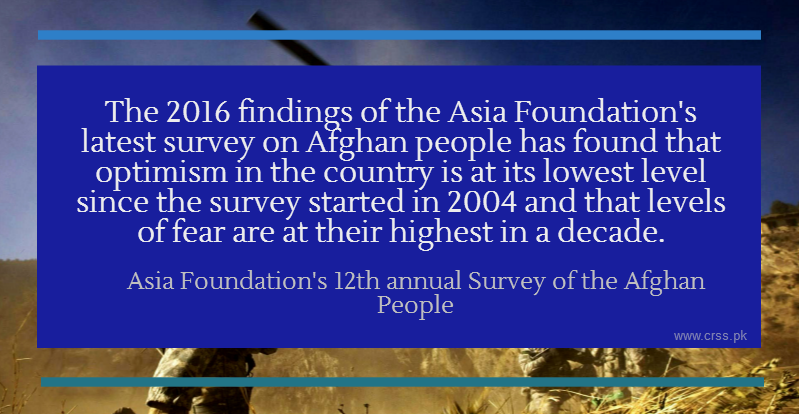
Findings of Asia Foundation’s 12th annual Survey of the Afghan People were released Wednesday in Kabul and found the downward trajectory in national mood, which began in 2013, has continued: in 2016, just 29.3 percent of Afghans say the country is moving in the right direction, the lowest level of optimism recorded in the Survey since it began in 2004, and down from 36.7 percent in 2015.
While the drop in 2015 can be partly explained by post-election disappointments after the exuberance and campaign promises preceding the 2014 presidential elections, the lower optimism in 2016 appears to reflect a sustained change in sentiment related to perceptions of security, the economy, and government achievements, their report stated.
Afghans appear to have less confidence in every level of government, yet they also have less desire to emigrate.
This year’s survey polled 12,658 Afghan respondents, 52.7 percent of them male and 47.4 percent female, representing 16 ethnic groups from all 34 provinces in the country.
The report stated that the marked rise in civilian casualties and worsening violence has contributed to the highest recorded level of fear in over a decade.
It states that Afghans in 2016 are more fearful for their security, more dissatisfied with the economy, and less confident in their government.
“The national mood continued to decline, and this year marks the lowest level of optimism since the survey began in 2004,” it stated.
More than one-third of Afghans say their household financial situation has grown worse in the past year and most Afghans say they have no confidence in the Independent Elections Commission. “Confidence in every level of government appears to have fallen since 2015,” the report stated.
But this year’s survey also provides some reasons for optimism. It stated that “despite the worsening economic and security environment, the desire to emigrate fell to a record low this year, a striking change from 2015, as large numbers of previous emigrants have returned from European countries where disincentives to immigration have been on the rise.”
In addition, more Afghans, particularly rural Afghan men, support women’s right to vote and women’s right to work outside the home than ever before.
Although corruption rates remain very high, the rate at which Afghans report actual encounters with corruption, in the customs office or their provincial governor’s office, has decreased.
The survey also found that when asked what is going well in their local area, many Afghans mention development in education. Internet access continues to increase rapidly, and rising television viewership appears to predict changes in the way that viewers see women’s role in society.
“With its broad scope and long duration, A Survey of the Afghan People is a map of social change over time, highlighting the Afghan experience in a rapidly transforming nation,” said David Arnold, President of Asia Foundation.
“Through this annual project we hope to provide a deeper understanding of Afghanistan, while also contributing to the knowledge environment for policymaking and programming as the Afghan government sets its own course towards peace. For international partners, this year’s findings point to a need for patience and strategic thinking, as well as sustained support, as Afghanistan weathers ongoing political challenges and economic hardship,” he said.
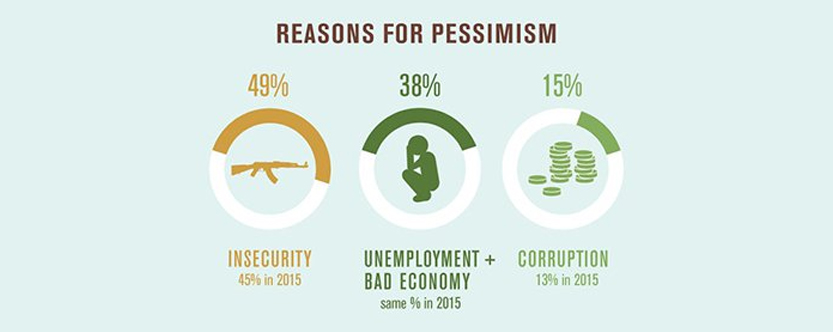
The report stated that insecurity is the reason most commonly given for why the country is moving in the wrong direction (48.8 percent), followed by unemployment (27.5 percent), corruption (14.6 percent), bad economy (10.4 percent), and bad government (8.7 percent).
The proportions of Afghans citing insecurity, unemployment, and corruption have increased from last year by 4.2, 2.1, and 1.6 percentage points, respectively.
The proportion citing bad government has decreased by 2.7 points.
The Survey asked respondents what is going well in their local area, and their responses echo an overall pessimism, while the biggest problems facing women, when asked, were cited as education/illiteracy as the biggest problem (36.1 percent) and unemployment, at 22.9 percent. Domestic violence way cited by 22.1 percent as the biggest problem. This is an all-time high. As in previous years, women cited domestic violence more frequently than men.
The biggest problems facing youth was unemployment (71.2 percent).
The survey found that overall, 69.8 percent of Afghans report sometimes, often, or always feeling fear for their personal safety, the highest level in over a decade.
Fear for personal safety is most salient in the South West region (82.0 percent). Within this region, Helmand stands out, with 55.4 percent of respondents saying they are always afraid for their personal safety.
Regarding the Afghan National Security Forces (ANSF), 53.7 percent said the ANA is getting better at providing security, while 20.0 percent said it’s getting worse. On the Afghan Local Police (ALP), 39.6 percent said it is getting better, 26.4 percent said it is getting worse.
The report stated confidence that the peace process can help stabilize the country remained comparable to 2015 (62.9 percent) and that the percentage of Afghans who say they feel sympathy for armed opposition groups (AOGs) decreased 10.8 percentage points this year, from 27.5 percent in 2015 to 16.7 percent in 2016.
This article originally appeared on www.tolonews.com ,07 December, 2016. Original link.
Disclaimer: Views expressed in the article are not necessarily supported by CRSS.