



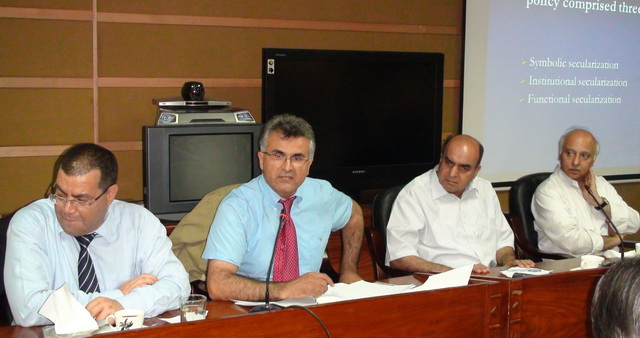
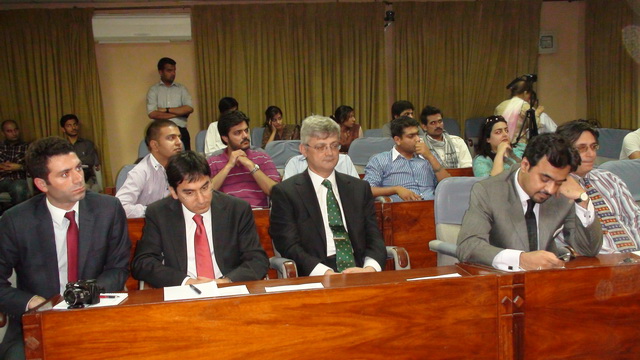
Two distinguished scholars from Turkey, Dr. Nuri TINAZ, Associate Professor Marmara University, Istanbul and Dr. Ali Murat YEL, Head of the Department of Sociology, Fatih University on Monday, May 27th spoke at the National Defence University on ‘State, Religion and Democracy,’ marking the launch of a series of lectures that the Center for Research and Security Studies– (CRSS) has initiated as part of its counter-radicalization advocacy.
Both professors gave a comprehensive overview of the historical perspective on Turkey ongoing evolution from the Republican-dominated constitutional framework to the socio-political transformation that the country has been undergoing since 1983.
Supported by the Heinrich Boell Stiftung, Germany and the Ministry of Foreign Affairs, Turkey, the dialogue aims to trigger a debate inside Pakistan about the need to keep view politics and governance from a purely universal democratic and human rights perspective, rather than using religion as the soul guiding principle. Under this programme, CRSS plans to invite academicians, intellectuals and political representatives also from Indonesia and Malaysia to Pakistan for presentations on their respective systems on how their governments ensure social peace and sectarian/religious harmony.
Dr. Ali Murat explained to the students and teachers of the NDU that Turkey is not evolving into a theocratic state. Nor is it transforming into a typical Anglo-Saxon secular democracy because Islam is part of life but not part of the state business in Turkey. It is borne by several surveys according to which less than seven percent of its population supports the shariat-based political system. He also highlighted the fact that most Turks agree the sharia should not be the foundation for constitution. Most people there agree that sin is a matter between God and individual while punishment for violation of the law is the duty of the state. Using the example of hijab, Ali Murat said that until 2007 head cover was not allowed in Turkey but now the issue is almost dead after the parliament decreed it as individual choice. Only about two percent of Turkish women wear head covers, he pointed out. Alcohol is prohibited in public places and has the sale of alcohol in the proximity of schools, mosques, temples and shrines have also been banned for deference to all faiths. But, he underlined, it does not mean that Turkey is becoming a theocratic state. There is more freedom of expression than ever before, he said.
Dr. Nuri TINAZ, who spoke on Turkey secular transformation, said that the programme of secularization was implemented through a well planned policy which included symbolic secularization, institutional secularization and functional secularization. The transformation was started in the early 1920s after the disintegration of Ottoman Empire and the establishment of Turkish Empire but the real structural changes came about in the last 30 years. The concepts of modernization of politics, media, entertainment, fashion etc began crystallizing since early1980s. At that time the display of Islamic symbols were prohibited. It was militant secularism which attempted to elbow out religion subsided from public lives because its founders considered religion as the primary reason for social discord and economic backwardness.
Now Islam is visible in public sphere and while there is a rise in individual religion and spiritualism, yet it does not mean Turkey is slipping into theocracy, Dr. Tinaz underscored. Nuri Tinaz said Turkey followed the western style of democracy but failed, but when it followed its own tradition it resurged as a vibrant democracy which is inclusive and secular. What we see in present day Turkey under the Justice and Development Party Adalet ve Kalkinma Partisi (AKP) may be the rise of individual spiritualism but there is no compromise on the fundamentals of the constitutional framework that Ataturk put in place. People at large have internalized secularism.
Answering the questions, Dr. Ali Murat said that the new and older generations in Turkey are now accommodating each other through formal religious education.
The imam/khatibs of mosques are regulated through the Directorate of Religious Affairs which ensures sectarian peace and harmony. Compulsory and free education has been extended to every corner of state in order to achieve the policy of democratization and secularization.
Answering another question, Dr. Murat said that military is a powerful institution, it was trusted by people in the past but now parliament is more trusted by people therefore military cannot interfere in the transition from laicism to Anglo-Saxon democracy. Because this transition does not mean that Turkey is deviating from Mustafa Kemal Ataturk principles. The opposition raised from the opposing party against this transition is also not supported by the people. The Republican Elites created the Ataturk cult and at times they even abused Kemalist principles to legitimize their wrong doings. They brushed aside the possibility that creeping craving for Islam and sharia may be influencing AKP agenda. Dr. Murat said we must keep in mind, its voter fatigue with other parties, and the worry for bread and butter that brought AKP to power and has kept it in power.
Dr. Murat suggested that while Turkey or other countries may serve as an inspiration, Pakistan should not follow any other country. Every nation needs to have its own model, based on its own socio-cultural context. Turkey is not following west; it has constructed its own model according to its own needs.
The problem of Pakistan, both professors argued, seems to be lack of quality education. There is lack of awareness on religion in Pakistan. Solutions to problems do not flow from mere religious sloganeering. Religion may be the first and foremost duty of everybody but individuals should be free to practice it the way they wish. A certain group or state must not impose Islam on others; as Allah has given us the choice to choose a right or wrong. Nobody can take that freedom from individuals. People practice their religion with freedom in democratic states.