



by Arshad H. Abbasi
University and college faculty serves as an agent of making leaders that will stop climate change; facts-based knowledge is imparted regarding environmental science. Faculty can take substantial steps in playing the key role in water security. The melting of Siachen Glacier is a big challenge, but the hegemonic Indian policy is the biggest hurdle to save this glacier.
Science tells us that glaciers are the most sensitive indicators of climate change. Worldwide, it is believed that the glaciers melt due to atmospheric warming but in the case of Siachen and Himalayan glaciers, there are other factors that should be taken into account. Direct human intervention on a large scale is the most significant cause of this melting which is then causing variance in the frequency and intensity of extreme weather events, including changing monsoon patterns in the sub-continent.
The Global Sustainable Development Report 2015 (GSDR), places the South Asian countries on the top the 193 countries at climate risk. Bangladesh ranks third while India, Sri Lanka, Nepal, Bhutan and Pakistan are 10th, 14th, 15th, 16th and 17th respectively. We owe this vulnerability to the human intervention in glaciers. Nevertheless, the official rhetoric of India over the melting of Siachen is global warming; this is only a red herring and is successfully sold by India, while Pakistan keeps mum over the issue. Why is India trying to cover up by using the excuse of global warming, without looking at the man-made direct interventions? Without accountability, climate change becomes a crutch.
High-resolution images of the Siachen glacier show deep cracks or crevasses every 10 feet, both in longitudinal and latitudinal directions, owing to military presence in the area. The retreat of the glacier is also visible by horizontal expansion of glacial lakes throughout the glacier, but the most alarming sign is the vertical thinning of glaciers, which is aggravating the widening of crevasses at a massive scale.
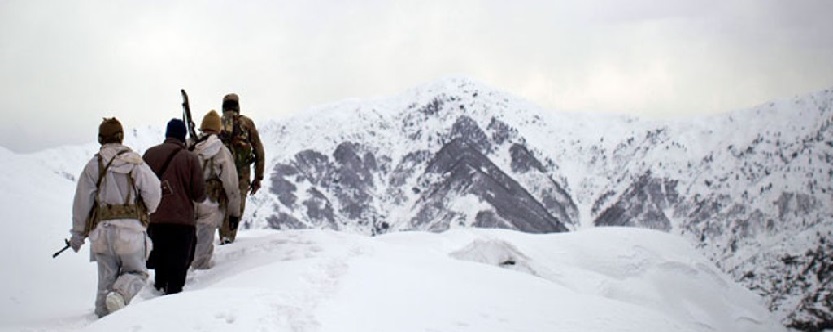
The Siachen glacier, approximately 2,300 km2, is located in the eastern Karakoram Range in the Himalaya Mountains. With a length of 76 kilometers, it is the second longest glacier in the world’s non-polar areas. The entire Siachen Glacier is currently under administration of India since 1984 when Indian troops gained control of the glacier. After the occupation, the glacier became the highest battleground on earth, where archrivals India and Pakistan have fought intermittently since April 13, 1984. Both countries maintain permanent military presence in the region at a height of over 19,500 feet. 97% of the casualties in Siachen have been due to weather and altitude, rather than actual fighting. This permanent presence causes permanent damage to the environment, which may be impossible to recover from.
This is a matter of national security because Pakistan will be vulnerable to floods. Change in local climate patterns can also destroy our agrarian economy. The matter should be treated with some level of urgency.