



Religion and politics should be separated for social peace and harmony and for giving equal rights to the citizens. A pluralistic discourse is a must to achieve a democratic society. Sometimes you need to get over history for social harmony and development and get over the romanticized ideas to replicate the models which no longer hold realistic in the contemporary context.
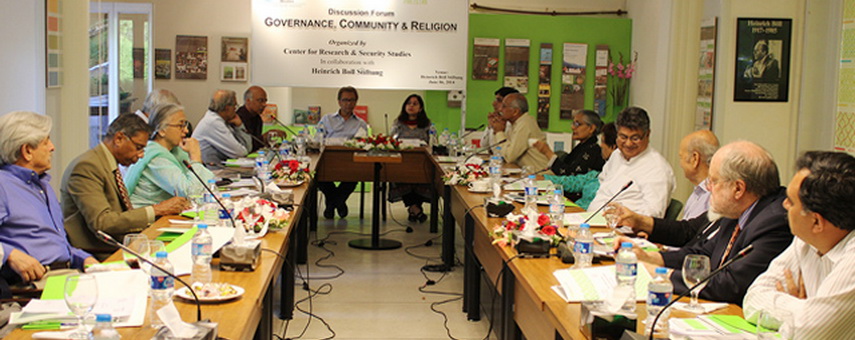
These were the notions expressed by the speakers from US and Indonesia during a roundtable dialogue as part of a series “Governance, Community and Religion (GOCORE)” jointly organized by Center for Research and Security Studies (CRSS) in collaboration with Heinrich Bӧll Stiftung (HBS).
Renowned anthropologist and the author Dr. Shabana Mir, who teaches at the Millikin University, US and prominent Indonesian journalist Endy Bayuni were the guest speakers. A select group of intellectuals, scholars, right activists, academia, intelligentsia and students participated in the roundtable discussion held at the Heinrich Bӧll Stiftung (HBS) premises on June 6, 2014. The discussion was moderated by the Executive Director, CRSS Imtiaz Gul, also a senior journalist and security analyst.
The speakers reflected that the state should not assume the role of a pastor or some religious authority to adjudge sin or goodness, instead it should only base itself on the constitution to ensure social peace and harmony and adjudicate the violation, breach and flouting of the law of the land.
Dr. Shabana Mir, Assistant Professor of Anthropology and Coordinator of Global Studies at Millikin University, USA said that religion could have multiple roles in politics while sharing the American perspective of dealing with the multicultural diverse society and underscoring the need for the separation between religion and politics. “US Constitution does not require ‘callous indifference to religion’ as it has free exercise clause as individual act”, she said. She argued that the States’ attitude to religion must be based on community while explaining US founding fathers firmly believed that the intertwinement of religion and politics and state religion could be very harmful for the society lived by the multiple ethnic groups. She said that there was a dire need for the development of civil discourse embedded into the universally acknowledged democratic values ensuring no voice remains unheard. “State had nothing to do with the religion in the United States of America as a measure of accommodating the American diversity”, she added. “The public schools at the US cannot propagate neither impose upon the students the religious views”, she explained. Dr. Shabana said, “A pluralistic marketplace of religious law should exist in a separate legal realm parallel to that of government law,” while adding that the State attitude to religion must be based on the diversity and communities living in the society. “American pluralism is not perfect but constitution guarantees individual freedoms while staying secular’, she said.
Dr. Shabana said that as per the reckoning of some of the American experts, there was a dire need for the separation between religion and politics keeping that the ecclesiasticism could corrupt the state and the state could possibly pollute the church likewise. “The overt pre-dominant purpose of the law should not be religious but it should be rather the public interest”, she said. Dr. Mir clarified that Americans did not believe in religion and that was why they separated religion from politics was more of a myth as it was out of respect for religion that they did not want to mix it with politics hence separating the two. “Americans do care about religion but exhibit strong commitment to protect religion from political influence”, she clarified.
Dr. Shabana Mir added that State was reasonably tolerant and accommodating towards the American diversity while quoting an example of Presidents’ Happy Holidays Wish instead of Merry Christmas. Dr. Shabana also referred to various clauses prohibiting the government in establishing any religion as official or favoring one religion over the other while terming the US State-Religion relation not static and as a ‘shifting porous wall of separation’.
“Secularism is more consistent with Islamic history than modern Islamic state movements because Islamic history was not fundamentally different from Western societies regarding the relationship between religion and the state”, she quoted Abdullahi An-Naim’s perspective, Author of Islam and the Secular State. She further said that Law/Policy was not enough to counter extremism, discourse on egalitarian development/ inclusion also a must.
Mr. Endy Bayuni, a prominent journalist from Jakarta Post who writes on the evolving political cultures, Islam, democracy, foreign affairs, economic development, and the changing media landscape termed Liberal Democracy as the way forward for Muslim majority nations based on egalitarian democratic principles, including guarantees of freedom and basic rights. “If Indonesia were Islamic, it could disintegrate” he said. He said Indonesia which is the 3rd largest Muslim democracy, member of G20, will soon be among the top 20 economies of the world by 2025 would not be possible without accommodating its ethnically diverse society. “Public services are being rendered to all the ethnic groups in Indonesia without any preferential discrimination of cast, color or religion as guaranteed by the constitution”, he added while referring that Islam in Indonesia was treated like any other religion without any prejudice and all religions stood equal with offices for all six recognized religions. He further said that the ministry also promoted inter-faith dialogue for social harmony and belief in liberal democracy.
He said Indonesia was confronted with a number of challenges in its process of democratization which were similar to Pakistan. He said that democracy and democratic values were taking roots in various Muslim countries, however, the challenges to become modern secular states still needed to be dealt with shared experiences and understanding about the modern democracy based on equal citizenry. He added that despite the resistance from hardliners the people of Indonesia have shown commitment to diversity and modern democratic values. For the people democracy is the only way forward to keep the country united and strong.
Mr. Endy said radical groups had been attempting to manipulate the constitution and to impose their version of religious dictates in the country. However, people in general are aware of the consequences of such efforts and are therefore supporting and strengthening democracy in the country. “The existence of all religions is constitutionally guaranteed, and so is the right to practice and the right to build houses of worship”, he said while adding that Indonesian founding fathers recognized that the diversity of the nation may be divisive elements in building the nation, but it might also be the one that would help unite and strengthen the nation. “Economic, administrative and political factors also help sustain liberal democratic model in Indonesia”, He said.
Executive Director CRSS Imtiaz Gul said that Article 25 of Pakistan’s constitution guarantees equal rights to every citizen of the country. “There should be no discrimination on the basis of religion and race”, he said while calling for equals rights for all the citizens.