



Afghanistan currently finds itself in a unique situation, and promising bilateral and multi-lateral opportunities for a regionally coordinated support mechanism for Afghanistan are emerging like, US-Pakistan Convergences, China – Pakistan Convergence, China-led efforts for a regional forum to help and steer Afghan peace and development efforts, New Afghan leadership, Acknowledgement of Pakistan’s centrality to the Afghan reconciliation process by the US, China, Iran and Afghans themselves.
In order to analyze, let us first have a look at how the US is repositioning itself and redefining its future role in Afghanistan
US Afghan Policy
The new Af-Pak envoy Danial Feldmann has come out with the contours of what seems to be the new policy on Afghanistan and looks like a marked departure from Washington’s policies so far: (Atlantic Council in Washington while discussing the status of Pak US relationship. (Washington, DC, October 14, 2014)
Firstly, he acknowledged Pakistan’s efforts and sufferings as a result of involvement in the war on terrorism. But Pakistan has also suffered dramatically. Over 50,000 Pakistani lives have been lost as a result of terrorism. Pakistan’s economy has suffered dramatically. Growth prospects have fallen. In recent times, inward investment and exports have declined, as security concerns have compounded the energy deficit.
Secondly, healso acknowledged how the US mission in Kabulshaped and influenced opinionin Washington:
It is no secret that for the last decade, the American approach to the region has been filtered through the lens of our mission in Afghanistan. The U.S. effort in Afghanistan – in human, material, and financial terms – drove our focus. Perhaps no relationship has been more affected than Pakistan.
Feldmann moreover underscored Commitment to continue political and financial support to Pakistan, and Afghanistan beyond 2014:
“It is a misconception that we will not be there. We will be there in significant numbers. The combat operations will stop. International community’s assistance and commitment will continue for a long term in Afghanistan” he said.
As far as India and Pakistan are concerned there is no relationship more critical to Pakistan’s future than its relationship with its neighbor. And I am convinced that India’s rise in prosperity and global leadership cannot be fully realized until it has a better relationship with Pakistan.
On Afghanistan-Pakistan relations Afghan President Ashraf Ghani and Chief executive Dr. Abdullah agree that a renewed effort at reconciliation is important, and each also envision a role for Pakistan in that effort. They each desire improved military-to-military cooperation to manage the border is also a key priority to reduce tensions and eliminate the safe havens that exist on both sides of the border
Both Islamabad and Washington are much focused on preparing the way ahead. So this is a time of great opportunity for Pakistan, and for U.S.-Pakistan relations. An opportunity for Pakistan to improve relations with its neighbors–particularly given the new leadership that has emerged in Delhi and Kabul. And it is a time when Pakistan can take its place as a leader in the community of nations.
Our ability to improve the bilateral relationship; to build on the progress of the past few years, is dependent on Pakistan’s continuing efforts to eliminate the safe havens from which militants in Pakistan plan and execute attacks not just on Pakistanis, but also on U.S., Afghan, and other personnel and facilities in Afghanistan and around the world.
The Military Operation clearly disrupted militant activities – but the job is not done. Militant groups, including the Haqqani Network and the Pakistani Taliban, continue to pose a threat to Pakistan, Pakistan’s neighbors, and the U.S. It is vital that these operations continue, and that every effort is made to prevent the safe havens from being reconstituted.
Our strategic interest extends beyond the Haqqani Network or any other particular group. The ungoverned vacuum allowed for a multitude of threats, both militant and criminal, that threaten first Pakistan, then the region, including Afghanistan, India and China, and then the broader world including the United States and Europe. Eliminating these safe havens is not just about eliminating one group, or one leader. It is a job that requires continued vigilance.
Pakistan advisor on national security and foreign affairs, Sartaj Aziz, says
“Our policy now is that the Afghan Taliban coming to power by force in Afghanistan is not in our security interests, that is the definition of our policy of non-interference in Afghanistan and no favorites”.
Challenges for Afghan Unity Government
Challenges resulting from these opportunities for Afghan Unity Government, how to encash the international, particularly the regional goodwill and interest in a terror-free and stable Afghanistan,
a) Dr.Ghani and Dr.Abdullah must first reconcile their differences over the issue of talks with Taliban, both define Taliban differently
b) How to reset relations with Pakistan by neutralizing the spoilers within Afghanistan. They also need to neutralize Pakistan-bashing from within the Afghan establishment if they want to reset relations with Pakistan
c) They must convince all opposition that they are protecting and safeguarding the Afghan interests only. This requires an extreme balance in the need for maintaining relations with the US and its allies (because of financial dependence), and the necessity of neutralizing the Taliban insurgency in a political way
d) Equally important for the Ghani-Abdullah Abdullah government will be not to exploit the Indo-Pakistan rivalry and their competition for influence in Afghanistan.
China – Bigger Responsibility
Keeping in view the US departure from its predominant lead role in a guided/controlled state-building (as set out by the neo-cons under the Bush administration), and the inclination towards regional consensual, collaborative framework for Afghanistan, a bigger responsibility falls on the shoulders of China and Russia:
Particularly China, because Russia carries a bitter baggage and that is Moscow’s disadvantage even if it wants to play an active role in the Afghan reconciliation and reconstruction process.
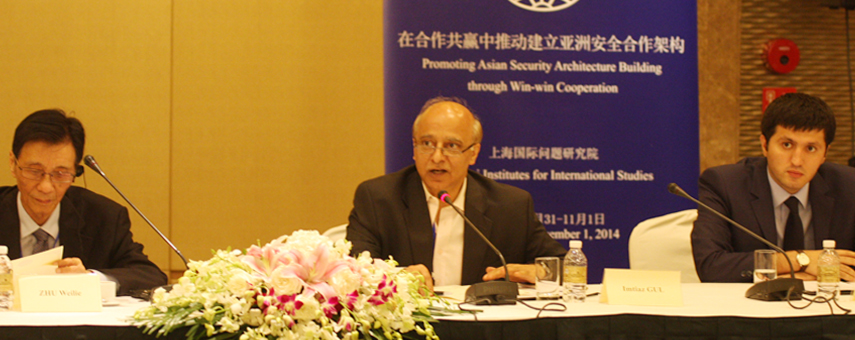
A regional collaborative framework fits precisely into the objectives of the gathering today i.e. promote win-win cooperation through non-traditional security means under an All-Asia Security Umbrella – relevant not only for Afghanistan but for the entire region. (The Chinese Prime Minister has also presented his five points for Afghanistan in Beijing yesterday)
The American reluctance in staying in the lead role in West Asia (which of course is the obvious result of its strategic blunders in Afghanistan and Iraq) offers unique opportunities for China and other regional countries.
Regional stakeholders must seize this opportunity, and fill-up the void being created by a battered United States. Regional countries including Iran should develop a regional collaborative mechanism for a non-traditional security engagement with Afghanistan, and jointly oversee the peace and reconstruction efforts in that country.
In this context, a lesson that Pakistan and China should learn from the US-led intervention in Afghanistan is that a security-centric, contractor-driven, selective approach instead of an-inclusive approach in conflict management and conflict resolution will never entail success. Unholy, short-term, tactical alliances with warlords in the name of security are extremely damaging in the long term. What is needed is an equal-handed, long-term, all-inclusive engagement with all stakeholders and only such an approach can help Afghanistan successfully handle its national reconciliation efforts.
China’s pro-active engagement with Afghanistan can serve as a mitigating/neutralizing factor in the acrimonious Pak-Afghan-India relationship and thus try to neutralize the impact of geo-politics that these three countries are involved in. All three countries need to stop mutual blame games, stop acrimonious brinkmanship and engage in a more constructive way not only to help Afghanistan preserve its sovereignty but also for their long-term gains.
Drugs – Regional Concern
Another big legitimate reason of concern for China, Russia, Iran and other regional countries is the booming poppy production in Afghanistan. They are justifiably concerned about this trade has flourished despite the presence of a huge 40,000 strong US-and UK force in Helmand province. The Camp Leatherneck (US) and Bastion (UK), shut down formally, last week, were in Helmand but the province topped the opium supplying Afghan districts, with at least 80 percent of the drug coming from Helmand.
Pakistan, too, suffers as much as the Central Asian republics as well as Russia and potentially China: Narcotics Control Division Secretary Akbar Khan Hoti said, “Pakistan is not only being used as transit country but it is also a consumer of different drugs, regretting that most of the youth from wealthy families was using drugs. Over 6 million people are drug addicts in Pakistan.”
Imtiaz Gul
CRSS, Islamabad, November 1, 2014
(The paper was read by Imtiaz Gul, executive director CRSS at a conference in Shanghai, China)