



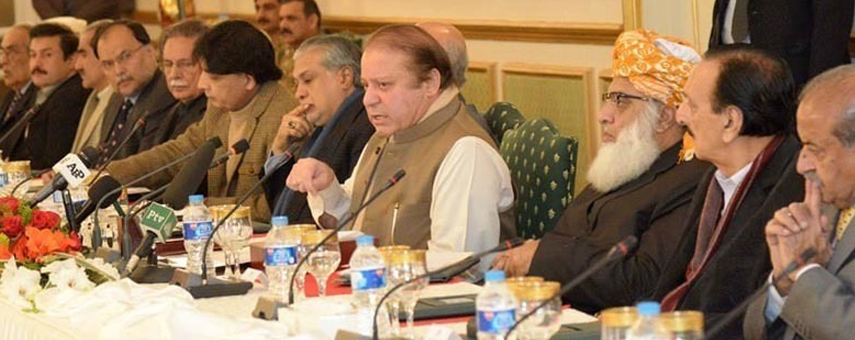
The National Plan of Action (NPA) to combat terrorism, has seen unprecedented political and military reconciliation, despite significant reservations by several key players. The Prime Minister and Chief of Army Staff hope this transforms into practical action and tangible results.
Political Reconciliation
Extraordinary times call for extraordinary measures, seems to be the go to line for the government and the military to justify and placate opposition to the various tenants of the 20-point National Plan of Action (NPA) to combat terrorism, as announced by Prime Minister Nawaz Sharif. The late-night televised speech was a landmark moment in Pakistani history, relaying to the public a “comprehensive strategy” to root out the menace of terrorism permanently.
The political response to the NPA has been at every point along the reconciliation spectrum. Mushahid Hussain of the Pakistan Muslim League – Quaid (PML-Q) fully supported the plan, stating, “We have unprecedented circumstances now which call for unprecedented measures.” This was in direct contract to Senator Aitzaz Ahsan of the Pakistan People’s Party (PPP), who opposed the formation of such courts, saying these they had no place in a democratic setup. The Awami National Party (ANP) and the Muttahida Qaumi Movement (MQM) also opposed the formation of the military courts.
Former Interior Minister also played a crucial role in the eventual reconciliation, calling former President Asif Ali Zardari to bring him on board. The central leadership also called MQM chief Altaf Hussain to ally the party’s fears of their workers getting caught in the net. The Prime Minister personally addressed leaders of the ANP to get their support. 0Other prominent politicians, such as Leader of the Opposition Syed Khurshid Shah, Hasil Bazenjo, and Aftab Sherpao also supported the decision. Imran Khan of Pakistan Tehrik-e-Insaaf, eventually came on board, but also asked that armed groups be banned across the country, a suggestion that the Prime Minister gladly rolled into one of the 20 points in the NPA.
Political Precedent
There is significant political precedent for setting up military courts in Pakistan.
Article 212-B, entitled ‘Establishment of Special Courts for trial of heinous offences’, was added to the constitution through the 12th Amendment of 1991. The landmark Sheikh Liaquat Hussain case of 1999 witnessed the Supreme Court had holding the government’s decision to establish military courts in Sindh as unconstitutional. The apex court also asked that all terrorism cases be transferred to anti-terrorism courts (ATCs) to be set up under the Anti-Terrorism Act (ATA) of 1997.
Additionally, Article 245 of the constitution deals with the military’s ability to defend the country against forces both foreign and domestic, the latter specifically subject to law, and in aid of the civilian power when called to action.
Despite political reconciliation, legal experts believe that these military courts will operate outside the ambit of the established judicial system in Pakistan. As has been the case in the past, this may also burden the apex court with questions about the integrity, efficacy and constitutional validity of these courts. That being said, in extreme cases, the executive branch of the government holds the cards, and must be supported and trusted for the system to work, especially since the political parties have all come on board with the NPA.
Military Blueprints
On Thursday, the top brass began putting together plans for the implementation of the NPA, in a high-level security meeting headed by Chief of Army Staff (COAS) General Raheel Sharif. The plan calls for establishment of military courts, training and strengthening the counter-terrorism apparatus across the country, raise ten additional wings of the Frontier Corps, intensify the ongoing operations in both the tribal belt and in urban centers such as Karachi, among others.
It may only be a few weeks before the courts will be set up, one official told Dawn newspaper, but the parliament has to first legislate the matter, staying within the confines of the constitution. Given the political leadership is all aboard, this aspect should see few hiccups, thereby allowing the military to be prepared well in advance for as soon as the executive marching orders come through. The COAS said that he wished the collaboration between civil and military leadership and the unanimity of the consensus could be transformed into practical action on the ground.
National Plan of Action – 20 Point Agenda
The following is summary of the short-term National Action Plan against terrorism announced by Prime Minister Nawaz Sharif in a televised address to the nation late Wednesday night:
- Execution of convicted terrorists will continue
- Establishment of special trial courts for two years for speedy trial of terror suspects
- A commitment to ensure that no armed militias are allowed to function in the country
- Strengthening and activation of NACTA
- Countering hate speech and extremist material
- Choking financing for terrorists and terrorist organisations
- Ensuring against re-emergence of proscribed organisations
- Establishing and deploying a dedicated counter-terrorism force
- Taking effective steps against religious persecution
- Registration and regulation of madrassas
- Ban on glorification of terrorism and terrorist organisations through print and electronic media
- Administrative and development reforms in Fata with immediate focus on return of IDPs
- Dismantling communication networks of terrorist organisations
- Tangible measures against abuse of internet and social media for terrorism
- Zero tolerance for militancy in Punjab
- Taking the ongoing operation in Karachi to its logical conclusion
- Empowering Balochistan government for political reconciliation with complete ownership by all stakeholders
- Dealing firmly with sectarian terrorists
- Formulation of a comprehensive policy to deal with the issue of Afghan refugees, beginning with registration of all unregistered illegal refugees
- Revamping and reforming the criminal justice system, to strengthen counter-terrorism departments including granting of powers to the provincial CIDs to intercept terrorist communications
Sources
- Army starts groundwork for setting up courts – Dawn
- Amending the constitution: precedents recalled – Dawn
- Military courts: How the reluctant were brought round – Dawn