



Introduction:
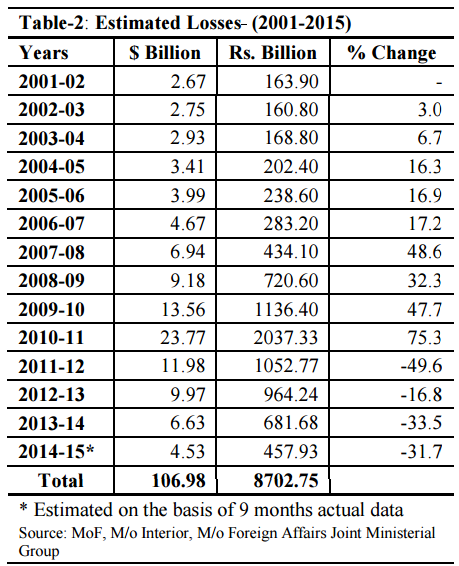
A government document Thursday claimed that Pakistan’s counter-terrorism related losses during the fiscal year 2014-2015 were down to about $4.5 billion from the $6.6 billion in the preceding year. The government reckons that the total losses to the economy since 9/11, when the country joined the US-led war against terrorism in Afghanistan, are around $107 billion.
These figures were revealed in the annual Economic Survey of Pakistan, a document that surveys the country’s economic performance and is released days ahead of the national budget. Federal finance minister Ishaq Dar unveiled the Survey.
Since the launch of the Operation Enduring Freedom (OEF) in October 2001, Pakistan has been trying to quantify the cost of conflict that it has suffered due to its partnership of the anti-terror alliance. The cost takes into account the loss of lives, diminishing economic opportunities and the damage to the country’s infrastructure.
Pakistan’s fiscal year begins on July 1, and closes on June 30.
Following is the story published in the daily Express Tribune.
Economic Survey 2014-15: Losses due to war on terror down by a third to $4.5b
ISLAMABAD: Though the total economic loss sustained by Pakistan due to War on Terrorism since 9/11 rose to $107 billion, the yearly losses from terrorism declined by a third to $4.5 billion in the outgoing fiscal year, in part due to a military offensive against militants in the tribal areas and the Karachi operation.
Finance Minister Ishaq Dar said on Thursday that the country sustained $4.53 billion direct and indirect losses from terrorism in fiscal year 2014-15- $2.1 billion (31%) less than $6.63 billion sustained in fiscal year 2013-14.
Although, the amount is significant, in terms of its impact on the public finances and the economy, the downward trajectory marks an improvement in the overall security situation.
The cost of lost export opportunities increased from $530 million to $730 million in outgoing fiscal year. The expenditure overruns due to war on terrorism have been estimated at $620 million, against $290 million in the previous fiscal year.
The cost of foreign investment went down from $2.1 billion to $900 million in the outgoing fiscal year. The cost of loss of industrial output decreased from $300 million to $200 million. The losses on account of less tax collection decreased from $2.52 billion to $2 billion, which is still significant.
In the category of others, the losses reduced from $720 million to $550 million, according to the survey.
The cost of uncertainty also reduced from $700,000 to $200,000.
Fiscal year 2014-15 was the consecutive fourth year when there was reduction in economic losses suffered from terrorism over the preceding year, shown under a section of the Economic Survey of Pakistan.
Dar explained that the quantum of losses was declining due to implementation of National Action Plan after the Peshawar tragedy, in addition to efforts in the Karachi and Zarb-e-Azb operations.
After 9/11, Pakistan had started including the cost of terrorism in its annual economic performance presentations, as the country heavily suffered on account of loss of lives, economic opportunities and damages to infrastructure.
The US drone attacks have drastically reduced, which also helped lowering the direct losses to the infrastructure and human lives, according to the defense experts.
After 9/11, the cumulative impact of these developments adversely affected the overall growth rate in all major sectors of the economy, according to Economic Survey of Pakistan. It added Pakistan continued to pay a heavy price both in the economic and security terms and substantial portion of precious national resources both, men and material, have been diverted to address the emerging security challenges for the last several years.
During the last 14 years, the survey said Pakistan had incurred $106.98 billion (Rs8.7 trillion), in direct and indirect costs owing to terrorism.
The total cost is twice next year’s proposed total budget of Rs4.2 trillion.
The cost has been worked out by an inter-ministerial committee, having representation of Ministries of Finance, Interior, Foreign Affairs and a Joint Ministerial Group.
The US embassy in Pakistan has long been opposing Pakistan’s decision to publish the cost of terrorism due to differences over methodology used to work out the price, officials privy to the discussions say.
Pakistan's Cost of Conflict down, Government claims
TOP STORIES
TESTIMONIALS
“Polarisation and social unrest can only be tackled through social cohesion and inclusive dialogue.”