



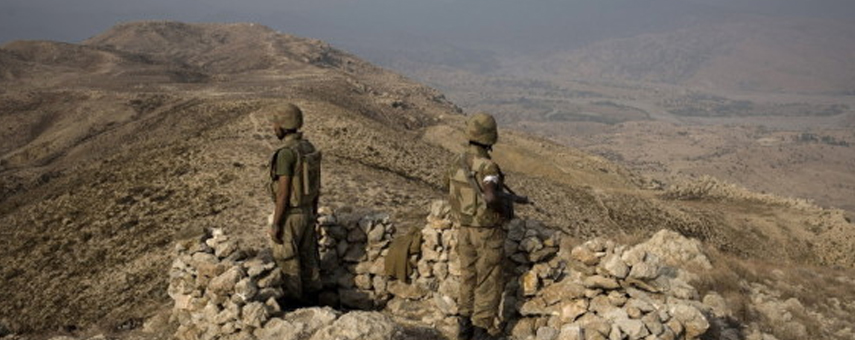
The ongoing War on Terror, militancy, operation Zarb-e-Azb, and now sectarian terrorist attacks; it seems as if Pakistan’s terrorism woes are still far from over.
In the past three weeks, the country has witnessed many major terror attacks in Shikarpur, Lahore, and Peshawar.
Although the attack in Lahore, killing 8, targeted the Pakistani Police, the other two, killing 81, specifically targeted Shiite Muslim places of worship.
Pakistan had witnessed a sharp fall in terror attacks on places of worship and public spaces since the initiation of military operation Zarb-e-Azb in 2014 in the lawless Federally Administered Tribal Areas along the country’s border with Afghanistan. But this long lull presumably was just the calm before a backlash for which terror outfits were apparently preparing.
Since the onset of US War on Terror in Afghanistan, more than 40,000 people have lost their lives in Pakistan – a majority of which were militants from major terror outfits.
Sectarian terrorism – a two-decade-long nuisance – spiked post-2001 in Pakistan. Since 1989, close to 5,000 Pakistanis have lost their lives in various incidents of sectarianism, 3,500 of whom have died since 2001 alone. These numbers not only indicate a serious security dilemma, but also speak to the complexity of the country’s terrorism and extremism problems.
Sectarian violence in the past was merely confined to a handful of regions, but the recent spate has expanded as far as Sindh Province, along Pakistan’s southeastern border with India.
In order to tackle this challenge, the government must pay special attention to law enforcement agencies, especially police, who could effectively tackle and counter various militant outfits based in rural areas of Punjab and Khyber Pakhtunkhwa.
In such a dire situation, Pakistanis are looking forward to December 2014’s National Action Plan (NAP) put forward by the Prime Minister Nawaz Sharif-led government. The NAP, presented in the wake of a deadly extremist attack on a Peshawar school in December, aims to clamp down on militant organizations by not only taking action domestically, but also authorizing the country’s finance and foreign ministries to reach out to friendly Muslim states to help cut off terrorist funding from abroad.
The NAP also saw the PM approve the establishment of military courts to try and prosecute convicted terrorists, who could otherwise not be tried in civilian courts.
Something worth considering for the government relating military courts is the timeliness of judicial process. As the military courts are to receive cases on referral basis from civilian courts, it is important that the time taken to expedite a terrorism case should be minimal.
One of the biggest positives coming out of the NAP was renewed civil-military cooperation with neighboring Afghanistan. Both countries have agreed to take strict measures against Maulvi Fazlullah – the Afghanistan-based head of Pakistan’s Tehrik-e Taliban – and his aides.
Both countries have launched joint military operations in Kunar and regions on the Af-Pak border where Fazluallh and other terrorists are reported to be taking refuge.
Moreover, Sharif and Army Chief General Raheel Sharif’s interactions with Afghan and ISAF counterparts seem to indicate renewed military cooperation between Pakistan and security forces in Afghanistan.
The Afghan government, with assistance from Pakistan, has also initiated a peace dialogue with the Taliban. Afghanistan and Pakistan realize that security in both countries is intertwined, and thus have started exploring all possible avenues for peace.
Pakistan is currently in the middle of extraordinary circumstances that call for extraordinary measures. Many in the country believe this to be a defining moment in the fight against terrorism.
Sharif, taking on board all important stakeholders, should make sure the NAP is implemented in its true spirit, as Pakistan can hardly afford a moment of weakness against terrorists.
Also, the ruling elite must take into consideration the fact that extremism is not only a physical phenomenon, but also an ideological one. Once the physical war is over, the government must take all possible measures to fight and eradicate the psychological form as well.
The Peshwar attacks succeeded in getting the whole Pakistan nation, irrespective of any differences, on one page. It is high time that this page is turned and written into a book of long-lasting peace in Pakistan.
The author Farooq Yousaf is a Research Analyst/ program consultant at the Centre for Research and Security Studies, Islamabad.
Published in Global Times, February 25, 2015