



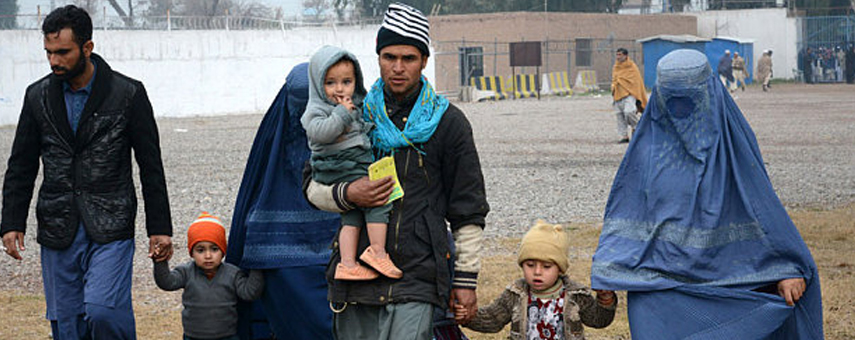
Pakistan often suffers from the inability of the political elite to rationally process complex national problems, and rely on rhetoric and misleading/emotive public sentiment to drive a particular agenda. Recently, this has been particularly true of the Afghan refugee/migrant issue, which has existed in one form or another for nearly four decades. At present, following high profile attacks blamed on cross-border terrorism from the Afghan side, and facilitators on the Pakistan side with Afghan connections, there has been a pronounced push to deal with the Afghan refugee/migrant issue.
Unfortunately, the solution has manifested itself as national and social media campaigns calling for the immediate deportation of Afghan refugees.
It is disheartening to see an incredibly complicated and longstanding problem whittled down to the bigotry and xenophobia. It is a horrid little sentiment, first to conveniently place the blame on the otherness of an already marginalized group, and second, to call for their blanket ostracization.
This is not to say that there are no problems. The Durand Line osmosis is a persistent problem that is further exacerbated by porous mountain terrain. Further, with the sheer volume of refugees and migrants, it is inevitable that a small percentage of miscreants, criminals, terror sympathizers and militants will get through.
Even in a country like Germany, currently experiencing the influx of a massive volume of refugees fleeing the Syrian war, the authorities accept the fact that even with heavy screening, a few bad apples will make it through to the population centers. However, for them, this is not reason enough to turn their backs on people who have fled a devastating warzone, fighting for their right to simply exist. Conversations with officials at the German Foreign Office show that they are fully cognizant of the problem, but this is not reason enough for them to close their doors to refuges. This is because the Germans, as a pluralistic society, see the value of diversity and acceptance. It is because for them, the ideals of tolerance, equality and lending a helping hand, despite the inherent risks involved, is more important than misplaced prejudice and a vocal public minority driven by narrow-mindedness.
Pakistan has a fantastic history of supporting and accepting refugees. For nearly forty years, we have accepted habilitated, naturalized and supported Afghan refugees. They are a part of our national story and history, and they have helped shape Pakistan into what it is today. Pakistan is maturing democratically and politically, and part of that process has to be to strip away these misplaced notions, strengthen institutions to help provide better national security, accept the fact that no system is 100% foolproof in a problem of such massive scale, and continue to be the country that has selflessly and willfully protected and sheltered refugees by the millions for decades.
The author Zeeshan Salahuddin is a journalist and senior research fellow at the Center for Research and Security Studies (CRSS). This article originally appeared in Friday Times, August 13, 2016. Original Link.