



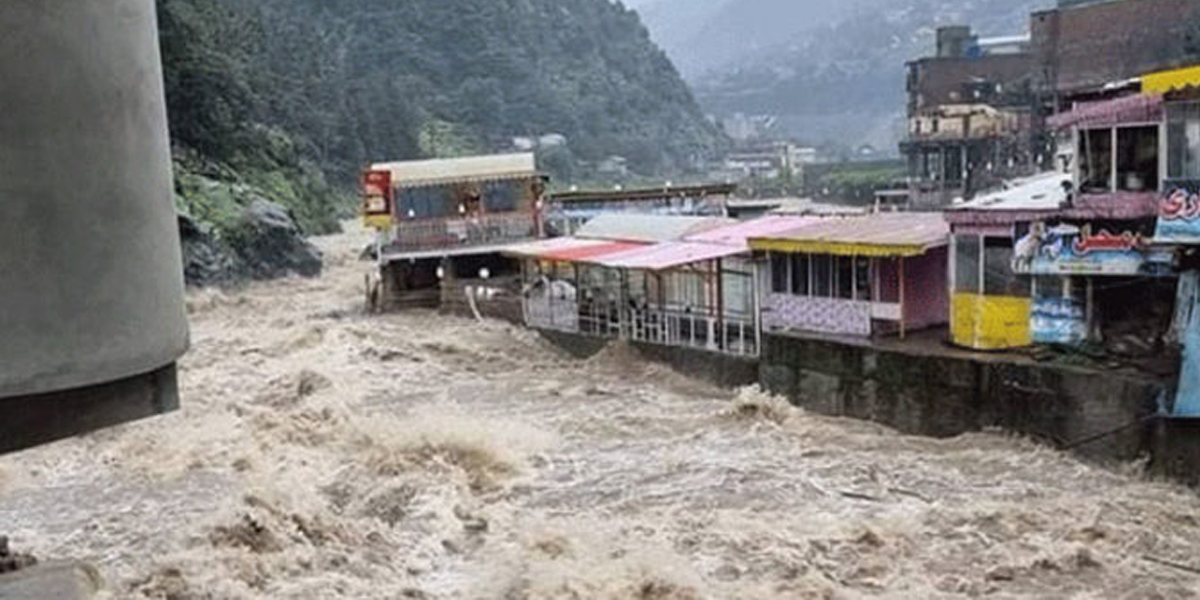
Climate Change Isn’t the Only Culprit — Pakistan’s Floods Expose Planning & Institutional Failures
In his letter to UN Secretary-General António Guterres, Engineer Arshad H Abbasi argues that Pakistan’s devastating floods are not only the result of climate change but also of long-standing governance and planning failures. He recalls how past catastrophes, including the 2010 and 2022 floods, exposed vulnerabilities that remain unaddressed. Abbasi highlights unchecked deforestation, unsafe construction on unstable slopes, and the lack of preventive measures such as river zoning and long-term planning as factors that continue to magnify destruction. He calls for urgent reforms to introduce effective zoning, protect forests with technological monitoring, enforce building safety standards, and strengthen flood management, warning that without these steps Pakistan will remain trapped in a cycle of predictable catastrophe.
Letter to the UN Secretary-General
His Excellency António Guterres
Secretary-General, United Nations
Your Excellency,
I recall with deep gratitude your powerful remarks at the Informal Briefing to the General Assembly on 27 September 2023, one year after the devastating 2022 floods in Pakistan. You reminded the world that the floods submerged one-third of the country, displaced 33 million people, and caused damages exceeding $30 billion. You said that “Pakistan is a double victim — of climate chaos and of a morally bankrupt global financial system.” Your words carried truth, compassion, and urgency.
But today, I must ask: what has the government of Pakistan done since 2022 to reduce these risks?
It is worth mentioning that CRSS released a comprehensive report on the catastrophic floods of 2010 and 2022 to both the public and the Government of Pakistan nearly 18 months ago, urgently calling for immediate and decisive measures.
https://crss.pk/the-myth-of-climate-change-in-pakistan-sorrow-tale-of-systemic-failures/
This year, floods again devastated Khyber Pakhtunkhwa, Gilgit-Baltistan, and Azad Jammu & Kashmir. The real tragedy is not nature’s force, but the failure of institutions and leaders to protect citizens from predictable disasters. History has already given us enough warnings. The catastrophic floods of 2010 exposed the same vulnerabilities. But instead of reforming, the Federal Flood Commission (FFC), a federal institution, concealed corruption and incompetence behind the vague banner of “climate change.” Even five thousand years ago, the Indus Valley civilization was destroyed in part by recurring floods. And yet, in today’s Pakistan—equipped with satellites, hydrological models, and scientific expertise—we continue to repeat the same fate.
For over fifty years, the FFC has neglected its most sacred duty: river zoning. It has never mapped maximum flood zones, never drawn the lines to keep communities safe, and never enforced restrictions on dangerous encroachments. India carried out river zoning decades ago, but Pakistan continues to bleed every monsoon because of institutional paralysis. Our floodplains remain unprotected.
The tragedy is worsened by the destruction of forests. Khyber Pakhtunkhwa once held nearly 40 per cent of Pakistan’s forests. Today, illegal logging has reduced them to stumps. Without roots to bind the soil and canopies to slow the rain, the land collapses at the first assault of water. Landslides clog rivers, temporary dams form and then burst, and torrents of flood rush down valleys with apocalyptic force. Forests are not ornaments—they are shields. Their destruction is not merely environmental vandalism; it is a death sentence for vulnerable families.
The danger grows with reckless construction. In mountainous areas like Khyber Pakhtunkhwa and Gilgit-Baltistan, houses are built on unstable slopes without geotechnical surveys. Heavy rains strike slopes stripped of trees, the ground collapses, and poorly built structures crumble—triggering landslides that sweep away entire communities. We have seen similar disasters in Uttarakhand, India. The lesson is the same: when forests are cut and mountains misused, floods and landslides are inevitable.
Solutions exist, but political will is absent. Years ago, during the New Murree Project, I worked to demonstrate how technology could safeguard fragile ecosystems. We showed how embedding electronic chips in trees, connected to sensors, could transmit real-time data on tree felling to a central system, enabling authorities to stop illegal logging instantly. The technology was feasible, cost-effective, and ready to deploy. But like so many opportunities, it was shelved.
Your Excellency, this is why Pakistan’s disasters cannot be blamed solely on climate change. They are also born of betrayal—by institutions that refused to act, leaders who chose silence, and corruption that stripped our natural defenses. Climate change intensifies rainfall, but it is corruption, deforestation, and reckless development that turn storms into slaughter.
The path forward is clear, but remains untraveled:
- River zoning must begin immediately. Communities in high-risk floodplains must be identified, relocated, and compensated fairly through resettlement programs.
- Forests must be defended. Strict bans on illegal logging must be enforced with technological monitoring systems that leave no room for evasion.
- Building codes must be enforced in mountainous regions, with mandatory geotechnical surveys and strict limits on steep-slope construction.
- The Federal Flood Commission must be reformed—cleansed of corruption and inertia.
Your Excellency, I appeal to you to ask the Government of Pakistan directly:
- What concrete steps have been taken since the 2022 floods to implement river zoning?
- What measures are in place to protect and restore forests?
- How are building codes being enforced in fragile mountainous regions?
- What reforms has the Federal Flood Commission enacted to prevent history from repeating itself?
Instead of solely blaming climate change, Pakistan must confront its institutional negligence. Until these measures are taken, Pakistan will remain trapped in repeated catastrophe. Each flood will come stronger, deadlier, and more unforgiving.
Your Excellency, I beg you to use your voice once more to hold Pakistan’s leaders accountable—not only to the promises made after 2022, but to the lives that depend on decisive action today.
With urgency and hope,
Engineer Arshad H Abbasi
BOG member CRSS
ahabasi@gmail.com -00-92-333-5144405
(The views and assertions expressed in this letter are entirely those of the author. They do not necessarily reflect the views, policies, or positions of CRSS, which provides this platform solely to encourage informed dialogue.)