



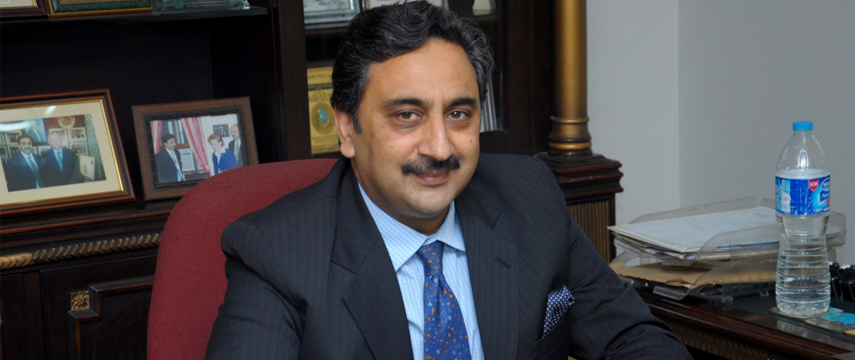
The parliament of Pakistan passed 21st amendment to the constitution on January 6, 2015, which provides for the composition of military courts for the period of two years for speedy trial of the terrorism related cases. However, the 21st amendment has triggered a debate; whether its composition is according to law and international standards of human rights? Former Law minister and highly esteemed international law jurist Ahmar Bilal Soofi speaks about its formation at a discussion forum organized by Research Society of International Law (RSIL), “Pakistan is in its rights to constitute these courts which mostly conform to the international law”. Meanwhile, Soofi brought Pakistani security dynamics to light in the context of international law as well as laws of Pakistan.
Soofi said, “Pakistan is in a state of war and every segment of the Pakistani society, from government in the center to governments of provinces, opposition and political parties, civil society and local populace all agree that a war has been waged against the state of Pakistan. We must fight back to protect our state and constitution as loyalty to the state is duty of every citizen and obedience to the constitution an obligation of every citizen, referring to article 5 of the Pakistani constitution”. He further stated that United Nations (UN) resolutions 1267, 1373 and 1540 are binding on its all member states. The international law obligations are not only binding for the center but its federating units as well, he said.
In Pakistan law of war can be invoked by the use of article 245 and 256 of the constitution. Article 245 states that
(1) The Armed Forces shall, under the directions of the Federal Government, defend Pakistan against external aggression or threat of war, and, subject to law, act in aid of civil power when called upon to do so.
(2) The validity of any direction issued by the Federal Government under clause (1) shall not be called in question in any Court.
Furthermore, article 256 forbids private militias,
No private organization capable of functioning as a military organization shall be formed, and any such organization shall be illegal.
These provisions of the constitution are in addition supported by the section 79 of Pakistan Army Act 1952, amended in 2015. And section 127 of Pakistan Police Act 1861. Moreover, there is a complete set of laws for terrorism related cases, which falls under Anti-Terrorism Act 1997.
Soofi while addressing international law stated that, article 8 of the Rome Statute of international court provides for the use of force.
Article 8 (2)(C)is about
Violence to life and person
8 (C) – Intentional attacks against civilians and international attacks against property.
However, Ahmar Bilal Soofi while emphasizing on the use of force also highlighted the due process and said, “There must be a fair trial and all actions must be taken in due process”. As it’s binding according to International Covenant on Civil and Political Rights (ICCPR), article 14, which provides for the information of crime and charge to the accused, adequate time and facilities for defense to the accused and he must be tried in his presence. Meanwhile, according to United Nations Human Rights Council the provisions of article 14 of ICCPR apply to all courts and tribunals within the scope of this article.
As military courts are yet to be formed, and some have filed petitions against the formation of military courts in Supreme Court of Pakistan, Soofi suggested to the honorable court, “Court would have to distinguish between law of war and law of peace. And Supreme Court will also have to define enemy, section 83 CPc and the concept of enemy alien”. The Pakistani army act section 8 (8) defines enemy as all armed rioters, mutineers, armed rebels, pirates and any person waging war against the state.
Last but not the least he suggested selected cases be sent to the military courts. A criterion must be developed to ascertain the objective and management of these courts.
Written by Abbas Ahmad, Research Fellow at CRSS