



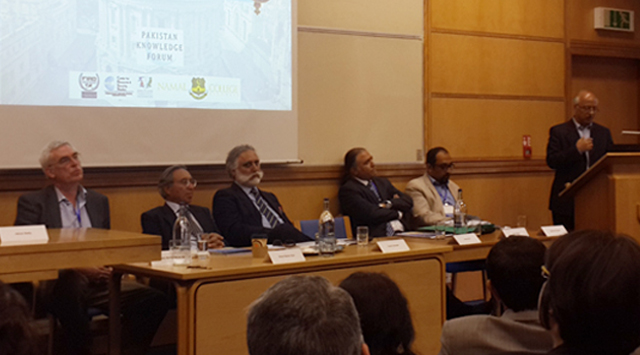

CRSS Executive Director, Imtiaz Gul, read this extract from a paper titled, ‘Judicial Activism and Rebalancing of Power among State Organs’ for an international conference, ‘Pakistan: Opportunity in Crisis’ held at Oxford University St Anthony College, May 10-11, 2014.
Before discussing the historical evolution of judicial activism and its implications for the present day Pakistan, two big factors must be kept in mind to explain the context:
- Domestic Factor
Ruling elites– largely squabbling self-serving landed aristocracy provided the pretext of intervention to the military within seven years of Pakistan creation in 1947 ´ resulting in three long military rules that stunted Pakistan growth as a democracy. This landed aristocracy and civil service bureaucracy served as the social crutches for the encroaching military and thus we have a Pakistan that continues to reel from the predominance of the general headquarters located south of Islamabad.
- Geo-Political Factor
Pakistan location ´ surrounded by India, Afghanistan, bordering with China and Iran ´ has sucked the country into endless conflict and wars. Running animosity with India, tensions with Afghanistan following the Soviet-Russian occupation of that country, and its recent clear lap-up of Saudi Arabia to the displeasure of Iran has often forced external forces such as the US and UK to deal with and legitimize military rulers, thereby lending undue legitimacy to military coups.
Dr. Peter R. Lavoy, who retired earlier this year as Acting Assistant Secretary of Defense for Asian and Pacific Security Affairs, recently also explained this in about a dozen words. During a lecture at the Institute of Strategic Studies three days ago in Islamabad: Answering a question about US polices towards Pakistan in the context of US India nuke deal,
“Equity, fairness and justice in international politics are some time overtaken by the principle of might is right”.
No doubt, what we see today is a direct consequence of the principle Might is Right, unusual socio-political circumstances inside Pakistan too; bad and mis-governance, Military predominance in political economy and foreign affairs, and also its tradition of having emasculated the senior judiciary for decades.

Let first compare two major phases of Judicial Activism:
- Sajjad Ali Shah, Oct 1997 ´ Nawaz Sharif was summoned twice before the court to explain his conduct which was seen as contempt of court.
This was the first major challenge to civilian authority but in the end only two judges, who declared the prime minister disqualified and dismissed his government, but about a dozen other judges stood by Nawaz Sharif. They thought the chief justice had gone too far in what he thought was the right way of taking a wayward civilian prime minister to task. The military was not visible anywhere in this tug of war between the court and the prime minister, probably because the then president was doing the bidding of the GHQ.
- The second judicial challenge ´ this time to the mighty military establishment ´came from Chief Justice Iftikhar Chaudhry.
Chaudhry stood his ground in the face of five generals, refused to be cowed down into compliance on March 9, 2007. General Musharraf reacted with the hasty suspension of Chaudhry and other senior judges. Musharraf did not realize though that the history had moved a full circle. The judicial abettors of military take-overs had decided to pay penance for their dubious past. The consequence was that all 12 or so judges of the Supreme Court stood united in the face of an arrogant president, who desperately needed the Supreme Court support for his presidential election.
And thus began an era of the hyper judicial activism, resulting in the restoration of about five dozen senior judges mid March 2009.
Judicial Activism morphs into Judicial Assertion (2009 ´ to date)
Since judiciary restoration in Pakistan, the Supreme Court of Pakistan started a frequent exercise of its judicial powers in all sorts of matters ranging from political, social, and economic to foreign direct investment (FDI). More specifically, it used and possibly also abused its ‘suo moto’ jurisdiction.
The powers of taking suo moto action, i.e., ‘on its own motion’, is vested in the Supreme Court by Article 184 (3) of the Constitution.
The apex court, under Chief Justice Iftikhar Chaudhry, took up over 100 suo moto actions since 2009 which include actions against army personnel, politicians, government officials and even several media persons. Due to its suo moto actions in the last five years, it placed immense pressure on not only the military but also the elected parliament and the federal government, claiming that the Supreme Court possessed overriding powers of suo moto actions conferred on it by the Constitution. The popularity of suo moto actions even encouraged High Courts of the four provinces to exercise this authority even on insignificant issues.
The Supreme Court even extended the scope of public interest litigation (PIL) which expanded the constitutional fundamental rights of individuals. In the expansion of the fundamental rights, saying that ‘any case which raises a matter of constitutional interpretation and enforcement regarding the composition, processes and powers of the legislatures is thus by its very nature a case of public importance, as it affects the rights of the public at large, and also affects the Fundamental Rights of the citizens.’
This assertion based on fundamental rights enshrined in the constitution of Pakistan essentially catapulted the Supreme Court into an unprecedented position, placing it at par, if not above, with the military and the civilian executive.
Impact
Encouraged by the popular response to its activism, the court began confronting the military establishment for hundreds of missing persons. It intervened to declare the US drone strikes illegal and asked the government and the military to explain its position, summoning senior army and intelligence officials like never before.
The court also kept blowing hot and cold on former president Zardari on account of corruption cases instituted against him over a decade ago.
In June 2012, the Supreme Court of Pakistan, for the first time, disqualified a Prime Minister from holding a seat in the parliament. Prime Minister Yousaf Raza Gilani had been convicted for contempt of court and the Supreme Court disqualified him retroactively from April 2012 in June 2012.
The extent of judicial activism has been such that the parliament and the executive have now become uncertain about what they can do or cannot do.
But the interventionist approach by the senior judiciary also has had a debilitating impact on issues which have primarily been administrative and often related to economy. This also strained relations with Turkey and Netherlands because their companies were involved in cases that the court thought were not transparent, and also a Canadian multi-national TCC.
Economist and a former governor of the central bank Dr. Ishrat Hussein at the recent international judicial conference in Islamabad (April 2014) highlighted this predicament, particularly of the foreign investors by telling the judges that their interventions had basically discouraged new business for fear of the court suo moto jurisdiction that he said had been excessively used.
The Bigger Picture
Critics tend to apply universal yardsticks when judging the conduct of the senior judiciary, particularly under CJ Iftikhar Chaudhry, and by doing so they end up nullifying the good that judicial activism has broadly done to Pakistan.
Suspension of judges, the lawyers– movement and the eventual political support for the restoration of the judges in March 2009 in fact injected a new dynamism into Pakistan political economy. Basking in public appreciation, the judges saw an opportunity in taking the bull by the horn i.e. challenging the thus far unchecked arbitrary decision making by the civilians and the military to the pleasure of common people.
From this perspective the courts have tipped the balance of power in favor of the state. But, if one were to draw on the examples of Australia, United States, Germany or UK, the legal framework governing the state there remains deeply cognizant of, and committed to, secular political governance. The courts there go simply by the law of the land, without discriminating among its citizens on the basis of belief, cast or creed.
The stack of blasphemy cases, or the Supreme Court interventions in the case of the Red Mosque (the orders for compensation, for example) simply go against the expedience of rule of law the way a state would want to enforce it (and in the countries mentioned above the judiciary did not intervene when they enforced new regulations to cope with the emerging challenges in the post 9/11 era).
Similarly, intervening in the gas or power price fixation mechanisms also do not find any parallel elsewhere. This is best left to the executive and the parliament.
The 2006 intervention in the Pakistan Steel Mills privatization, for instance, has thus far cost the tax payers at least 100 billion (the bail-out packages by the federal government). The PSM is simply a white elephant, as much as the PIA and WAPDA ´ which the ruling elites have used as ‘extractive institutions’ to benefit their cronies ´ friends and families.
Critics also argue that the judiciary has not been hard enough on the military establishment. But one must also keep in mind that an institution that has been deeply entrenched in Pakistan political governance for over six decades, and which tended to emasculate other institutions and exploit their perceived weaknesses, finally found in the SC an adversary that was rearing its head and hold it accountable. With the categorical rejection of the doctrine of necessity and a vow not to legitimize illegal take-overs by the military, the judiciary has emerged as a formidable challenge to the traditional triangle of the ruling elites i.e. military, bureaucracy and the politicians.
Comment on recent tensions between military and government:
‘With the military diminishing political power post-2007, it was an ideal situation for the elected government to assert its authority in various policy realms. Though the military continued to dominate national security policy and influence foreign affairs, its political role had certainly receded. That provided significant political space for the elected civilian government to focus on critical issues of governance and on strengthening democratic institutions. An assertive superior judiciary also transformed the power matrix, further shrinking the room for any extra-constitutional intervention.’ Zahid Hussain: May 07, 2014. Dawn.com.
Under the present Chief Justice Jillani, the Supreme Court appears to be gradually departing from the Chaudhry legacy and has even called for a possible review of the article 184-3 ´ the suo moto – that grants the Court the intervene in issues of public interest and fundamental rights. It appears to be a conscious attempt to move away from the feared populism under Iftikhar Chaudhry to a more rational, dispassionate approach.
Cumulatively, the Supreme Court has emerged as a beacon of hope for common Pakistanis who feel helpless in the face of powerful civilian kleptocrats and the might of military establishment. The senior judiciary is setting new benchmarks for, and putting limits to, the rulers– arbitrariness. This is what represents an opportunity for Pakistan to survive its multiple crises and emerge stronger if the ruling elites commit themselves to the rule of law. This also promises hope for Pakistan.