



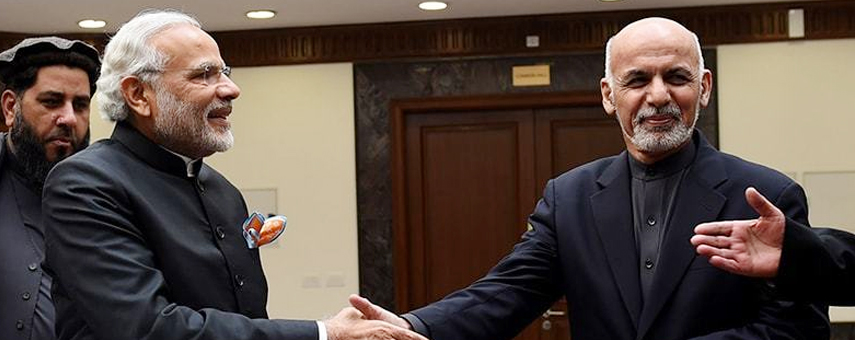
For the past 10 years or so, India has been fishing in the troubled waters of Afghanistan for a central role and to marginalize Pakistan in the final settlement of the Afghan issue. Despite its historical relations, bolstered by a decade-long Hamid Karzai’s pro-India policies and its surging ability to extend economic assistance, India did not really succeed in its mission. Even the signing of Strategic Partnership Agreement in 2011 did not ensure Indian primacy to the extent that Pakistan should feel squeezed and its interests crashed beyond repair. Now that President Ashraf Ghani in his visit to New Delhi has completely reversed his two-year-old policies of depending on Pakistan rather than on India, Pakistan is deniably nervous. Civilian and military establish are denouncing the move as a grave security threat for Pakistan.
The US government and Afghanistan jointly agreed that India could play a bigger role in Afghanistan under a trilateral framework. India was already providing weapons, raising the fighting capacity of the Afghan Army and the National Police against Taliban groups and ISIS. To this effect, a conclusive statement came at the India-US Strategic Commercial dialogue in Delhi on August 29, 2016 from Secretary of State John Kerry. He announced that in September the United States, India and Afghanistan would finally hold a trilateral dialogue in New York this month.
For those who have been watching Indian maneuverings during the decades-long government of President Hamid Karzai and Pakistan’s continued failure to assuage Afghan’s concerns regarding Islamabad efforts to persuade Taliban groups to remain engaged in national reconciliation process aimed at reduction of violence and establishing lasting peace in Afghanistan, the tripartite agreement is not a big surprise. With Quadrilateral Coordination Group (QCG) of Afghanistan, Pakistan, the United States and China dead, and no possibility of all Taliban groups minus Hekmat Gulbadeen Yar group entering into talks with the Afghan government, India got the chance to present itself to the US and Afghanistan as a credible ally in the fight against Taliban and ISIL
The move has been projected in Media as an attempt to designate India as a ” successor of US” to take over Washington’s role in Afghanistan in the hope that Afghans will remain positively inclined towards any move to synergize their efforts to promote national reconciliation, leading to stable Afghanistan. Due to the sensitivity involved, the finer details of the Indian engagement in Afghanistan may never come out even after President Ghani’s 2-day visit to India, from September 14.
But the impact is palpable. The Afghan leadership has already started issuing threats to Pakistan. President Ghani warned closing down the transit route for Pakistan to Central Asian countries as the Wagah border has been closed for the Afghan traders for import and export (denied by Pakistan) to India.
The courting of India by Afghanistan carries a veiled security threat to Pakistan and a rude snub to repeated complaints Pakistan has made to the Afghan Government over misuse of its territory by India to ferment instability and mayhem by financing terrorism in Baluchistan and Karachi. The change will be seen more than a pressure tactics in Pakistan.
India and Pakistan have been jostling for influence in Afghanistan. Pakistan as a next-door neighbor and home of Pashtuns as majority mostly had an upper hand over India. However, some developments occurring in last two months helped charter out the new assertive role for India in Afghanistan. These developments include i) the visit of General John Nicholson Junior, Commander of Resolute Support Mission and US Forces to India early August and his backing Afghanistan’s request for more helicopter gunships from India, ii) the 4-day visit of Afghanistan’s Army Chief, General Qadam Shah Shahim, in the last week of August and iii) the last visit of Hamid Karzai to India in mid August.
The events on the face value are not directed at Pakistan. Afghanistan has the legitimate right to request any country for military assistance. It is also free to develop relations with any country it likes and can pursue any mode of intra-Afghan reconciliation it feels appropriate. It can choose to allow or deny transit rights to any country provided the denial does not violate land lock country’s access to sea.
But given the past Indian policies in Afghanistan and the current Indian inimical activities from Afghanistan against Pakistan, the new Indian role looks like another ring in the encirclement of Pakistan. The exclusion of Pakistan from the proposed trilateral talks is a big diplomatic gain for Indian diplomats and Security agencies officials. India has all the reasons to be ebullient and Pakistan concerned but not despondent.
The price India has paid for this distinction is not small: Bilaterally, India has to invest more than $ two billion, became a major source of weapons and military equipment, and development partner for Chabahar port. On September 14, India offered a fresh one billion dollars in aid to Kabul for building capacity in education, health, agriculture, energy and infrastructure. Strategically, India integrated itself with the US global agenda of encircling China, risking further informal polarization of South Asia into pro or against China block. While it is up to historians to judge whether India paid an hefty cost, its reward is likely to be grand: the continued US support for NSG and UNSC, access to high tech military equipment and nuclear facilities, and use of US airbases against perceived enemies for air attacks or smart espionage.
The more relevant question today is whether the new status given to India in the context of Afghan imbroglio will generate more tension or a smooth way out to ease the intra-Afghan conflicts. According to Siegfried O. Wolf, a South Asia analyst at the University of Heidelberg Afghans are increasingly concerned about the severe impact the geopolitical struggle involving Afghanistan, Pakistan and India is having on their lives and security. The answer lies with the ground reality in Afghanistan. Sampath Perera and Keith Jones reported on 10 September 2016 that experts believe Afghanistan’s increasingly close ties with India are a reason for the uptick in violence in Afghanistan.
The ground reality, confirmed and repeatedly expressed by the west, is that Taliban and other groups are winning against the Afghan government. The latest report by the US Congressional watchdog SIGAR reveals the extent of the ominously receding writ of the state and territorial gains by the insurgents. The report divulges that the area under the Afghan government “control or influence” has decreased to 65.6 percent by the end of May from 70.5 percent near the end of January. The Japanese Media finds the situation worse than in 2001 when the US sent forces in Afghanistan. Further, the mounting differences between the President and the CEO have seriously eroded the government’s writ and capacity to stem the insurgent Taliban. Now when anti-India Taliban are winning, how will they react to the Indian weapon supplies to the Afghan government is not an enigma.
Wolf, a South Asia analyst at the University of Heidelberg, is of the view that the recent Taliban statements show that the jihadists are identifying India not only as a partner of US interests in Afghanistan but also as an increasing successor in military terms and subsequently as a primary target. The statement of the spokesperson of Taliban, Zabihullah Mujahid, issued on September 4 betrayed the same trend. He urged New Delhi to stop giving defense equipment to the Afghan government and condemned it as a “clear hostility” towards the war-ravaged nation. It is not a surprise that discerning analysts have starting conjecturing that the Afghanistan’s friendship at the cost of Pakistan will imperil regional security by fuelling existing alliances and rivalries in the negative fashion.
The most unfortunate dimension of the issue is that President Ghani has raised the ante blaming Pakistan solely for his troubles in Afghanistan during his just finished visit to India. He seems to have bought the preposterous Indian propaganda that the terrorist activities financed by India in Baluchistan is “a war which the Media does not speak about. The second war is the war in Pakistan. There are two hundred seven thousand members of the Pakistani army just in Khyber Pakhtunkhwa and of course in Baluchistan”.
There is no harm if President Ghani wants to break Afghanistan’s economic and strategic dependence on Pakistan by ingratiating himself to the Indian leadership. Within this paradigm, he should, however, not forget the internationally acceptable interstate rule that national territory cannot be allowed for instability by a third state in a neighboring country. On this account alone, the Indian visit is poised to embitter the ongoing standoff between Afghanistan and Pakistan. Like in the past, it looks that the both sides one again miss the opportunity to consolidate common interests.
The way out looks highly bleak. Relations are not irreversible, just need to be nudged in a constructive direction Because, the ongoing flare-up in bilateral relations is a disastrous recipe for the region, particularly for Afghanistan and its immediate neighbors, both sides should take time out and rethink fresh options. The issue is that the two sides must consider what approach is mutually beneficial to resolve the Afghan issue: a myopic or a big picture approach. A myopic approach is divisive in nature and thus cannot ensure connectivity endlessly talked about by Afghanistan and India. President Ghani can issue a barrage of political statements but cannot deny that Afghanistan is and will remain a landlocked country. He should blame geography, not Pakistan for this. Undoubtedly, he has options, maybe more economical than those available in the past but certainly more expensive than he is bent upon ignoring for want of efforts. The big picture entails a win-win situation and creates adequate space for each country to consolidate its respective national interests.
Experts say that Afghanistan and Pakistan have to cooperate regionally and work towards normalization of their bilateral relations. If Afghanistan and Pakistan fail to improve their high stake relations, they will face not only economic disaster but also unravelling of whatever little national cohesiveness exits in their multi-ethnic populations.
Can India really replace Pakistan? One is reminded of a remark from Sayed Mahdi Manadi, a Kabul University lecturer, who told a German Radio recently “it is unclear if Afghanistan can really afford this gamble. Closer ties with India could be helpful for Afghanistan’s economy but, at the same time, it might create new security challenges for the country”. So there is an urgent need to understand each other’s security and economic concerns. Each other’s bashing or snubbing is not the right strategy to stem the growing mistrust.
Also, one should not forget that Afghanistan was initially wrecked as a country by foreign powers. It used to be a peaceful tourist paradise with a happy blend of liberal values and conservative traditions. It is incumbent upon them to return the peaceful past back to the war-torn Afghanistan. They should help the regional powers to unite against forces of poverty, under-development, and militancy instead of pursuing their own predatory global policies.
The author Mian Sanaullah is a former ambassador and Advisor to the independent Center for Research and Security Studies(CRSS).