



The 2016 BRICS Summit was the eighth annual BRICS summit held on the 15th and 16th of October, 2016 in Goa, India. It was attended by the heads of country or heads of government of the five member countries Brazil, Russia, India, China and South Africa.
Prime Minister Narendra Modi on Sunday continued to define Pakistan as the hub of terrorism, telling BRICS leaders’ meeting in Goa that India’s neighbour was the mother ship of the problem.
He obliquely disputed Chinese President Xi Jinping’s apparent reluctance to pin the blame on Pakistan, but the Chinese leader responded by seeking political solutions to the hotspots. Indian reports interpreted the reference to hotspots as including the dispute between India and Pakistan over held Kashmir.
“There must be no distinction based on artificial and self-serving grounds,” said Mr Modi, a day after President Xi remained firm on blocking India’s bid to get Jaish-e-Mohammad chief Masood Azhar designated as an international terrorist by the United Nations.
President Xi, in his 10-minute speech, did not hold back. In an apparent reference to India-held Kashmir, he talked about the need to find a “political solution” to “regional hotspots”.
He also called for concrete efforts and multi-pronged approach that addressed both “symptoms and root causes” to global challenges like terrorism — an argument that mirrored Pakistan’s position on Kashmir, local reports observed.
Russian President Vladimir Putin, in his remarks, did not mention terrorism at all.
With the differences between India and China out in the open — against the backdrop of Delhi’s attempts to isolate Islamabad — the Goa declaration stopped short of mentioning the Uri attack. “We strongly condemn the recent several attacks against some BRICS countries, including that in India,” it said.
However, there were five specific paragraphs on terrorism in the 109-para declaration, in which the BRICS members called upon all countries to work together to “expedite” the adoption of the Comprehensive Convention on International Terrorism (CCIT) in the UNGA “without any further delay”.
India’s National Security Adviser Ajit Doval had impressed upon his BRICS counterparts to put it back on the agenda, as it had been dropped in the Ufa declaration of 2015. CCIT had been mentioned in the BRICS statement in 2014.
The sessions on Sunday began with Mr Modi targeting Pakistan and calling it the “mother ship” of terrorism, weeks after India called Pakistan the “Ivy League of terrorism” at the United Nations.
“In our own region, terrorism poses a grave threat to peace, security and development. Tragically, the mother ship of terrorism is a country in India’s neighbourhood. Terror modules around the world are linked to this mother ship… BRICS must speak in one voice against this threat,” he said at the inaugural session of the summit.
A couple of hours later, while making the country’s statement at the BRICS leaders’ session, he took on both Pakistan and China, reports said. “Our response to terrorism must, therefore, be nothing less than comprehensive. And we need to act both individually and collectively. Selective approaches to terrorist individuals and organisations will not only be futile but also counter-productive. There must be no distinction based on artificial and self-serving grounds,” he said.
His comment on “artificial and self-serving grounds” was interpreted as indication of India’s disappointment with the Chinese leadership over the Masood Azhar issue. China recently put a “technical hold”, once again, on designating Azhar — accused in the Pathankot attack in January this year and the parliament attack in 2001 — as an international terrorist at the UN.
“Criminality should be the only basis for punitive action against the individuals and organisations responsible for carrying out terrorist acts. Terrorist funding, their weapons supply, training and political support must be systematically cut off,” Modi said.
‘Global challenges’
President Xi in his turn said: “We need to confront global challenges together. We, BRICS countries, share a common future. We are not only a community of convergence interest, but take concerted actions and make progress together. It is imperative that we step up coordination and communication on major international issues and regional hotspots and act in concert to find political solution to hotspot issues and take on such global challenges like natural disasters, climate change, infectious diseases and terrorism.”
“While speaking with one voice in calling for greater international input, we should also address issues on the ground with concrete efforts and multi-pronged approach that address both symptoms and root causes,” said the Chinese president. Indian reports saw in it a line voiced by Pakistan’s establishment.
While Mr Modi wrapped up the proceedings saying that the BRICS leaders were unanimous in their view about terrorism, the statement was strongly-worded — but did not name the Uri attack, which Delhi wanted mentioned, reports said.
Also, it did not mention any of the specific terror groups or use the phrase “cross-border terrorism”.
Xi warns of Globalization Backlash at BRICS Summit
Chinese President Xi Jinping said Sunday a rising tide of protectionism and anti-globalisation was endangering the world economy’s still fragile recovery as BRICS leaders vowed to forge closer business and trade ties.
BRICS was formed in 2011 with the aim of using members’ growing economic and political influence to challenge Western hegemony.
The nations, with a joint estimated GDP of $16 trillion, set up their own bank in parallel to the Washington-based International Monetary Fund and World Bank and hold summits rivalling the G7 forum.
But the countries, accounting for 53 percent of world population, have been hit by falling global demand and lower commodity prices, while several have also been mired in corruption scandals.
Russia and Brazil have fallen into recession recently, South Africa only just managed to avoid the same fate last month and China’s economy has slowed sharply.
Both Xi and Modi said the group must stick together, insisting there was much to remain positive about even though its members have been beset by domestic woes and problems sparked by the 2008 financial crisis.
“At present the deep-seated impact of the international financial crisis is still unfolding. The global economy is still going through a treacherous recovery and deep adjustments,” Xi said.
The Chinese president said “deep-seated imbalances that triggered the financial crisis” were far from being resolved.
“Some countries are getting more inward-looking in their policies. Protectionism is rising and forces against globalisation are posing an emerging risk,” he added.
While Xi did not single anyone out, Republican candidate Donald Trump has threatened to erect trade barriers to Chinese products if elected US president. Britain’s vote to leave the European Union has been interpreted partly as a backlash against globalisation.
While China’s economy has been running out of steam of late –although it is still the world’s second largest — India is now the fastest-growing major economy and its GDP is expected to increase 7.6 percent in 2016–17.
– ‘Deeper bonds’ –
Modi said it was vital the BRICS nations increased cooperation by dismantling trade barriers and developing infrastructure.
“I think I speak for all when I say that through a common vision and collective action, we will create and sustain deeper bonds among BRICS nations, develop our economies and secure our societies,” he said.
“While our achievements have been substantial, we need to sustain the positive direction and strong momentum of intra-BRICS engagement.”
Xi said BRICS countries had much to be proud of and had contributed to more than 50 percent of global growth in the last decade.
“The past decade has seen BRICS partnership expanding with win-win results,” he said.
“We need to deepen our partnership: we BRICS countries are good friends, brothers and partners that treat each other with sincerity.”
Russian President Vladimir Putin meanwhile called for closer cooperation in areas such as e-commerce and space exploration. Modi confirmed that the leaders had agreed to fast-track setting up a new ratings agency amid accusations from within the bloc that the three traditional agencies — Moody’s, Standard & Poor’s and Fitch Ratings — are all Western-based.
“We look forward to translating into reality the idea of a BRICS Credit Rating Agency,” he said, without giving details of the much-trailed agency or timeline for its establishment.
Modi, who is pushing to isolate Pakistan following a surge in tensions between the nuclear-armed neighbours, urged his peers to take a strong united stand against the “mothership of terrorism” in the South Asian region, in a thinly veiled reference to Pakistan.
But with China reluctant to embarrass its traditional allies in Islamabad, a joint statement at the end of the summit only referred to a vague goal of combating “cross-border terrorism and its supporters”.
China defends Pakistan after Modi’s ‘mothership of terrorism’ remark
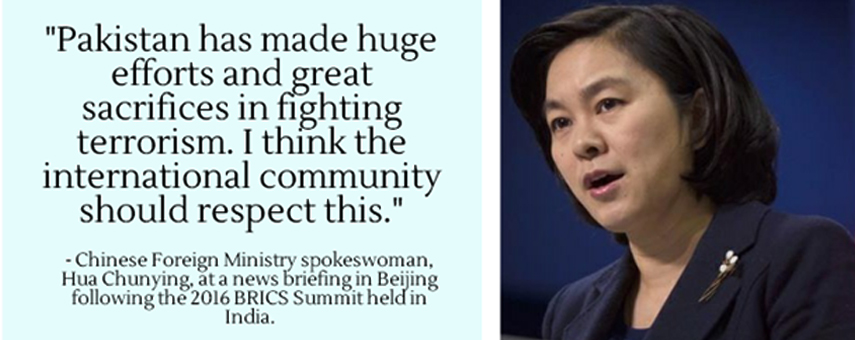
Chinese Foreign Ministry spokeswoman Hua Chunying, asked about Modi’s comments, said China opposed all forms of terrorism and that the international community should increase counter-terrorism cooperation.
“We also oppose the linking of terrorism to any specific country, ethnicity or religion. This is China’s consistent position,” she told a daily news briefing in Beijing.
“Everyone knows that India and Pakistan are victims of terrorism. Pakistan has made huge efforts and great sacrifices in fighting terrorism. I think the international community should respect this,” Hua added.
China and Pakistan consider each other “all-weather friends” and have close diplomatic, economic and security ties.
Sources:
http://www.dawn.com/news/1290527
https://www.yahoo.com/news/modi-hosts-brics-leaders-amid-blocs-economic-woes-021131674.html
http://www.oann.com/china-defends-pakistan-after-mother-ship-of-terrorism-comment/
Disclaimer: Views expressed in the article are not necessarily supported by CRSS.