



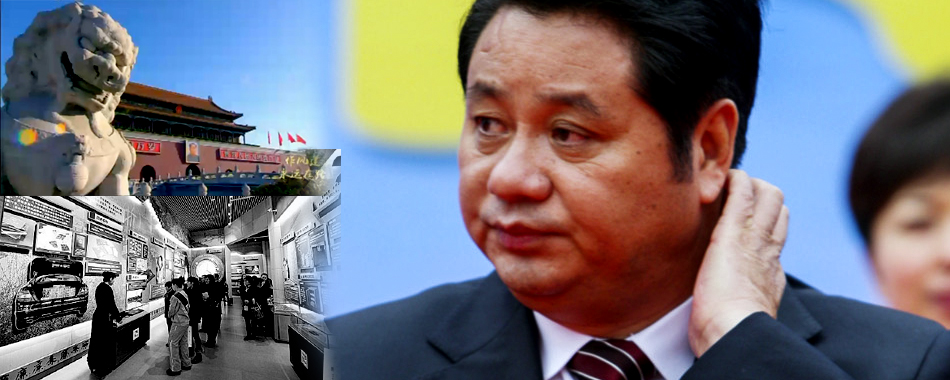
President Xi sends graft warning to military
President Xi Jinping has called on the military to learn lessons from the corruption case involving Xu Caihou, former vice-chairman of the Central Military Commission.
Xi, who is also general secretary of the Communist Party of China Central Committee and chairman of the Central Military Commission, emphasized the need to run the armed forces in accordance with the law when he met with senior officers of the Nanjing Military Area Command during an inspection tour in Jiangsu province on Sunday.
He said military officials at all levels, especially senior ones, should take a warning from the cases of Xu and Lieutenant General Gu Junshan, former deputy chief of the People’s Liberation Army’s general logistics department.
“Our military should guarantee unity and loyalty to the Party and the Military Commission of the Central Committee of the CPC,” Xi said.
He emphasized that efforts to ensure the army is run in line with the law will be further strengthened.
Zhu Lijia, a public administration expert at the Chinese Academy of Governance, said Xi’s speech was intended to ring alarm bells. It sent a signal that the anti-corruption campaign in the military will widen, and the authorities will apply a zero-tolerance policy to graft cases.
“The Xu and Gu cases show that correcting attitudes and standardizing behavior are urgently needed in the military,” Zhu said.
Xu, 71, who retired as vice-chairman of the Central Military Commission last year, was found to have taken advantage of his position to assist the promotions of others while accepting “extremely large” bribes, the military procuratorate said in October.
Gu is alleged to have accumulated goods and property worth more than 600 million yuan ($98 million) through taking bribes, misuse of State funds and abuse of power, according to the military procuratorate.
Updated: 2014-12-16 05:42
By WANG QIAN (China Daily)
Graft watchdog steps up SOE investigations
74 senior directors have been probed in corruption cases so far this year
The top anti-graft watchdog is to intensify its efforts to uncover corruption in State-owned enterprises.
More than 70 senior directors from such companies have been investigated for suspected graft since January, said a senior official from the Party’s Central Commission of Discipline Inspection.
SOEs’ operations are closely linked to national economic security, and corruption causes huge losses and seriously threatens the rule of the Party, Hao Mingjin, vice-minister of supervision under the CCDI, said in an interview on the commission’s website.
“Some SOE directors have colluded with foreign forces to trade national assets in return for huge bribes, and we will fight such cases resolutely,” he added.
He said that since January, the CCDI has been collecting and classifying information provided by the public while carrying out inspections of SOEs to gather further tipoffs.
According to the commission, 74 senior directors of SOEs were placed under investigation for alleged corruption between January and November, 59 percent more during that period in 2013.
Those being probed include Jiang Jiemin, former chairman of the China National Petroleum Corp; Song Lin, former chairman of the China Resources Group; and Wang Shuaiting, former vice-chairman of China Travel Services Hong Kong.
Since November 2012, when the new leadership took office, President Xi Jinping has conducted a sweeping campaign against corruption. The CCDI has sent inspectors on six rounds of inspections in key provinces and regions, educational institutes and central authorities and administrations, including SOEs, to gather information about corrupt officials.
In early December, the investigators visited eight SOEs, including Sinopec and China Unicom, and five other central administrations.
During the inspections, Xue Wandong, former manager of a petroleum engineering technology subsidiary of Sinopec, and Zhang Zhijiang, former deputy director of China Unicom’s network unit, were taken for questioning about alleged in corruption.
Sinopec said on Tuesday that it will investigate the conduct of some managers and reshuffle a number of senior posts.
“Once we suspect someone is guilty of malpractice, regardless of who it is, we will undertake a thorough investigation without any leniency,” Sinopec said in a statement.
Hao said most of the suspects in SOEs were in charge of valuable resources, including petroleum, gas, coal, and electricity. They were very powerful and operated without proper supervision, and this created opportunities for misconduct.
Others abused their positions by arranging for their spouses and children to operate businesses, gain benefits for other companies and accept huge bribes, he said.
“Although some progress have been made in combating corruption in SOEs, we still face a difficult task to uncover more cases,” he said.
Cheng Lei, a law professor at Renmin University of China, said the priority is to strengthen inspections of SOEs and employ more professional personnel to gather information.
In addition, he said, managers in SOEs who are found to have behaved in a corrupt way should be transferred to the judicial system to face trial immediately after the discipline inspection departments complete their investigations.
By ZHANG YAN (China Daily) Updated: 2014-12-17
Du Juan contributed to this story.
Anti-corruption battle takes to prime-time TV
An anti-graft TV documentary was aired on Monday night by China Central Television with the aim of educating Party members to lead a frugal lifestyle and warn other corrupt officials, the Communist Party of China Central Commission of Discipline Inspection said on Monday.
The four-part program, jointly shot by the CCDI’s publication department and CCTV, will be screened at prime time every night through Thursday and disclose details of the extravagant lives of corrupt officials “who abused their power to gain benefits for other enterprises and accepted huge bribes for either themselves or their family members, or had abnormal relationships with their mistresses”, according to a statement by the CCDI.
Fighting corruption has been a top priority of the CPC Central Committee since November 2012, when the Party’s new leadership took office, and President Xi Jinping has taken a series of strong measures to combat corruption.
The CPC Central Committee has also put forward a set of clean-governance rules, including requirements to lead a frugal lifestyle and cutting public expenditures on government vehicles and overseas trips to regulate the Party members.
By early December, more than 50 senior officials – provincial or ministerial-level and above – had been placed under investigation on suspicion of corruption, including Zhou Yongkang, former security chief, and Xu Caihou, former vice-chairman of the Central Military Commission, according to the CCDI.
The program’s production crew went to 18 provinces and regions to interview key persons, including family members of corrupt officials, private secretaries, club waiters, case informers and members of the public who had evidence of corruption.
The program will show a luxurious private club, where Wan Qingliang, former Party chief of Guangzhou, Guangdong province, often had dinner with bosses from enterprises and how Ni Fake, former vice-governor of Anhui province, used his position to gain huge benefits for other enterprises and accepted bribes of precious jade.
“We have shot more than 30 graft cases, telling stories about how central discipline inspectors worked to collect corruption clues concerning corrupt officials,” said the CCDI statement.
In addition, the crew also interviewed officials with the central government and well-known scholars and experts to share their opinions on the widening anti-corruption campaign.
“The TV program reflects the major achievements in fighting against corruption since November 2012,” said Li Wei, a member of the Beijing Lawyers Association.
“But above all, the TV program presents how tough a task the central government is facing to conduct an ongoing campaign to clean up the corruption at the roots,” she added.
Updated: 2014-12-16
By Zhang Yan and Wang Qian(China Daily USA)
Anhui ex-official pleads guilty to taking bribes
Former vice-governor stands accused of possessing unexplained properties
The corruption trial of Anhui province’s former vice-governor Ni Fake got underway on Monday at Dongying Intermediate People’s Court, in Shandong province, to avoid any conflicts of interest.
Ni stands accused of accepting huge bribes and having assets that appear to be beyond his legitimate means. Prosecutors said Ni took 49 bribes totaling 13 million yuan ($2 million) and possessed unexplained properties worth 5.8 million yuan.
Ni is suspected of abusing his power and accepting large bribes when he was mayor and Party chief in Lu’an, Anhui, and the provincial vice-governor.
His properties and expenditures obviously exceeded his income, and he couldn’t identify the source of the “huge difference” between his salary and properties, the indictment said.
Ni was probed by the anti-graft authority in June for the misuse of power, accepting huge bribes and moral degeneracy. He was removed from his post and expelled from the Party in September.
The top procuratorate designated the procurator in Shandong on Oct 27 to file Ni’s case in the Intermediate People’s Court in Dongying.
Under current rules, China’s anti-graft authorities pass corruption cases on to procurators at the appropriate levels after the authorities deem the officials have a case to answer. The procurators then further investigate the cases and file them in designated courts.
The cases are often tried in legal jurisdictions other than the one in which the officials held their posts to avoid any conflict of interest.
Corrupt officials are believed to have developed a tight network with local judicial personnel and could interfere with an independent judiciary.
Ni was alleged to have colluded with local businessmen and helped them with illegal mining and real estate property development.
Ni’s case has drawn nationwide attention for his unique way of accepting bribes from businessmen. He was said to be obsessed by his passion for jade and accepted precious stones as bribes under the guise of “gifts” from friends.
Ni made a statement to the court in which he confessed to all the crimes in the indictment and said he would accept the court’s ruling.
The court will announce its verdict at another time.
Updated: 2014-12-16
By Zhang Yi(China Daily USA)
Shanxi’s deputy head of discipline dismissed
Another senior official has been removed from his post and expelled from the Party in corruption-plagued Shanxi province as a wide-ranging anti-graft campaign continues.
Yang Senlin, executive vice-secretary of the Shanxi Provincial Commission for Discipline Inspection, was deemed guilty of “misuse of power, taking huge bribes, accepting gifts of money and committing adultery”, the nation’s top anti-graft authority said on Monday.
Forty-seven officials in Shanxi have faced corruption charges since the nationwide anti-graft campaign started in late 2012. They include seven at the provincial level, making it the province with the most high-ranking officials to come under suspicion so far.
Yang, 58, was placed under investigation in July for suspected “serious violations of discipline and laws”, a term used to signify corruption.
He is a native of Shanxi and spent most of his working life in the provincial government. He joined the government in 1975 and climbed the career ladder until he was appointed deputy head of the provincial anti-graft body in 2006.
Yang was formerly the right-hand man of Jin Daoming, who worked as head of the Shanxi anti-graft watchdog from August 2006 to February 2011. Jin was placed under investigation on Feb 27 while serving as deputy head of the Shanxi provincial people’s congress.
Yang is alleged to have helped Jin cover up illegal operations by mining companies.
Coal-rich Shanxi has been hit hardest by corruption scandals because of collusion between government officials and businessmen. A third of the members of the province’s top decision-making body have been investigated.
Updated: 2014-12-16
By Zhang Yi(China Daily USA)
Network exec at China Unicom suspected of Party rule breaches
A senior executive with China Unicom is under investigation, the disciplinewatchdog of the State-owned Assets Supervision and AdministrationCommission said on Monday.
More State-run business executives are expected to be probed as the latestround of discipline inspection targets the enterprises, experts said.
Zhang Zhijiang, deputy general manager of the network unit of China Unicom,is being investigated on suspicion of discipline violations, according to a reportpublished on the website of the Central Commission for Discipline Inspection,China’s top disciplinary watchdog.
Zhang was also responsible for network building at China Unicom.
Previous media reports showed that Zhang is a top mobile telecommunication expert, andwas in charge of 3G-technology research at China Unicom.
No details of the investigation were released. China Unicom confirmed the investigation ofZhang on its Sina micro blog account on Monday.
The post said that China Unicom has zero tolerance for any behavior that breaks the law orthe rules.
The investigation of Zhang was announced 18 days after a discipline inspection team wassent to China Unicom at the end of November. The team is scheduled to stay there until Dec26.
Zhu Lijia, a professor and specialist in anti-corruption studies at the Chinese Academy ofGovernance, said discipline inspection is now focusing on State-owned enterprises.
“Many of the State-owned enterprises are more or less in businesses that have monopolyconcerns. Take the telecom sector in China as an example. The whole industry is controlledby three SOEs and is not fully open to competition in the market,” said Zhu.
He added that these enterprises are likely to have corruption because their development isinfluenced more by power than by the market.
A large number of senior SOE managers-many of them from the oil and gas industry-havebeen investigated on corruption allegations since 2013.
Qiang Weidong, secretary of the disciplinary commission with the State-owned AssetsSupervision and Administration Commission of the State Council, said earlier in Decemberthat it is still challenging to fight corruption in SOEs.
“Despite the ongoing anti-corruption campaign, many of the SOEs still take the risk ofbreaking the rules,” he said.
Qiang said that construction, procurement and marketing are the areas most likely to havecorruption.
Updated: 2014-12-16 13:34
By MENG JING (China Daily)