



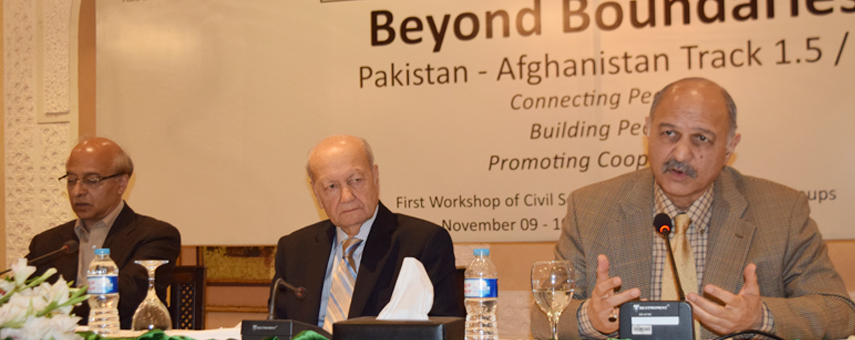
Pakistan wants its relations with Afghanistan to be based on equality and reciprocity; without peace and stability in Afghanistan, there cannot be peace and stability in Pakistan. The Pakistan of 2015 does not distinguish between good and bad terrorists; combating, crushing and containing all forms of terrorism is a national priority for Pakistan.
This was noted by Senator Mushahid Hussain Sayed in his remarks at the concluding session of the first Af-Pak bilateral meeting of Civil Society and Youth Representatives. The meeting was part of the project “Beyond Boundaries”, a track 1.5/II initiative conceived by Centre for Research and Security Studies, Islamabad aimed to promote peace between Afghanistan and Pakistan. The concluding session of the Track I.5/II dialogue was well attended by various groups of stakeholders, members of civil society, media, intelligentsia, government officials and diplomats from different embassies.
Mr. Sayed noted that in the changing geo-political realities and rise of Asia, it is imperative that Pakistan and Afghanistan seize the opportunity and work together for regional peace and long term prosperity. Chairing the concluding session Lt. Gen (R) Talat Masood noted that though both Pakistan and Afghanistan must appreciate the role of third parties in facilitating dialogue – it is the responsibility of both countries to work together to resolve differences and actualize the potential within both countries. He noted that good nations commit mistakes but great nations do not repeat them- Pakistan and Afghanistan must continue dialogue to lower the trust deficit. He further noted that initiatives such as Beyond Boundaries provide an excellent and much needed opportunity for civil society and youth representatives to build understanding on common issues on a people-to-people level.
Dr. Muhammad Zubair, a prominent economist briefed the delegates on Afghanistan-Pakistan trade relations and noted that Pakistan is Afghanistan’s number one trade partner & Afghanistan is a destination for third highest number of exports for Pakistan. He observed that the trade potential between both countries was so significant that if national interests were truly considered on both sides – they would overlook all other issues between the two countries.
During the concluding session, Civil Society and Youth representatives from Pakistan and Afghanistan presented the “Islamabad Declaration from the Regional Civil Society Group”. The declaration while recognizing the historic ties between Afghan and Pakistani societies, urges the need for strong partnership to bring stability to the region. Delegates from both sides unanimously condemned all forms of terrorism – as both countries have been severely affected by the menaces of extremism, radicalism and terrorism. CSO Representatives also urged “respective governments to prioritize security and peace as a key milestone in providing conducive environment for mutual cooperation”. During the discussions, both sides recognized that lack of multi-sectoral legal cooperation and facilitation on both sides created un-necessary hurdles for enhanced bi-lateral cooperation. The Islamabad declaration thus called on Afghan and Pakistani governments to work together on the implementation of their international and mutual commitments under bilateral and multilateral treaties.
Bearing in mind the strong role of curriculum in shaping up country perceptions on both sides, delegates called on educational experts to review curriculum in order to raise the new generation Afghans and Pakistanis with a more positive perception of each other and a better understanding of historic ties. They also called on both governments to devise an effective mechanism to promote educational exchanges between the two countries.
Media’s role in shaping perceptions is hardly negligible. Noting the powerful voice of media, representatives called on journalists and media community on both sides to play a strong role in positively projecting both countries in each other’s print and electronic media. It was noted that civil society institutions on both sides must join hands to protect human rights and learn from best practices.
The civil society delegates called on the need for protection of human rights of Afghan Refugees and emphasized facilitation for voluntary repatriation to Afghanistan.
This was the first meeting of Af-Pak Civil Society Working group. Six more meetings are planned between Pakistani and Afghan delegates in Kabul and Islamabad – which will analyze regional security dimensions, foreign and defence relations between Afghanistan-Pakistan as well as a broader framework for cooperation between civil society and youth groups.