



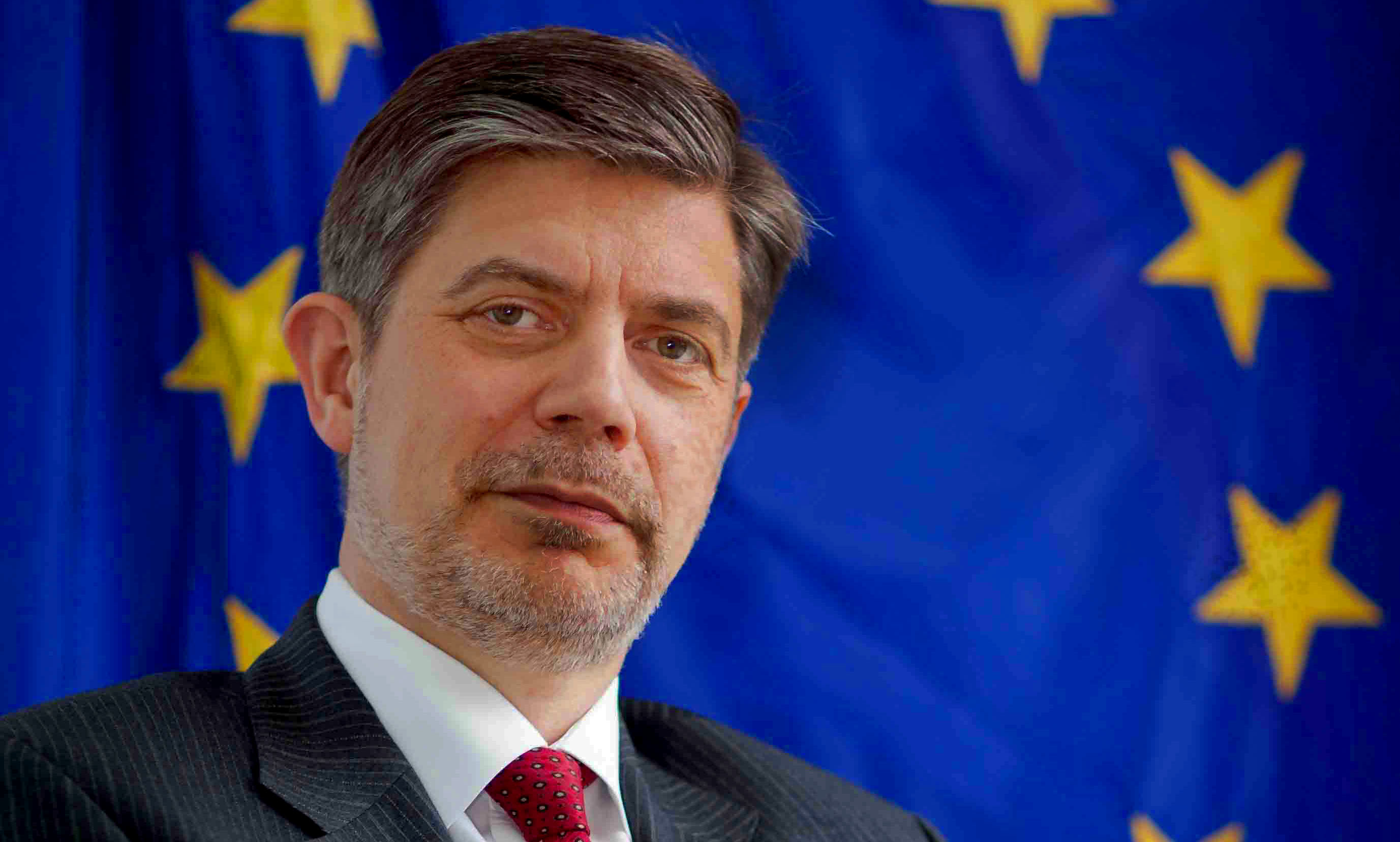
The European Union (EU) has voiced serious concern over worsening ties between Pakistan and India, urging the two nuclear-armed neighbours to resume the stalled peace process. EU Ambassador Lars-Gunnar Wigemark addressed Foreign Affairs committee of the National Assembly on Wednesday, December 3. Apart from India-Pakistan stalled peace process, he also urges on the need of reforms in political system, devolution of power to the grass root level, deteriorating situation of Human Rights and uplift of the Pakistan economy.
Below is the speech of EU ambassador
•Dear Chairman of the Foreign Affairs Committee, honourable members of the National Assembly, thank you very much for giving me the opportunity to address you on EU-Pakistan relations.
•We have been working hard in recent years to strengthen EU-Pakistan relations, expanding beyond the traditional sectors of trade and development cooperation. To this end, the EU and Pakistan adopted in 2012 a 5-Year Engagement Plan. Pakistan is the only country with which such a Plan exists, illustrating the importance we attach to our relationship.
•The Engagement Plan aims at facilitating cooperation on a wide range of issues, including democracy, human rights, rule of law, economic cooperation, energy, counter terrorism and migration. We are now working to implement this Plan and to translate it into concrete results.
•2013 already bore of this Engagement Plan with two very important milestones: the EU Election Observation Mission for the general elections in May and the granting of GSP+ status for Pakistan in December.
•At the end of 2014, the EU will start rolling out its next seven year framework for development cooperation with Pakistan with a budget of €653 million. It is a 53% increase compared to the previous seven years, demonstrating the seriousness of our commitment. Our programmes will focus on rural development, education, rule of law, respect for human rights, strengthening of democratic institutions, economic and trade cooperation and regional cooperation. If you add the contribution of EU Member States, the overall contribution to development and humanitarian assistance is €600 million per year. The EU also committed 40 Million Euro this year to address the humanitarian satiation, including the IDP crisis as a result of the North-Waziristan operation.
•Now let me focus on four key areas that are critical in our engagement with Pakistan: 1/Consolidation of democracy and local governance; 2/ Enhancement of trade, including through GSP+; 3/ Human Rights situation; 4/ Regional stability and regional integration.
1. Consolidation of democracy and local governance
•Our support for democracy is central for everything we do as European Union here in Pakistan. The EU itself is a union of democracies. Parliament is the primary institution enabling and safeguarding the democratic process. It demonstrated its strength in August when political parties expressed unequivocal support to the democratically elected government.
•This is why the EU is so strongly committed to support and work with the Federal and Provincial Assemblies. Our commitment to democracy in Pakistan is long-standing. The EU was invited to observe three Parliamentary elections in 2002, 2008 and 2013.We currently have a democracy portfolio with a total budget of €37 million for improving elections and strengthening parliamentary institutions. In other words, the EU invested in democracy in Pakistan.
•Our cooperation with the National Assembly and the Senate started in 2012 and it is gradually evolving and shaping up. Through the EU parliamentary programme (IP3), we are currently working in partnership with the leadership of the Parliament to assist the Parliamentary Committees, increasing their legislative, research and budgetary oversight capacity. However, without the political will for reforms, no cooperation or assistance can produce the results it aims to achieve. We therefore rely on your commitment to make progress on Parliament’s performance.
•In this respect, let me emphasize the importance of electoral reforms, not least given the current political crisis. Electoral reforms should be seen as an opportunity to build consensus and to address structural shortcomings in the electoral process. The EU Election Observation Mission in its report about the 2013 elections welcomed the progress made since 2008 and estimated that the overall outcome was acceptable. At the same time, it pointed out at a large number of irregularities and made 50 recommendations to improve the election process.
•As a sovereign country, it is for Pakistan to decide on the nature of its laws, but improvement of the electoral framework would strongly reinforce confidence of the citizens in the election process. Steps can be quickly taken on transparency and accountability, dispute resolution, role of the Election Commission and the organisation of a long-awaited national census. Holding of local body elections would also contribute to bring governance closer to the citizens and would complement the EU’s approach of working with local communities. The Parliamentary Committee on electoral reforms that has been formed is a step in the right direction and I hope it will deliver a comprehensive electoral reforms package. The expectations are high and the EU is ready to support this process.
2. Enhancement of trade relations, including GSP+
•Everyone agrees that Pakistan has a great economic potential. You have a strong business and trade culture. This vision needs to be reflected in transparent regulatory environment and strong competition to allow for further foreign direct investment.
•The EU has done a great deal to facilitate the access for Pakistani goods to our markets. In 2012, a special scheme of autonomous trade preferences was adopted as a response to the devastating floods of 2010, giving temporary access for 75 product categories exported to the EU at reduced duties.
•On 1 January 2014, new trade preferences entered into force under GSP+ scheme. It provides preferential market access to countries that have ratified and are implementing 27 international conventions on human rights, labour standards, good governance and the environment. Benefitting from this scheme means that you will not pay any duties at all on 91% of tariff all lines for exports to the EU.
•Currently, the EU is Pakistan’s largest trading partner. The EU-Pakistan trade volume in 2013 was of €8.35 billion, accounting for 20% of Pakistan’s total trade. The EU received 21% of Pakistan’s exports while 17% of Pakistan’s imports are from the EU.
•I am confident that the strengthening of EU-Pakistan trade relations following the award of GSP+ will become even more noticeable in the coming year. Looking at the first three quarters of 2014, the benefits of GSP+ are already positive. Pakistani exports to the outside world have gone down by 9% but, at the same time, exports to the EU have gone up by 18 to 20% or almost €700 million. This demonstrates the economic potential of the instrument.
•However, let me underline that this is only the start of the process. In order to preserve the trade preferences, it is critical to show clear progress in the effective implementation of the 27 international conventions covered by the scheme. The first progress report is due by early 2016. The overall situation in Pakistan will be considered as well – e.g. death penalty – even if not part of the GSP+ scheme per se.
•The EU is also supporting through technical assistance a number of sectors to help diversity Pakistani exports, including fisheries, leather, fruit and vegetables and gems and precious stones.
3. Human Rights
•Human rights are a major priority for the EU. Europe itself faced the most horrendous Human Rights violations during the 20th century and is based on the fundamental principle that prevention of such acts is indispensable.
•Pakistan continues to be faced with many human rights challenges. The EU follows the situation closely, as illustrated by the recent visit of the EU Special Representative for Human Rights Mr Stavros Lambridinis who also met with the Parliament.
•Access to justice, freedom of religion and belief, rights of women and children and the death penalty are key priorities. Important steps have been taken by Pakistan, including the signature and ratification of international conventions and empowering the provinces to play a pivotal role. However, a policy for implementation is crucial.
•Independent institutions must be reinforced and made to function. In particular, the rapid appointment of a Head of the National Human Rights Commission would send an important signal of the Government’s commitment to Human Rights. The EU stands ready to support this Commission.
•The EU is also deeply concerned over continued reports of sectarian violence and attacks against all religious minorities, be it Muslim or non-Muslims, and the lack of efforts to bring the perpetrators to justice. The case of Asia Bibi is emblematic and attracts a lot of attention in the EU. Beyond individual cases, it is critical to address the more systematic challenges.
•The situation facing many women in Pakistan remains acute. Pakistan was labelled as the third most dangerous place in the world for women, owing to the prevalence of domestic violence, honour killings or acid attacks. Violence against women is also of major concern in Europe where one third of all women have been exposed to domestic or sexual violence.
•Human Rights defenders and journalists run significant risks in carrying out their work in Pakistan. There needs to be proper mechanisms in place to protect them and their organisations.
•Improvement of the Human Rights situation will ultimately benefit the citizens of Pakistan and improve the socio-economic environment. This would also indirectly contribute to curb illegal immigration to Europe. In this regard, the EU and Pakistan have agreed to a Joint Readmission Agreement and progress has been made on its implementation. Further efforts are, however, necessary.
4. Regional situation and regional integration
•One of the greatest challenges facing the country is countering terrorism. I would like to pay tribute to the great sacrifices that Pakistan has made and underline how beyond establishing national measures to prevent radicalisation and extremism, a regional approach is also required. The EU is ready to further expand its commitment through the EU-Pakistan Counter-Terrorism dialogue.
•A regional security approach is essential and Pakistan’s role is crucial. PM Sharif’s commitment to constructive relations with both Afghanistan and India is very much welcomed by the EU.
•The positive outcome of President Ghani’s visit to Islamabad, in particular on trade and security, is very welcome. Improvement of relations between Afghanistan and Pakistan is critical to the stability of both countries. This message will feature very high at the London Conference on the future of Afghanistan starting tomorrow.
•In London, the European Union will reiterate its continued support to Afghanistan´s transition and to the new Afghan leadership. Afghanistan is receiving the most development cooperation from the EU of any country in the world. The new President of the European Council, Mr Donald Tusk, and the new High Representative for Foreign Affairs and Security Policy, Mrs Federica Mogherini, met with President Ghani and Chief Executive Abdullah yesterday and reaffirmed the EU’s commitment.
•As regards relations with India, the recent deterioration of relations, including through cross firing at the Line of Control and Working Boundary, is worrying. Efforts to re-launch bilateral dialogue should remain a priority; the EU underlines this message both in Islamabad and Delhi.
•Despite bilateral irritants, the SAARC Summit demonstrated that regional cooperation is the way forward, illustrated by the agreement on energy. The economic benefits of regional integration are well documented: larger markets, increased competition and lower prices for consumers. Regional integration in South Asia is indispensable. In the longer term, Pakistan’s largest trading partner should not be the EU, but its neighbours.
•Relations between Pakistan and Iran are also essential for regional stability and recent efforts to address border incidents are welcomed. Meanwhile, the EU has been involved in intense negotiations with the E3+3 to find a comprehensive solution to Iran’s nuclear programme. Despite the difficulties, we continue to believe a deal is possible and a new deadline for the Joint Plan of Action has been agreed until 30 June 2015.
Conclusion
•To conclude, let me underline that Pakistan has many friends in the European Union. But you need to make sure that they understand the stark realities in your country. Pakistan has undertaken important international commitments and as a partner of Pakistan, the EU would like to work with Pakistan in meeting these obligations in the spirit of mutual respect and understanding.
•The European Parliament, in particular, is a willing and engaged partner. The kind of parliamentary contacts that took place before the critical vote on GSP+ in December last year should be maintained and sustained. As the British-Pakistani Member of the European Parliament, Mr Sajjad Karim, said in Lahore shortly after the successful vote in the European Parliament, the intense contacts in the run up to the vote represent the missing link in EU-Pakistan relations and needs to be cultivated.
•The Foreign Affairs Committee of the European Parliament, chaired by Mr Elmar Brok, should be a priority target for these parliamentary contacts. The Committee is playing an increasingly significant role on foreign policy through several means:
Adoption of a high number of resolutions, including last week on the issue of blasphemy laws in Pakistan but also previous ones to condemn the use of drones or on the Kashmir issue;
Regular interactions with the European External Action Service through official meetings at all levels, including with the High Representative for Foreign Affairs and Security Policy and hearings with EU Ambassadors;
Field visits to third countries – e.g. Head of EOM, Mr Michal Galher, visited Pakistan six times in two years.
•Let me also pay tribute to you for the rejuvenation of the Foreign Affairs Committee of the National Assembly and, in particular, to the efforts of its Chairman Mr Leghari. The first Progress Report of the work of the committee is the best illustration of your increasing role in defining Pakistan’s foreign policy with its key partners.
•The European Union is one of them and I thank you once again for giving me the opportunity to meet with you today.