



Secularism is about equality, provision of basic human rights to all indiscriminately, freedom of belief, and guarantees of justice and welfare. Secularism in Australia is enshrined in the constitution which predominantly ensures state, religion separation.
The societal change will not happen until appropriate policy choices are made. Bangladesh, India, and Pakistan have many similar issues which are different than the western settings, therefore the panacea lies in home-made solutions tailored to the relevant contexts, not imported!
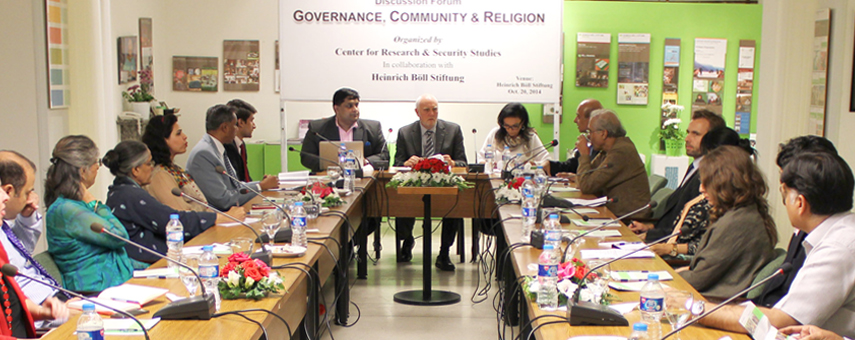
These were the notions expressed by the two member delegation of speakers each from Australia and Bangladesh, during the dialogue at Quaid-i-Azam University and a Roundtable at Heinrich Bӧll Stiftung (HBS), Islamabad on Oct. 20, 2014 as a part of a dialogue series “Governance, Community and Religion (GOCORE)” with Pakistani universities students, intelligentsia, academia and civil society jointly organized by Center for Research and Security Studies (CRSS) in collaboration with Heinrich Bӧll Stiftung (HBS).
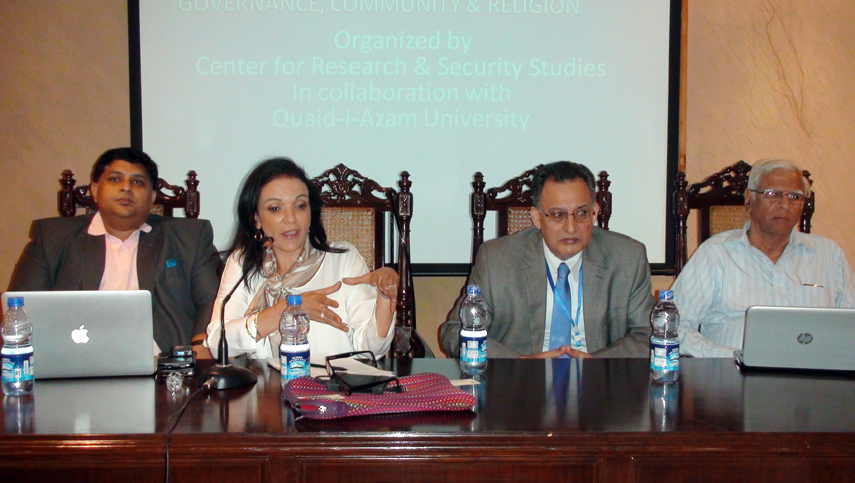
The speakers for the dialogue series include Dr. Ann Aly, one of Australia’s foremost academics dealing with counter-terrorism and Mr. Shahab Enam Khan, one of Bangladesh’s eminent scholars and researchers in the fields of international relations, security studies, media, and public policy. These speakers from Australia and Bangladesh shared their respective experiences of dealing with multicultural diverse societies and ensuring religious freedoms as well as states’ impartiality towards different religions and ethnic groups. They underscored the need to embrace concepts such as tolerance for diversity and equal citizenry in a multi-faith society.
Dr. Ann Aly, a research fellow in the Department of Social Science and International Relations at Curtin University, Western Australia said that we might think of secularism and democracy as a form of government, a way of life, a system of organization, a set of values or beliefs, western way of life or losing Islam but in reality, secularism and democracy were not about any of these perceptions. “They are about equality, provision of basic human rights to all indiscriminately, freedom of belief, and guarantees of justice and welfare”, she said.
She said that the two main characteristics of secularism were separation of the state & religion and religious equality before the law where separation did not imply no religion. Nevertheless, the cultural and religious values of society can still influence political decision making. Secularism and democracy are two different things as the first guarantees religious pluralism and the latter guarantees political pluralism but they both often go hand in hand with and are necessary conditions for each other.
“The Commonwealth shall not make any law for establishing any religion, or for imposing any religious observance, or for prohibiting the free exercise of any religion, and no religious test shall be required as a qualification for any office or public trust under the Commonwealth”, she quoted the Section 116 of the Australian Constitution while adding that the secularism in Australia is enshrined in the constitution which predominantly ensures state, religion separation.
She said that state governed by the religion couldn’t make rulings for the multi-faith and religiously diverse society. She also referred to the court ruling in Australia which was overturned as it ordered Muslims to cancel Friday prayers in the community hall. “The citizens should talk about the issues that are of importance to them, in a political language to protect their rights”, she said while talking about the concept of the common currency of political debate as a measure of ensuring mutual respect, civil rights, right to freedom of thought and belief, equality before the law and participation from multi-faith society to resolve the conflicts facing the Muslim communities in the multi-cultural diverse societies. “Secularism and Democracy open up many opportunities including citizenship, education, participation, freedom of thought and belief, dialogue and equality”, she said while underpinning the need for democratizing state conduct and politics.
She also said that the separation did not mean no religion, instead, it meant inclusion of all the ethnic groups and multi-faith societies and ensured that no one remained marginalized.
Mr. Shahab Enam Khan, Research Director at the Bangladesh Enterprise Institute, and Chair of the Department of International Relations, Jahangirnagar University, Bangladesh said that the cases of Bangladesh, India, Pakistan and Afghanistan showed that the radicalization was a dynamic process that varies for each individual and groups, but shared some underlying commonalities.
He said that the process of violent radicalization intended to ensure transformations of society, state and class structures, based on religion and violence. “It is accompanied and carried through by class-based and belief-based revolts from below with supports from external actors”, he said while adding that radicalization involved intermingled political and religious ideologies not at par with Islam and secularism. He further added that radicalization misinterpreted pluralism, secularism, or perhaps “co-existence”.
“The secularism principle was removed from the Bangladesh’s constitution in 1977 by the 5th amendment of the constitution and declared Islam as the state religion. In 2010, Bangladesh Supreme Court declared the 5th amendment illegal and restored secularism as one of the basic tenets of the Constitution. In principle, Bangladeshi identity is deeply rooted in the society and plays stronger role than religion in determining identity”, he added while sharing the Bangladeshi experience of dealing with the multi-cultural diverse society.
“State has to be receptive and proactive”, he said while underscoring the need for devolution of power to empower the general public and de-politicization of religion as state and religion were two separate entities.
Mr. Shahab said that the societal change would not happen until appropriate policy choices were made. Bangladesh, India, and Pakistan have many similar issues which are different than the western settings, therefore the panacea lies home-made solutions tailored to the relevant contexts, not imported!
He suggested that the counter-radicalization would need counter-narratives which required enlightened discourse and a multi-stakeholder cooperation across the society. Keeping that the hard approaches generally proved wrong, he therefore suggested holistic and plural approach and all-encompassing counter-radicalization strategy with humane approaches. He also stressed female empowerment as a measure of slowing down the growth of extremism.
He said that Pakistan could look towards Bangladesh and how the Bangladeshi government was working to reverse the process. Pakistan needs to develop its counter-narrative discourse for its youth and must not ignore youth’s radicalization.