



In the ongoing process of democratization in the country, Indonesia is confronting increasing challenges that are similar in nature to those haunting Pakistan. Democracy has taken roots there but the challenge to turn Indonesia into amodern state with secular governance structures is still daunting. An equally big challenge is to inculcate the spirit ofan all-inclusive democracy which is the only way to ensure equal citizenry.
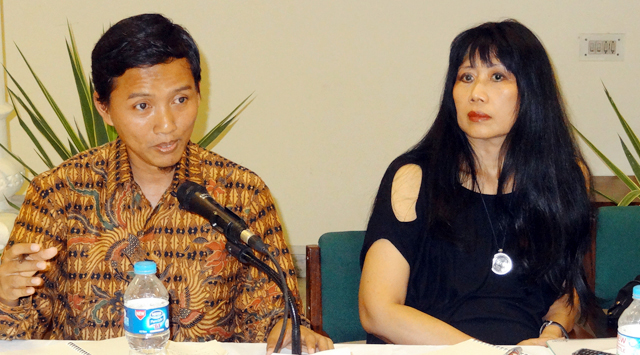
Expressing these enlightening notions, two Indonesian scholars and a socio-political activist from the United Kingdom, observed that without guaranteeing equality among citizens, the goal of creating and maintaining social harmony and peace will remain elusive not only in Indonesia but also elsewhere, particularly in the Muslim world.
These interactions with students and academia at the Quaid-e-Azam University Islamabad and Fatima Jinnah Women College Rawalpindi were part of the series of dialogue on ¿¿State, Religion and Democracy, ‘ a project the CRSS is carrying out in Pakistan with the support of the Heinrich Bӧll Stiftung (HBS) and the Turkish Ministry of Foreign Affairs, Ankara.

Ms. Julia Indiati Suryakusuma, renowned intellectual and writer from Indonesia, said that the despite many efforts by hardliners to change the discourse of Indonesian state, the people have shown a remarkable commitment to democracy, belief in religious freedom, and acceptance of ethno-culturaldiversity. She said that Indonesian people have ade it clear time and again that they are deeming democracy as the only way forward to keep the integrity of one nation state.
Indonesian scholar said various groups in Indonesia have been attempting vigorously to manipulate the constitution and to impose their version of religious dictates in the country. However, she said, people in general are aware of the consequence of such efforts and hence raising their voice for the strengthening of democracy in the country.
Dr. Izza Rohman, lecturer of Education at the University of Muhammadiyah, Jakarta (UHAMKA), in his presentation said that several Islamic organizations in the Indonesia are venturing in the areas of education and philanthropy quite successfully but the chances of their emerging as major political force are not that conducive because of the rich cultural diversity of the country. He said that Indonesian people celebrate the diversity and hence believe that only modern democracy could protect the rights of every individual.
You don–t have to wait for the Islamic Shariat to become good Muslims. Neither do you need the Shariat to be a good citizen of the state you live in, said Dr.Rohman. The society may be Muslim or Christian but the state doesn–t have to be religious in executing governance. For governance, experience has shown, the state needs to be secular to be a just and fair adjudicator of violations of the document that guides the state and regulates life within that state i.e. constitution.
Earlier, Imtiaz Gul, executive director CRSS underlined the feature of a modern democracy and said that mixing religion with politics has always proved to be socio-politically disastrous for governance. He said that this dialogue is a part of the ongoing endeavor of counter-radicalization advocacy and modern democracy as the role of a state is to treat all of its citizens on equal basis.
Students asked various fundamental questions on the occasion regarding the experiences of Indonesia in its democratic endeavor as well as commonalities in Pakistan and Indonesia both in the terms of democracy as well as efforts to impose various sets of beliefs on others. The guests while responding to various quires said that both the countries have ample experiences to share with each other to move forward under a shared vision of achieving peace and prosperity for the people.
The Indonesia scholars as well as Mr.Toaha Qureshi, a British Pakistani scholar who is heading a pioneer de-radicalization programme in the United Kingdom, also got together at the Peshawar University (Oct 10, 2013) to explain to curious students and the Faculty of Social Sciences their view on the subject. Mr. Qureshi, who also announced two fully-paid scholarships for two top students of the Faculty to study in London, underscored the need to use the Quraan only as the guiding document.
He explained that religion in UK still enjoys great influence but governance there is guided by the dominant popular consensus that religion has no role in governance. The state must not be the adjudicator of sin but must act as the judge for breach of law and the constitution. We must all guard against ignorant Mullahs, who rather than serving Islam, end up discrediting it.
Both Indonesian scholars also underscored that for economic and technological progress, a pre-requisite for a modern democratic state, we need to seek knowledge and look at socio-political issues critically.We must clarify our confusion about the role of religion and deploy our own critical prism to it rather than being misguided by illiterate or half-literate clerics, they said.