



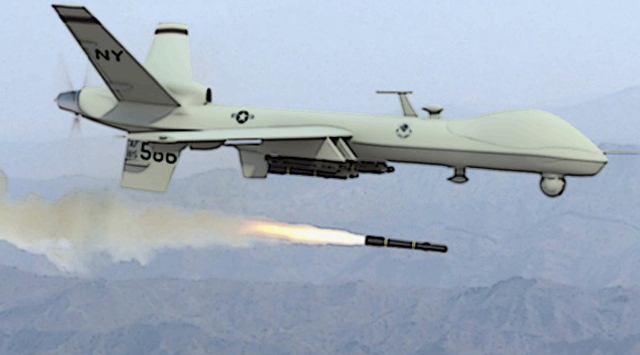
A little over three months after the 193-member strong United Nations General Assembly had unanimously spoken against the controversial US drone campaign in foreign territories, the 47-member Geneva-based UN Human Rights Council on March 28, too called on all states to ensure that the use of armed drones complied with international law.
Of 47 members of the Council, 27 voted in favour of a Pakistan-sponsored resolution, understandably aiming at the United States but not singling out any state. The co-sponsors of the resolution included Yemen and Switzerland. The United States, Britain and France opposed the resolution while 14 other members abstained from the voting. The United States, Britain and France said it was not appropriate for the forum to put weapons systems on its agenda.
The resolution said: ‘The UN Human Rights Council urges all states to ensure that any measures employed to counter terrorism, including the use of remotely-piloted aircraft or armed drones, comply with their obligations under international law […] in particular the principles of precaution, distinction and proportionality.’
It raised concern at civilian casualties resulting from the use of remotely-piloted aircraft or armed drones, as highlighted by the UN special investigator oncounterterrorism Ben Emmerson in a recent report. It also called on UN human rights boss Navi Pillay to organise expert discussions on armed drones and report back in September.
Akram, speaking before the vote, said: ‘Opposition can only lead to the conclusion that these states are guilty of violating applicable international law and demonstrate that they are afraid of being exposed in the expert panel.’
Earlier, it was on December 18, 2013, that the 193-member strong United Nations General Assembly had unanimously spoken out against the controversial US drone campaign in foreign territories. The resolution to this effect underlined the culmination of an enquiry that Special Rapporteur Ben Emmerson had launched in Pakistan and Africa in 2012. Mr. Emmerson had submitted his report on drones in October 2013.
The 28-paragraph resolution, entitled ‘Protection of human rights and fundamental freedoms while countering terrorism’ had called on the United States to comply with international law, and underscored the ‘urgent and imperative’ need for an agreement among member states on legal questions about drone operations.
The unanimous call for regulating the use of remotely piloted aircraft against suspected terrorists was also accompanied by the demand that the US ensure that any measures taken or means employed to counter-terrorism, including the use of remotely piloted aircraft, complied with international law. This includes Charter of the United Nations, human rights law and international humanitarian law.
CRSS Role and Contribution in Anti-Drone Campaign
Part of Ben Emmerson 2013 report had come from a field investigation that the Centre for Research and Security Studies (CRSS) had conducted in the affected areas. The CRSS had handed the UN envoy 24 cases of ‘innocent victims of drone strikes’ cases where innocent women, children and men had become the unintended victims of the drone strikes.
Also, in its security report ‘The Deadly Drone Campaign: A Pakistani Perspective’ the CRSS had made observations similar to those expressed in the December 18, 2013, UN resolution. These were based on extensive field studies on the consequences of the drone campaign (For details seeState in Turmoil2012 atwww.crss.pk