




Big Step Forward
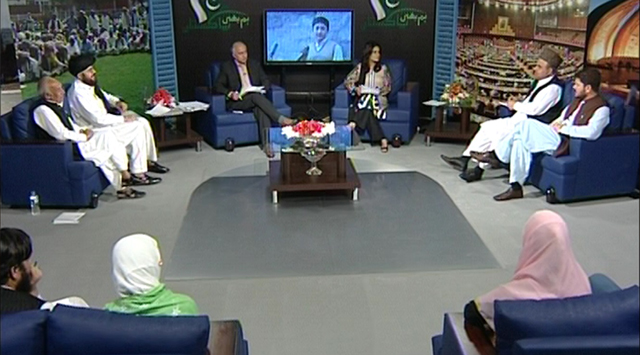
In May 2014, the Centre for Research and Security Studies (CRSS) took a big leap forward in its drive for inclusive democracy and fundamental rights. With the support of as many as 40 parliamentarians, rights– activists, analysts and academia in the first phase, the CRSS produced a series of shows for airing on national TV on the past, present and future of the Federally Administered Tribal Areas (FATA). The show also included 60 male and female students from different regions. They had specially traveled to Islamabad for participating in the shows and each of them had a chance to put at least one question to panelists.
Never before did FATA come under such focused and sustained debate involving leading stakeholders from within FATA as well as those representing Pakistan mainstream political parties ´ a first in FATA political rights– advocacy in history to debate FATA problems, concerns and future prospects.
The talk show gave an opportunity to the people from FATA to share their problems and seek solutions that can best help mainstream FATA with Pakistan. At the same time it provided the panelists a chance to speak on the issues such as the draconian FCR, the role of Political Agents and its implications and the possible role of the parliamentarians in addressing issues arising out of the special status of FATA.
Context
The 1901 Frontier Crimes Regulation (FCR) governs the Federally Administered Tribal Areas (FATA). It is a set of laws that was essentially a replication of the British-era magistracy system, but with a Political Agent (PA) at the centre who these laws turn him into the uncrowned king of the agency under his control. The PA control extends into the agency through the privileged class of Maliks ¶ about 35,000 of them officially hold the title of Malik and serve as the bridge between the PA and the tribes. Residents of FATA got the right of adult franchise in 1997 and the Political Parties Act was extended to it before the 2013 general elections to allow political parties to participate from there.
But this hardly changes the reality ¶ that extremely wealthy people in FATA buy votes for the National Assembly or the Senate (20 seats altogether). It also remains a fact that while being part of the parliament, these MNAs cannot influence governance or legislation in their respective areas. Also, what is more ironic is that by the virtue of the FCR, these MNAs are virtually subject to the will of their respective political agents, who can place them under house arrest, banish them, or even have their properties demolished or seized. Why? Because the FCR empowers the PA to do so even if he has the slightest suspicion that a particular individual has or is about to commit a crime. This is one of the 50 or so regulations that arm the PA with absolute authority. The penalties that the PA imposes on tribes or individuals or the funds he gets from the federal government for his respective area are also essentially never audited. And that is why every new recruit to the civil service vies for the PA position, particularly in the Khyber Agency.
The dominant majority of FATA residents demand that the FCR be abolished and the tribal area be brought under the Constitution.
They question then, the value of FATA MNAs and what work they do ¶ apart from supposedly making tons of money during their tenure. Those intending to become senators first spend huge sums of money on MNAs to buy their votes and then find ways to recover it.
Resonating popular demands, 10 major parties have therefore, joined hands to strive for ridding FATA of the FCR and put forward eleven demands. Some of these recommendations are as follows:
1) Article 247 of the Constitution should be amended to guarantee fundamental rights for all tribal citizens and shift legislative power from the President of Pakistan to the parliament. (Many participants pointed out that the clause 6 of the Article 247 empowers the President to change part of or entire FATA in consultation with local stakeholders but none of the presidents had exercised that authority thus far).
2) Local bodies– elections should be held in FATA
3) A comprehensive package should be developed for FATA and infrastructure development be initiated with special focus on health, education and employment
4) The future status of FATA should be decided by its people
5) The Pakistan Electronic Media Regulatory Authority (PEMRA) jurisdiction should be extended and media should be provided greater access to the region
6) Actions in Aid of Civil Power Regulation 2011 should be abolished
What transpired during the TV Discussions
During the shows, most guests agreed that the FCR should be dealt with according to the wishes of people of FATA. It is for them to decide whether they want to repeal it or amend it.
These TV shows will hopefully add to the knowledge of the dominant majority of Pakistanis who know little about the governance and legal structures in FATA. By inviting students and youth activists from the FATA region, CRSS attempted to encourage the people of FATA towards a constructive demand for their rights.
Major themes of the shows:
- 1. FATA Reforms: Implementation of 2011 reforms ´ Political Parties Order and Amendments to the Frontier Crimes Regulations (FCR).Why did the FCR fail in combating crime and militancy?
The show deals with the FATA reforms introduced in 2011 and the extent to which these reforms have been implemented. The State failure to implement these reforms has resulted in an increased level of crime and militancy in FATA. It made it easy for criminals and militants to take refuge here and later use the area to further their agenda of Islamization in the rest of the country. The laxity of the State to take action against these religious militants, both homegrown and foreigners who moved here after the end of Soviet invasion and post 9/11, has rendered some parts of FATA dysfunctional and under the de facto rule of the militants. The show will also discuss the role of the FCR in facilitating the entrenchment of militants in FATA.
- 2. Basic Human Rights, Constitution and the FCR.
This show provides viewers with an overview of fundamental human rights under the FCR. To debate whether clauses given under Article 247 Administration of Tribal Areas are enough or need further explanation for improved implementation for the welfare of the people of FATA? Are the FCR regulations in sync with fundamental rights available to other citizens of Pakistan? In addition, the show focuses on political, civic and human rights obligations relating to FATA with the aim of highlighting the need for ensuring ‘Equal Citizenry’ for all citizens of Pakistan – as promised in the Chapter one of the constitution; equal rights for the people of FATA being the main focus in this regard.
- 3. Justice and Separation of Powers in FATA: Extensive power of political agent, democracy vs. draconian system
This show discusses as to why not the extensive powers of the executive (Political Agent) given under the FCR be amended? With the help of case studies, the show aims to elaborate on how the powers vested in the Political Agent under the FCR promotes corruption, cronyism, and poor governance without any accountability mechanism and how these powers have impacted adversely on the lives of the people of FATA in many different ways? The show also focuses on implications of the FCR on the Rule of Law in adjacent settled areas, the role of FATA judicial tribunal, and citizen access to the appeals process. Extending court jurisdiction to the victims of FCR who are denied justice would also be discussed in the show.
- 4. Local Bodies– System in FATA: A Tool of Empowerment
This show highlights FATA residents– helplessness in the absence of local representative institutions and they are denied representation in the public life under the FCR.The parliamentarians from FATA in the National Assembly (12) hardly represent the people and are often inaccessible to their community. The show discusses the idea of extending local bodies– Act to FATA as a first step to empower the residents through directly elected community leaders. Of course, ideally, the law of the land should be extended to entire FATA and integrate it with rest of Pakistan.
- 5. The Role of FATA Parliamentarians
This show discusses as to why should precious public funds be wasted on FATA parliamentarians if cannot legislate on issues relating to FATA? Most participants agreed that these parliamentarians are probably an additional burden on the national exchequer because of their inability to introduce legislation on FATA. Most end up much richer at the end of their tenure because they often side with the government in return for certain perks and favors.
- 6. Women Empowerment in FATA
The show discusses the plight of women in FATA and tries to underline the need for treating FATA women as equal citizens. Academics, social activists and students agreed that the conservative social set up in as far as their basic rights are concerned, political representation, voting rights etc. The fact that if they are even recognized as an entity as a human being and enjoying basic rights to decision making, education, health etc. And what measures may be taken to empower them.
- 7. Strengthening Economic Development, Education and Health System in FATA
FATA lags behind in economic development, education, health infrastructure. Most of the funds allocated in the name of development schemes are skimmed off by officials and colluding FATA representatives. This show discusses possible measures for the uplift of FATA and also explores the possibility of ensuring financial transparency in development projects. How to promote education in FATA, that has one of the lowest literacy rates in Pakistan. How to improve healthcare and especially contain the spread of polio virus and steps to bring economic development to the area? During the show it is pointed out that over 80 percent of 66 polio cases until May 2014 were reported from FATA, the bulk of it coming from Waziristan.
- 8. What is the Future of FATA?
This show reviews the future status of FATA. The participants are given an opportunity to debate and discuss the means and measures required to mainstream FATA with the rest of Pakistan. This is considered important for not only improving the lives of the people in FATA but also to curb and deal with the problem of terrorism emanating from there.
- 9. Obstacles and Opponents to FATA Mainstreaming and Reforms
This show focuses on whether piecemeal reforms in an oppressive system can bring socio-political change in FATA or not. It also addresses the question; why not mainstream FATA instead of doing what the forces of status quo are trying to preserve? And what is the role of the political parties in FATA where the system is founded on the draconian powers of the political agent and 35,000 Maliks who wish to maintain the status quo?
- 10. Access to-, Access of -, and the Role of Media in FATA
One of the political parties recommended extending PEMRA jurisdiction to FATA because FATA cannot establish its own electronic channels. As such they rely more on foreign media, FM radio and Pakistan State radio from the settled areas. Journalists and other media have limited access to FATA. In addition, journalists are generally barred from entering FATA because of the security situation and threats from the militants. And when they are inside, they are often intimidated, threatened and blackmailed by military and political agents. As a result, the reporting that comes out of FATA is unreliable and influenced by powerful actors.
This show discusses what legal and administrative reforms are needed to ensure FATA citizens– access to media. Alternatively, what can be done to ensure that Pakistanis outside FATA get more accurate information about what going on inside FATA?