



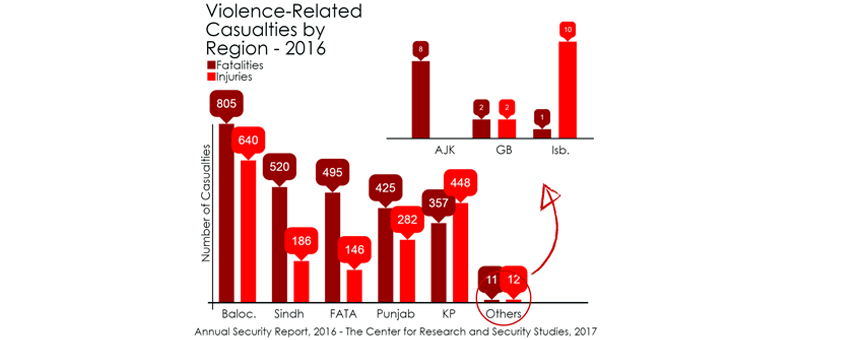
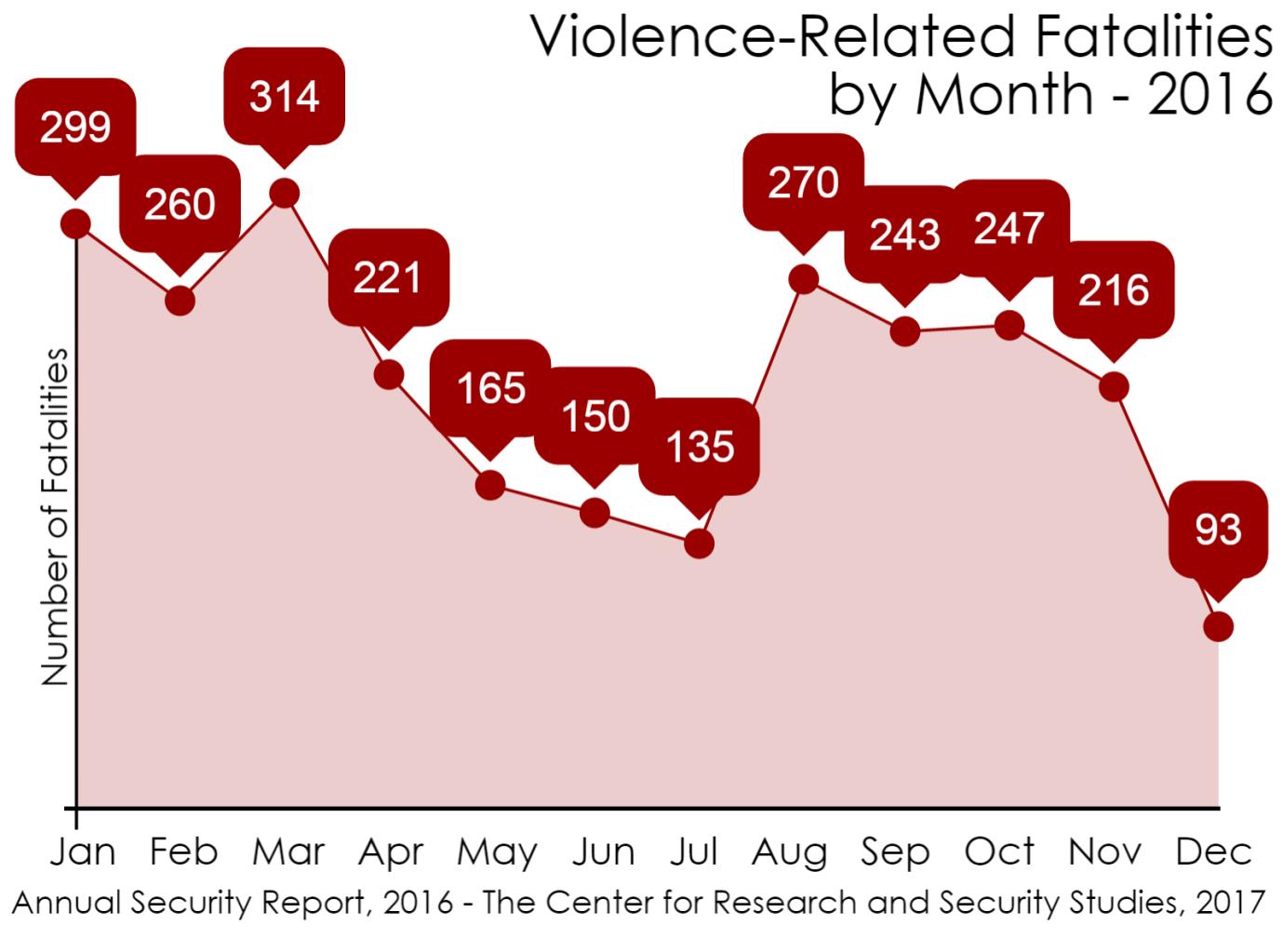
The year 2016 witnessed a significant decline in violence. The fatalities from violence in 2016 were not only half the fatalities of last year but significantly lower than the annual average of the fatalities (5,980 per year) recorded during 2013-2015. Overall, this is a 66% decline from 2014. This achievement says a lot about the kinetic implementation of the National Action Plan (NAP).
The militants, facing the onslaught of the military operations and the tightening of the law enforcement noose around their necks, began fleeing the country and evolved new strategies. They targeted geographical areas and population centers that were softer, least protected, and unprecedented. In addition, they deployed a wider array of improvised explosive weapons and suicide bombers despite strong resistance by the security personnel.
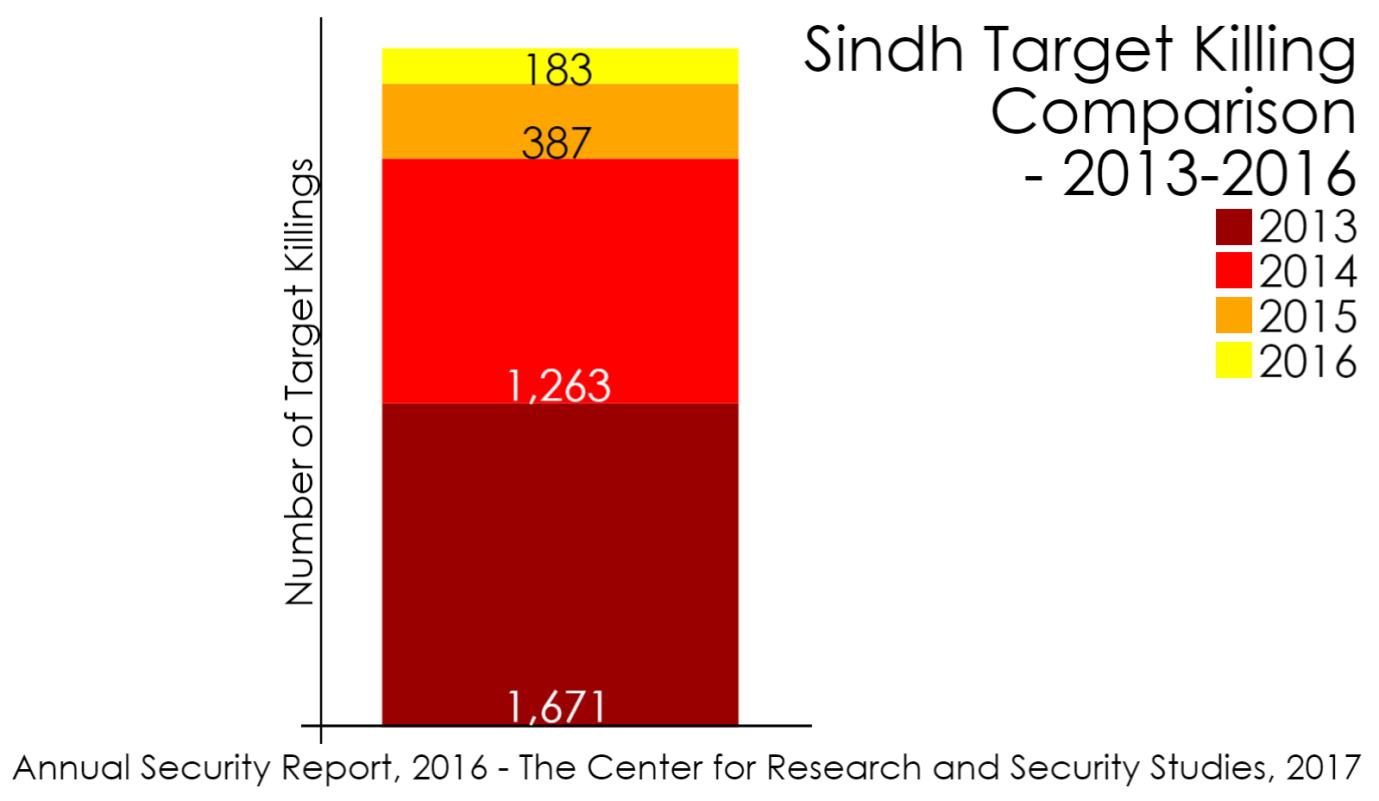
Karachi has perhaps seen the most improvement, with urban crime and target killings on the decline. Compared to 1,671 people killed in target killing incidents in 2013, 183 people lost their lives in 2016.
Threats, however, still exist and operate. For instance, sectarian violence has seen a major spike, even though the deaths resulting from it have reduced significantly.
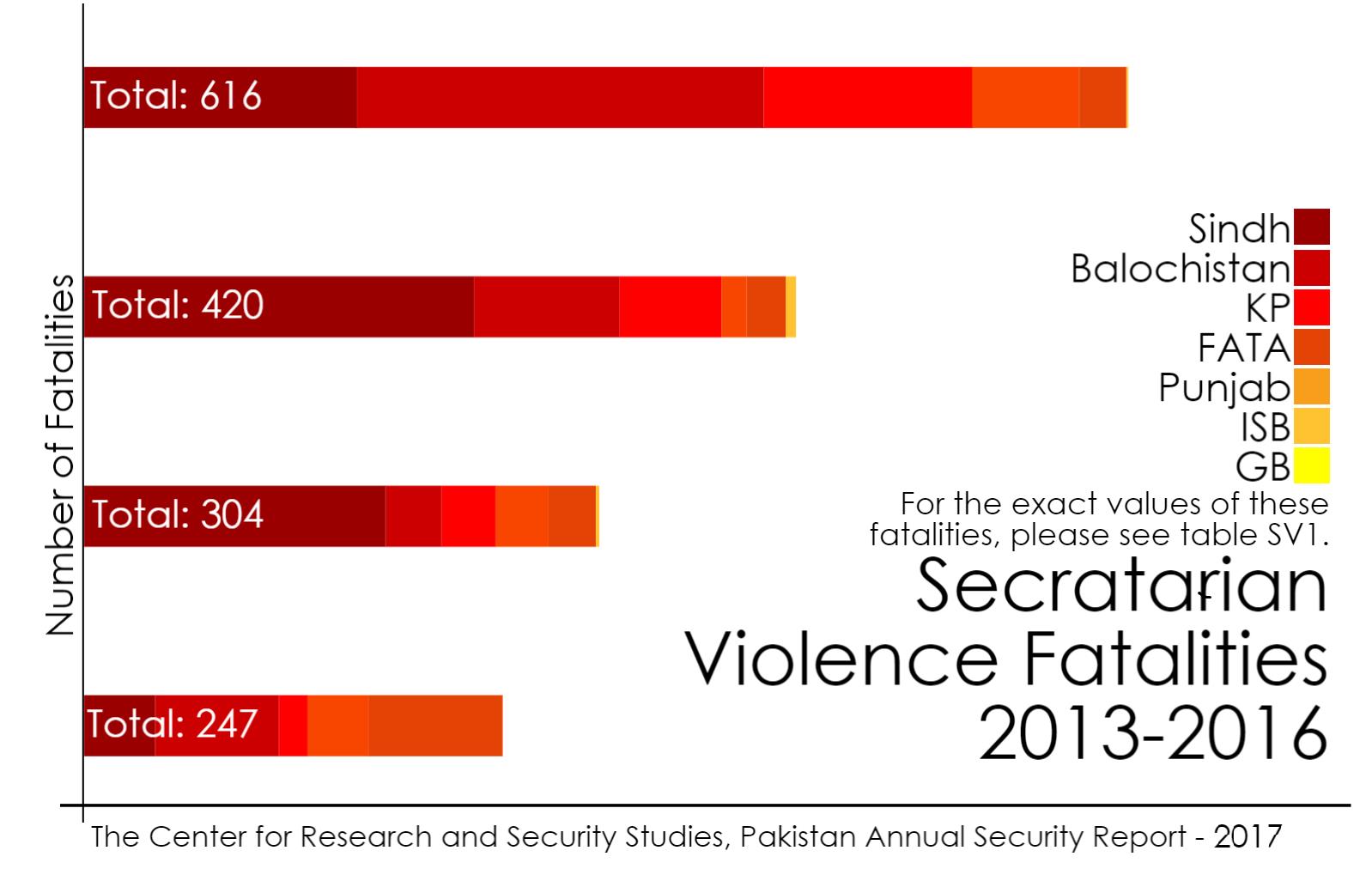
The menace is far deeper than it is perceived. Although many terror attacks are not categorized as sectarian violence, the motivations arise from mindsets influenced by religious hatred. The surge in attacks on polio team and the attack of a mob in Chakwal at Ahmadi mosque are two examples of this trend.
Another major change observed was the escalation of fatalities from violence in those provinces that earlier experienced a decline while an inversely opposite trend was observed in other provinces. Violence in Balochistan spiked, while in the Federally Administered Tribal Areas (FATA) and Sindh, it declined significantly.
The persistence of militancy in Balochistan and KP reflected both a rapidly evolving militant strategy and difficult for the law enforcement agencies to adapt to the changes. In Sindh, two suicide attempts were foiled by security guards while in Balochistan and KP, no such attacks could be thwarted by the security forces. In an incident of extreme negligence, 11 ‘hardcore terrorists’ escaped from police custody in Mardan district of Khyber-Pakhtunkhwa.
The strategy change in carrying out suicide attacks was also a big reason for their successes. Instead of sending one suicide bomber at a location, two were sent. The multiple claims of violence by various militant outfits are reflective of similarities in their approach. Considering IS or any other militant outfit as more brutal and barbarous doesn’t carry any weight in view of the crimes they commit.
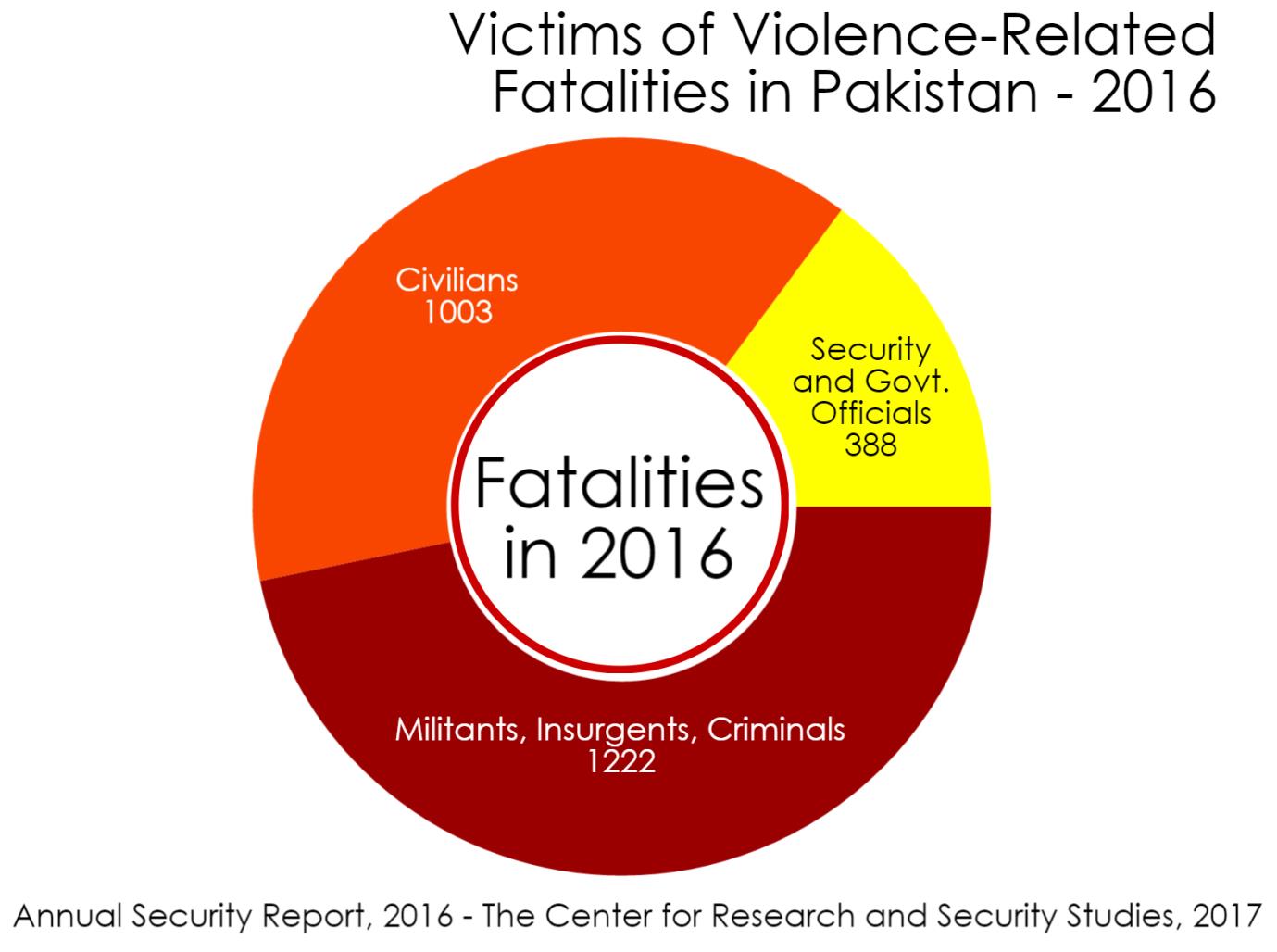
Balochistan and FATA are the two important regions of the country that continue to manifest extremism and insurgency in the form of armed conflict. Throughout the country nearly 2,068 outlaws were arrested in 2016, some with known identities and groups. Only 14 of them were apprehended in FATA. This raises a serious question about the law enforcement mechanism prevailing in the region. However, 349 militants were killed in that region.
The only change observed so far in government narrative is the downgrading of militants from “disgruntled brothers” to “foreign agents funded by foreign intelligence agencies” especially of India. This narrative may be useful in hunting down the hardcore militants but may not be effective enough to change the mindset that gets common people riled up, and leads to, in some cases, mob attacks. Long-term, softer strategies are needed to combat the root cause of terrorism, extremism itself.
See Full Report Click here.