



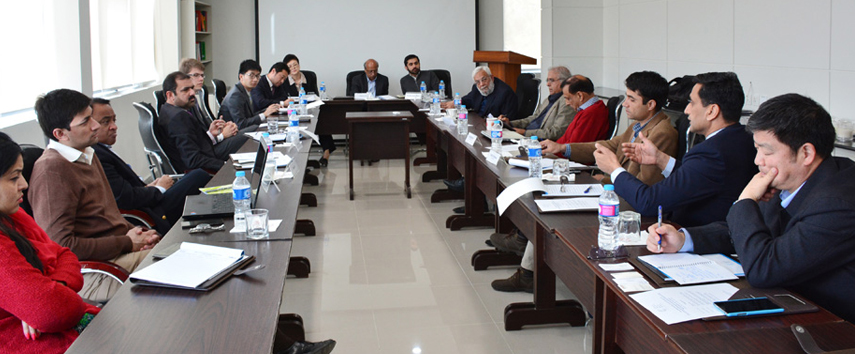
The Center for Research and Security Studies (CRSS) held a joint roundtable briefing with China Institute of Contemporary International Relations (CICIR) on the subject of “New Geopolitics and the Region”. Imtiaz Gul, the head of CRSS and Hu Shisheng, director of CICIR, were the main speakers of the event. Among the other speakers were former Federal Finance Secretary Waqar Masood, Ambassador Mian Sanaullah, Ambassador Qazi Hamyun, Economist Syed Husaini, and Engineer Arshad Abbasi.
Hu Shisheng shared his thoughts on the China-Pakistan Economic Corridor (CPEC) and the policies of the new American President Donald J. Trump. He said that CPEC was not only a mega project but the pilot-project of China’s “One Belt One Road” (OBOR) initiative. Given the massive nature of the project, Pakistan and China should expect that challenges will also be enormous. CPEC is very important for China and it would never like it to fail as some countries may wish so. He said one basic goal of China is to help its ‘all-weather’ friend Pakistan stand economically on its own footing. The pre-CPEC relations between the two countries were military and political in nature. Mr. Shisheng observed that as China was suffering economic overcapacity, it was compelled to export part of industrial capacities to countries like Pakistan. Industrial zones under CPEC are supposed to play crucial role in the respect. He noted that as the guiding principle of China’s OBOR initiative was inclusiveness, CPEC can be connected to Iran’s Chabahar port. This policy of China stands in contrast to the India’s approach of excluding and isolating Pakistan from regional initiatives and platforms.
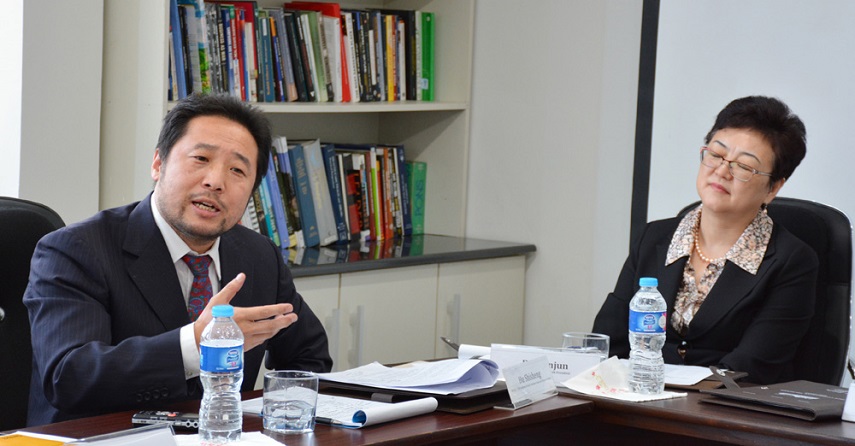
About the Trump’s policy towards the region, Shisheng said that the new US President will scale back American engagement in Afghanistan and consequently the responsibility to deal with Afghan issue will fall on the regional countries like China, Pakistan etc.
Ambassador Mian Sanaullah discussed Trump’s South Asia policy. He said that Donald Trump had neither talked much about the Pak-Afghan region nor met any of their top leaders so far. He pointed out that three views prevail regarding Trump’s South Asia policy. First, he might follow Obama type equation wherein he will adopt case-to-case approach. The second view says that he is more of a businessman and wherever he finds opportunity for his country’s interests, he can strike a deal. The third view assumes that he might not be that good for Pakistan. The reason is his obsession with China that might bring the US closer to India so that China can be balanced and countered. Mr. Sana observed that he personally thinks a tough time was coming in US-Pakistan relations.
Arshad Abbasi raised the issue of disproportionately expensive financial conditions connected to the CEC projects. He said that if we compare the terms and conditions of CPEC projects with more or less the same development projects that China had signed with Myanmar and other countries, the costs were very high in the case of former. Therefore he suggested Pakistan and China should revise the pricing mechanism for all the projects of CPEC so that it is win-win situation both the parties.
Ambassador Qazi Hamayun talked about the role of the US and regional actors in Afghanistan. He said that the Kabul government and the US were pressurizing Pakistan to help break the prevailing stalemate between the Taliban and Kabul in favor of the latter. But he said that it was not possible as Pakistan knew the government in Kabul was predominantly controlled by the Tajiks, to the disadvantage of Pakhtuns who were the major ethnic group of the country (around 40%). To find a lasting solution to Afghan problem would therefore require the proper representation of other ethnic groups in any settlement deal.
Waqar Masood said that even though Donald Trump was very dismissive of Pakistan during elections campaign his policy about the country was not clear yet. Trump had a good telephone talk with Prime Minister Nawaz Sharif but that is no guarantee for amicable relationship. He said that Trump will increase the military spending and employ tax cuts which at the end of the day will lead to a huge financial deficit.
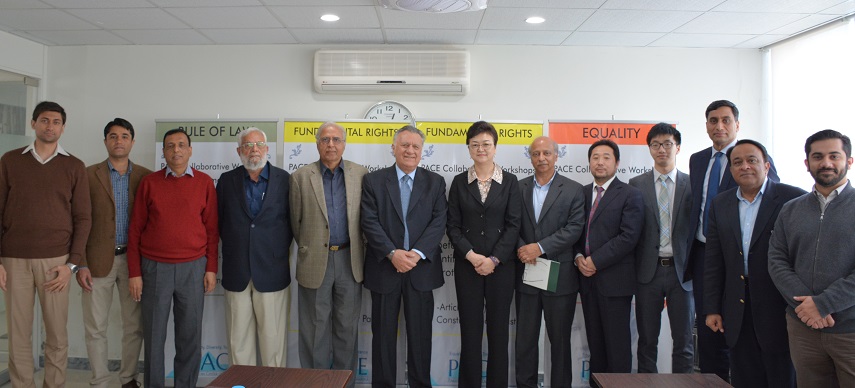
CICIR and CRSS have also entered into an agreement to collaborate on research projects to better inform the CPEC project and their respective governments.