



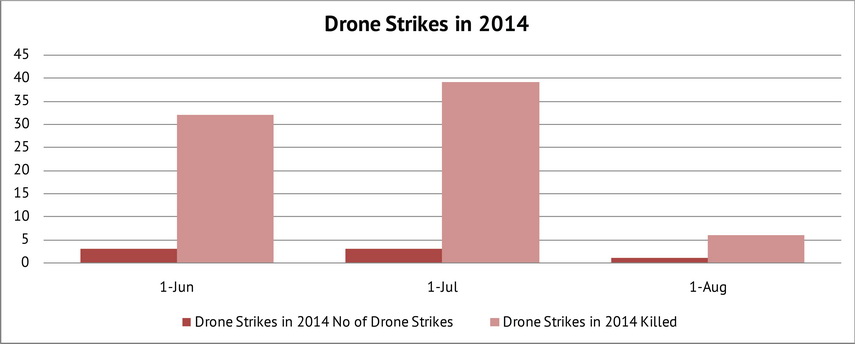
A yet another CIA-operated drone, seventh in 2014[i], killed six militants and injured two in Datta Khel, North Waziristan, on Wednesday, August 06, 2014[ii], amid international anger and concern over the legality of drone strikes. The drone strikes resumed in June 2014 after an intermission of six months around the time when Pakistan army had already launched its military offensive Zarb-e-Azb against al-Qaeda-linked militants in North Waziristan. Those killed in the latest drone strike were reportedly Uzbek militants.
The CIA-operated drones remain an extremely contentious issue in Pakistan and continue to stir up public resentment for loss of innocent lives in such attacks. Although the number of US drone strikes in Pakistan has dropped to six so far this year, the issue remains a major irritant in bilateral relations and a public discourse theme. Foreign and Pakistani legal experts and academics, including ex-UN rapporteurs on human rights Philip Alston and Ben Emmerson, have been raising voice for an accountable mechanism for such illegal strikes which not only entail collateral damage i.e. innocent killings but also violate international law and human rights conventions.
A recent report by the London-based Bureau of Investigative Journalism[iii] said at least 2,342 people have died in CIA drone strikes in the tribal region of North-West Pakistan since 2004. It also published a record of the people reportedly killed in these strikes, who have been identified. The Bureau, under its “Naming the Dead” project, has now recorded the names of more than 700 people reportedly killed by CIA drones in Pakistan. Nearly half – 323 – of the people identified are reported to be civilians, including 99 children. The database of names has grown since its launch last year, but those identified still make up fewer than one in three of the 2,342 reportedly killed in drone attacks.
Over the past nine years, the tribal region of Pakistan’s north-west has been hit by hundreds of drone attacks as the CIA has sought to stamp out al Qaeda fighters and the militant groups that have given them shelter. Missiles launched from these high-tech, unmanned aircraft have hit homes, cars, schools, shops and gatherings. Those killed by drones include high-ranking militant leaders – figures such as Abu Yahya al Libi, al Qaeda’s feared second-in-command, or Baitullah Mehsud, commander of the Pakistan Taliban (TTP). But according to media reports analysed by the Bureau, the dead also include at least 400 civilians. Some were unlucky enough to be nearby when militants were attacked. Others were killed alongside their husbands or fathers, who were believed to be militants. Still others were mistaken for terrorists by drone operators sitting thousands of miles away.
In most cases, there is little information available about who the drones are really killing. Most of the dead – an estimated four-fifths of those killed – are believed to be militants. But their deaths are typically reported as a number – their names, origins and livelihoods remain a mystery. For so many people to die in obscurity, unnamed and unacknowledged, is a tragedy. But it is a further tragedy that the public, and even policy makers, are unable to properly test whether drones are ‘highly precise weapons’ when so little is known about who is actually dying.
| DRONE STRIKES AND CAUSALITIES IN PAKISTAN (2004 – JULY 2014) | |
| Total Obama strikes | 338 |
| Total US strikes since 2004 | 389 |
| Total reported killed | 2,342 – 3,789 |
| Civilians reported killed | 416 – 957 |
| Children reported killed | 168 – 202 |
| Total reported injured | 1,101,657 |
It was on March 28, 2014, that the 47-member Geneva-based UN Human Rights Council had called on all states to ensure that the use of armed drones complied with international law. Of 47 members of the Council, 27 voted in favour of a Pakistan-sponsored resolution, understandably aiming at the United States but not singling out any state. The co-sponsors of the resolution included Yemen and Switzerland. The United States, Britain and France opposed the resolution while 14 other members abstained from the voting. The United States, Britain and France said it was not appropriate for the forum to put weapons systems on its agenda.
The resolution said: “The UN Human Rights Council urges all states to ensure that any measures employed to counter terrorism, including the use of remotely-piloted aircraft or armed drones, comply with their obligations under international law […] in particular the principles of precaution, distinction and proportionality.”
It raised concern at civilian casualties resulting from the use of remotely-piloted aircraft or armed drones, as highlighted by the UN special investigator on counterterrorism Ben Emmerson in a recent report. It also called on UN human rights boss Navi Pillay to organise expert discussions on armed drones and report back in September.
Earlier, it was on December 18, 2013, that the 193-member strong United Nations General Assembly had unanimously spoken out against the controversial US drone campaign in foreign territories. The resolution to this effect underlined the culmination of an enquiry that Special Rapporteur Ben Emmerson had launched in Pakistan and Africa in 2012. Mr. Emmerson had submitted his report on drones in October 2013.
CRSS Role and Contribution in Anti-Drone Campaign
The Center for Research and Security Studies (CRSS) considers drone operations against suspected militants and terrorists a national and international crime as they violate domestic and international laws and fundamental rights (of the accused and suspects) and impinge Pakistan’s sovereignty. Another major concern is the collateral damage i.e. killing of innocent people.
Part of Ben Emmerson’s 2013 report had come from a field investigation that the CRSS had conducted in the drone-affected areas. The CRSS had handed the UN envoy 24 cases of “innocent victims of drone strikes” cases where innocent women, children and men had become the unintended victims of the drone strikes.
Also, in its security report “The Deadly Drone Campaign: A Pakistani Perspective” the CRSS had made observations similar to those expressed in the December 18, 2013, UN resolution. These were based on extensive field studies on the consequences of the drone campaign.
[i] http://tribune.com.pk/story/745020/drone-strike-in-north-waziristan-kills-6-2/
[ii] http://tribune.com.pk/story/745352/unmanned-war-6-militants-killed-in-drone-strike/
[iii] http://www.thebureauinvestigates.com/namingthedead/?lang=en