



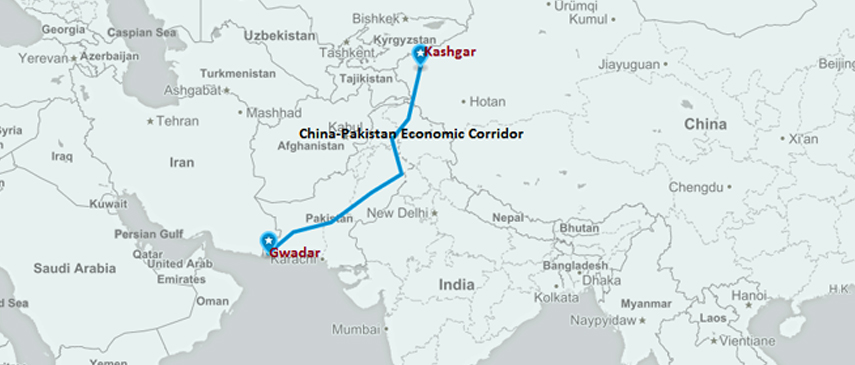
China Pakistan Economic Corridor (CPEC) is not just a one highway or road; it is rather a comprehensive package of cooperative initiatives and projects, which covers various fields including Gwadar port, energy, transportation and infrastructure, finance, agriculture and tourism. These projects would prove helpful for the achievement of the goal of improving the livelihood of Pakistani people.
The consensus on CPEC was reached in a meeting between Pakistan leaders and Chinese premier Li Keqiang in May 2013. The economic corridor starts from Kashgar, Xinjiang in the western China and runs throughout the whole of Pakistan finally reaching Gwadar port in the south. For overseeing the project China and Pakistan have established the Joint Cooperation Committee (JCC) on the Long-term planning of CPEC, and set up three working groups of energy, transportation infrastructure and comprehensive planning. The JCC after three meetings have reached initial consensus on the planning and construction of the Economic Corridor.
The Hydropower projects under construction and to be built in KP will yield the capacity of more than 9000MW
In a talk with CRSS, the Chinese Deputy Head of Mission in Pakistan Mr. Yao Wen explained the purpose of CPEC, “CPEC is to bring benefits to all the people of Pakistan including Balochistan and Khyber-Pakhtunkhwa (KP). Actually some projects in the two provinces are well underway. For instance, in Balochistan, the building of flagship project of Gwadar port is underway, including the construction of eastbay expressway and international airport. In KP the KKH phase II is being advanced. Both sides have successfully built Gomal Zam dam, Khan Khawar Hydropower station, Duber Khawar Hydropower station. Tarbella Dam phase IV is now under construction and projects such as Suki-Kinari Hydropower station and Keyal Khawar Hydropower station are to be built. The projects under construction and to be built in KP will yield the capacity of more than 9000MW, which will greatly ease the electricity shortage and bring tremendous benefits to the local people”.
 By giving no time frame for the completion of the CPEC Wen said, “Both China and Pakistan are developing countries and due to the limited resources and feasibility of operation, projects of CPEC will be built step by step with clear focus and emphasis, combined with both long term and early harvest projects. The current alignment of CPEC is out of thorough and in-depth feasibility studies and will bring about great benefits to Pakistan. That’s why both sides decided to start with KKH phase II, highway between Multan and Sukkur, some energy projects among others.” The security conditions should be taken into the consideration during the construction of CPEC. The federal and local governments are expected to provide necessary security protection, which is the precondition of construction, he further added.
Referring to the current debate in Pakistan over change of route of CPEC Mr. Wen said, “It will only add divergence between different regions and parties in Pakistan. It is not conducive to the unity and development of Pakistan. The debate should come to an end for the fundamental interest of Pakistan. All circles in Pakistan are expected to understand and support the construction of CPEC, work together to build a friendly environment of public opinion, promote the projects and benefit local people as soon as possible”. 
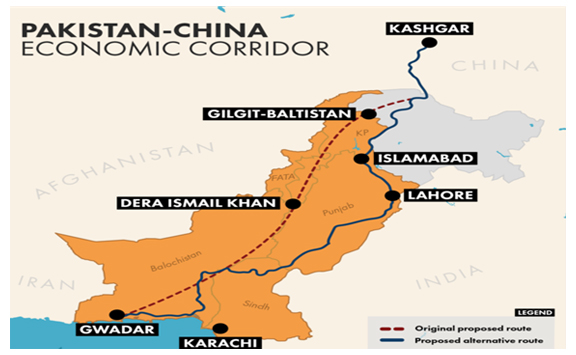
However, on March 5, 2015, the News Lens reported, “Political parties and civil society activists in KP and Balochistan are protesting against the alleged change in plan for the CPEC route between Pakistan and China, believing it is a conspiracy against them”. The opposition leaders have been protesting the alleged change in the route of the corridor – originally proposed to pass through the less developed provinces of KP and Balochistan. The criticism comes from the politicians and civil society in the provinces of Balochistan and KP, expressing concerns that the corridor would be connected through the province of Punjab. Several demonstrations, seminars and public gatherings have taken place to denounce the alleged change in the route.1
Asfandyar Wali Khan, Chairman Awami National Party (ANP) while addressing an All Parties Conference on the Pak-China economic corridor in Islamabad said, “They [the government] talk about the connecting roads to KP, FATA and Balochistan when actually the route [Pak-China economic corridor] does not go through this region. The federal government sees only Punjab as Pakistan, not the rest of the deprived areas and masses. We want a brotherly federation, one that treats all equally.” Similarly, political leaders from FATA and 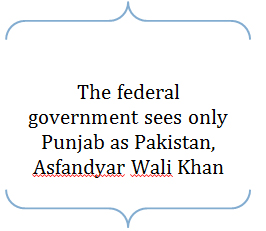 Balochistan also raised their concern over the change of route. The Gwadar-Kashghar route was originally planned to go through Bisima, Khuzdar, Kalat and Quetta onto to Zhob, DI Khan, Hassan Abdal and onwards to Kashghar but it has been changed to Bisima, Ratodero and towards Punjab which means by passing the Baloch and Pashtun areas, Senator Abdul Rauf Khan, Member of Senate Standing Committee on Defense told News Lens Pakistan. He said economic development and prosperity in the Pakhtun and Baloch regions of Khyber Pashtunkhwa, FATA and Balochistan would decrease militancy to a negligible level. “Because of oppression, a sense of deprivation prevails among the Pakhtun and Baloch people. The change in route means taking every economic opportunity to Punjab and neglecting the rest of the nationalities,” said Rauf Khan.2
Said Alam Mehsud a social activist from FATA opines that, “the initial route would have changed the fortunes of the people of FATA and Balochistan. Motorways, fast track railway, fiber optic line, oil and gas pipeline, free trade and industrial zone are components of the corridor that will usher in prosperity”. However, the Punjabi mindset did not allow that to happen.3
Negating the general perception and conspiracy theories regarding route change of CPEC, the Chinese deputy head of mission in Pakistan Yao Wen reiterated that CPEC is not just for one region, but for the prosperity and economic development of whole of Pakistan. The perception is wrong that only Punjab and Sindh are benefited and rest of the provinces are deliberately left behind, he said. In fact, the route touches every province from KP to Punjab to Sindh and finally Balochistan, Wen said while referring to the express way from Ratto Dhero Sindh to Gwadar passing from Turbat to Gwadar.
The Daily Times an English daily, reported that, “there is no challenge on the Chinese side. The CPEC starts from Kashgar, enters Pakistan via the Khunjerab Pass and ends at Havelian, Abbottabad. However, there is no denying the fact that the route on the Pakistani side of the CPEC has been changed”.4
Given the complex internal security challenges Pakistan is faced with, it seems rational on the part of government to alter the originally planned route. There is no denying the fact that FATA and Balochistan are worst hit by militancy. While FATA is home to radical Islamic militants, Balochistan faces a separatist movement. In both cases the militants hit key economic drivers and fundamental national interests of Pakistan. For instance in Balochistan the insurgents blow up every now and then natural-gas pipelines, whereas in FATA kidnapping for ransom, military maneuverings against the terrorists and retaliatory attacks against the army are routine. In such a scenario starting a multi-billion project with no basic infrastructure in FATA and restive parts of Balochistan could be a disaster and a security risk.
In the meantime, a Chinese Expert Group on Long Term Planning of CPEC visited Pakistan from March 2 to March 11, 2015; Mr. Hu Dongsheng, Deputy Director General of China Development Bank, headed the 19 member group. During the visit Pakistani and Chinese counterparts held extensive in-depth discussions. Both sides emphasized the importance to speed up the process of drafting CPEC long term plan, scheduled to be finalized by July, 2015. It was agreed in the meeting that CPEC is a comprehensive package. With the experience earned in the process of CPEC construction and the improvement of local economy and security conditions, CPEC will not only benefit the entire Pakistan in terms of improvement of its economy and security conditions, but also contribute to the regional peace, stability and prosperity.
SOME KEY FACTS ABOUT CHINA’S SUPPORT TO GWADAR PEOPLE
- In 2012, China donated 2 million RMB (more than 300,000 US dollars) to the Technology institute of Gwadar to support its efforts of upgrading teaching facilities and equipment.
- Since May 2013, China Overseas Holdings Limited (COHL) took over the management of Gwadar, the port infrastructure and operations are improved now and job opportunities are also created.
- In August 2014, COHL donated 3 buses and 2 million Rupees to the local schools of Gwadar. Moreover, 1 million Rupees were also donated to the Gwadar hospital.
- COHL is now working with Gwadar Port Authority to launch a charity foundation.
- Karamay of Xinjiang and Zhuhai of Guangdong are interested in establishing sister-city relations with Gwadar.
- Construction of Gwadar airport and Eastbay Expressway.
By CRSS Research Fellow Abbas Ahmad ______________________________________________________________________________________
[1] News Lens, March 5, 2015, http://newslens.pk/oppositions-outcry-over-the-alleged-change-in-pak-china-corridor-route/
[2] Ibid
[3] Ibid
[4] Daily Times, February 25, 2015, http://www.dailytimes.com.pk/opinion/28-Feb-2015/pakistan-china-economic-relations