



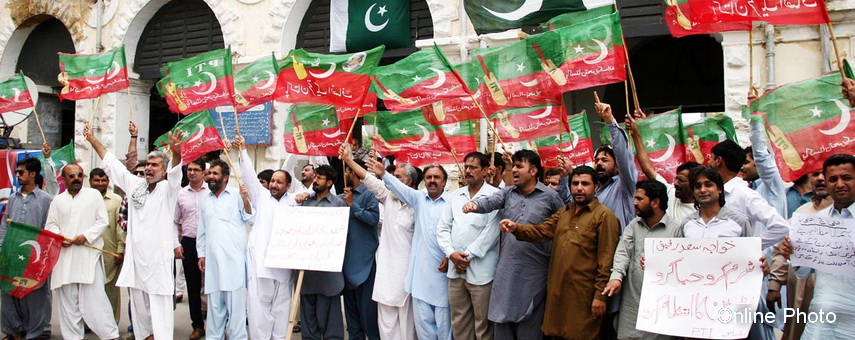
The Independence Day 2014, as it seems, will be different from how it has been celebrated previously. The 68th anniversary of Pakistan is flashed by ‘Azadi’ and ‘Inqelab’ march.
Pakistan Tehreek-e-Insaf (PTI) announced its march towards Islamabad for August 14, calling it the ‘Azadi’ or ‘freedom’ march. On the other hand, Shiekh-ul-Islam, ‘Allama’ Dr Tahir-ul-Qadri’s Minhaj-ul-Quran (MUQ) cum Pakistan Awami Tehreek (PAT) has announced its ‘Inqilab’ or ‘revolution’ march.
In case of Qadri, his long march last year was nothing but a futile exercise, which left serious doubts about his intentions, capabilities and persistence. A dual nationality holder, Qadri, thus, eroded his own popularity and proved to be good for charismatic sermons only.
On the other hand, Imran Khan – a cricketer turn politician – has been successful in garnering the support of larger population.
“It was the most rigged election in Pakistan’s history. We tried to go through the legal channels to expose this but the legal channels have been exhausted,” said Imran khan.[1]
Khan’s protesting call on fair elections seems more stable as compared to that of Qadri’s call for vaguely defined “revolution” to create an “egalitarian society”.
Although, Khan’s changing stances including demand for resignation of Prime Minister Nawaz Sharif and fresh elections despite PML-N government’s willingness to not only open four constituencies, reform the electoral process but also to set up a three-member judicial commission to investigate election rigging claims, has provoked cynics to believe him as serving some military agenda.
Au contraire, PML-N is driving all the energy in tackling the accusations both PAT and PTI have put on their government by sealing Islamabad, the capital, and Model Town, Lahore (having both the secretariats of PTI and PAT) with containers and well equipped police force to arrest the political workers. These tactics have nothing but spurred a wave of frustration among the already grieved masses reeling with mounting crisis of all kinds.
One stark reality is that population of Pakistan has a past of being driven like mobs by vested interests due to lack of education and poverty. Today, earning $2 a day, 60.19% population live below poverty line.[2] 31 suicides in Tharparkar district this year exposes the seriousness of matter.[3] In terms of education, Pakistan has almost 5.5 million children that are out of school, the second highest number in the world only after Nigeria. Pakistan also has the highest number of illiterate adults in the world, after India and China.[4] In addition, terrorism has posed a greater threat, resulting in a loss of almost 53,000 lives since September 11 attacks of 2001.[5]
The list of crisis that Pakistan faces today does not end this short. Besides Afghan refugees, Pakistan also has the largest internally displaced population of at least 1.5 million, the latest being the displacement of nearly a million from North Waziristan following a military crackdown on Al-Qaeda-linked foreign and local militants.[6]
Unfortunate but true, society’s growing subscription to exclusive ideologies has led to inescapable internal security issues and provided fuel for insecurity and instability at both the internal and regional levels.
Under this scenario of government’s negligence towards social sector, political polarization, the absence of education-centric policies, and short-term political alliances of convenience, the national cohesion has only moved towards destabilization.
Apart from few energy and infrastructure projects like RWP-ISL Metro Bus and Nuclear Power Plants in Karachi, PML-N has little success stories to share about its one year in power. Government’s Laptop and Youth Loan Scheme could not successfully serve to silence sceptics as it made unnoticeable difference for youth, employment and entrepreneurs in the country. It could hardly save the people of Pakistan from power cuts lasting up to 16 hours a day during the heat of summer. The 2014 Human Development Report published by the United Nations Development Program (UNDP), Pakistan’s per capita GDP places it globally at 136th. Further, on the gender inequality index, Pakistan slipped four spots to 127 from last year’s ranking of 123[7].
To more disappointment, the country faces worrisome Rule of Law situation. According to the Rule of Law Index 2014, based on a set of 47 indicators built around 9 factors: constraints on government powers; absence of corruption; open government; fundamental rights; order and security; regulatory enforcement; civil justice; criminal justice; and informal justice, released by the World Justice Project, Pakistan ranks 96 overall among a total of 99 countries.[8]
The figures mentioned above give enough understanding on why and how the call of ‘azadi’ and ‘inqelab’ managed to attract the attention of noteworthy population from across the country who have almost lost every hope. Regardless of various loud and bold press conferences being called by party in power and opposition, the matter of the fact remains that the common citizen of Pakistan continues to strive for his survival every day against all odds. Despite the national territorial independence, called as Pakistan, the real independence that is the individual independence within the legal boundaries, which includes basic human rights and rule of law, is enjoyed by very few in Pakistan.
However, the question rises is whether Imran Khan is using the legitimate means to challenge the ‘sultanate’ or ‘autocracy’ of PML-N. If one was to ask Imran khan, why choose a street agitation route for demonstration after the completion of one year of government in KP province which was formed through what Khan refers to as ‘rigged elections’ and wait a year to challenge the election results? So why form a government in a province, become part of the assemblies, and then choose the street agitation route? Most notably, regardless of the hiatus of a year, why has PTI been submitting substantive proposals in the National Assembly to amend and repair the electoral system in the absence of its acceptance of election results?
These questions surely raise many eyebrows over the method and timing of the protests.
However, one cannot deny that in such a milieu, achieving the sustainability of democratic process in Pakistan is a Herculean task. The country is underdeveloped and on the flipside of the coin is lawlessness, corruption, ethnic divides, sectarian killings, clash of institutions, differences in political ideologies and most importantly, vested interests served by blame game. Therefore, ‘independence’ is a mere concept for every common Pakistani citizen.
Written by Shumaila Ishfaq, Research Fellow at CRSS.
She can be reached at Shumaila@crss.pk
- “Nawaz Sharif under pressure”, Daily Times, August 1’ 2014, http://www.dailytimes.com.pk/punjab/01-Aug-2014/nawaz-sharif-under-pressure↑
- “Earning $2 a day, 60.19% population live below poverty line,” Daily Times, Jun 3’ 2014, http://www.dailytimes.com.pk/business/03-Jun-2014/earning-2-a-day-60-19-population-live-below-poverty-line↑
- “Call to address socio-economic issues of Thar,” The News, Aug 7’ 2014, http://www.dawn.com/news/1123698↑
- “5.5 million children out of school in Pakistan: UNESCO report,” Express Tribune, February 1’ 2014, http://tribune.com.pk/story/666285/5-5-million-children-out-of-school-in-pakistan-unesco-report/↑
- South Asian Terrorism Portal, http://www.satp.org/satporgtp/countries/pakistan/database/casualties.htm↑
- “Nation’s help sought for IDPs,” The Nation, July 18’ 2014, http://www.thenews.com.pk/Todays-News-3-262315-Nations-help-sought-for-IDPs↑
- “Human Development Index: Pakistan remains stagnant at 146,” Express Tribune, July 24’ 2014, http://tribune.com.pk/story/740478/human-development-index-pakistan-remains-stagnant-at-146/↑
- “Rule of Law Index 2014: Pakistan at 96 among 99 countries,” Lahore Times, Aug 12’ 2014,
http://lhrtimes.com/2014/08/12/rule-law-index-2014-pakistan-96-among-99-countries/#ixzz3AHZUSOcE
↑